



(Photo by Omar Ramadan via Pexels)
By Stephen Beech
Fans are to take part in a giant "soccer fever" scientific experiment during the World Cup.
German researchers studying the physical and emotional effects of watching matches will analyze how supporters of different national teams respond to events on the pitch during the showpiece FIFA tournament.
A ground-breaking study of the 2025 German Cup final by the research team from Bielefeld University showed for the first time a direct link between match action and vital functions such as heart rate and stress levels in fans.
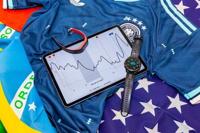
Now the researchers will use data from supporters who wear Garmin smartwatches to compile data during the World Cup.
The study will examine whether and how match events and nationality influence fans' physiological responses.
Heart rate, stress, movement and sleep are recorded automatically via smartwatch.
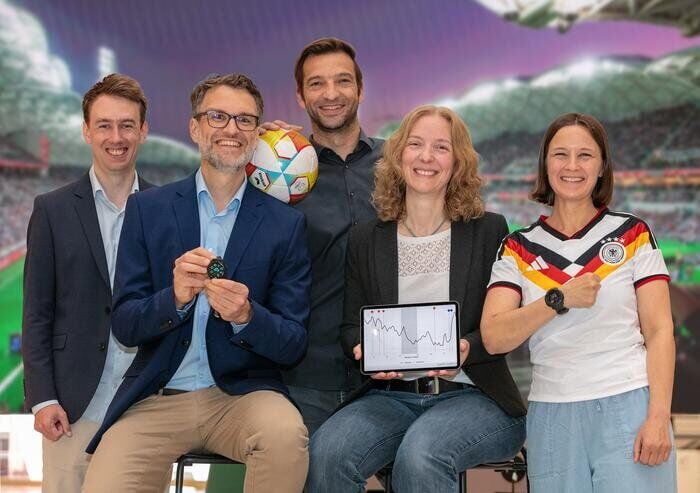
In time for the World Cup, they are calling on football fans to provide their vital data via smartwatch (from left): Professor Dr. Timo Adam, Professor Dr. Christian Deutscher, Professor Dr. Roland Langrock, Professor Dr. Christiane Fuchs, and Sophie Kammerer, press spokesperson for Bielefeld's Wissenswerkstadt. (Universität Bielefeld / Alejandro via SWNS)
The research team want to gain insight into how soccer supporters from around the world physically experience victories and defeats for their teams.
They are inviting fans to share data from their smartwatches once the tournament kicks off on Thursday when co-hosts Mexico play South Africa.
When a sufficient number of fans of a particular national team has registered, the researchers will send personalized invitations to connect their smartwatch.
Participants will also be asked during the tournament which matches they followed live — and whether they watched on television, via live ticker, or at a public viewing event.
Participation requires a smartwatch manufactured by Garmin.
The research team will access anonymized data from fans who have voluntarily registered for the study via a data-protection-compliant interface.
Co-project leader Christiane Fuchs, of Bielefeld University, said: "The long battery life enables us to obtain uninterrupted data series over several days."




Project co-leader Christian Deutscher said: "We are interested in whether fans of different national teams react with differing intensity to the same match event – for example, whether a goal is measurably different for German fans than for Turkish or Brazilian supporters."
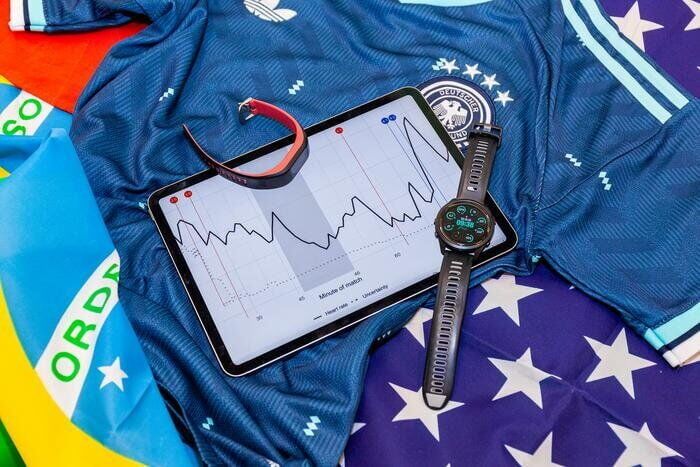
Researchers at Bielefeld University are using smartwatch data gathered during the World Cup to investigate how football affects the heart. (Universität Bielefeld / Alejandro via SWNS)
Deutscher, also of Bielefeld University, added: "The World Cup provides an ideal research setting because it places fans from all over the world in comparable emotional situations at the same time."
The World Cup fever project is being supported by the Wissenswerkstadt Bielefeld science museum.
Jens Franzke, from the museum, said: "Smartwatches have become part of everyday life – so why not make use of what people already wear on their wrists?
"These are precisely the kinds of projects we seek to support: accessible, close to everyday life, and offering genuine scientific added value."
The new investigation will build on findings from the research team's study of the 2025 DFB Cup final.
Over a period of 12 weeks, the researchers collected data from 229 supporters of DSC Arminia Bielefeld using their smartwatches.

(Photo by Fabrizio Velez via Pexels)
Fans attending the stadium reached an average heart rate of 94 beats per minute, whereas television viewers averaged 79.
Heart rates recorded in the stadium after goals were up to 36% higher.
Stress levels began to rise as early as 14 hours before kick-off, according to the findings published in the journal Scientific Reports earlier this year.
Fuchs said: "With our study design, we make visible how closely collective emotions, sporting identification and physiological responses are interconnected."
She added: "Such interactions can only be measured to a limited extent under laboratory conditions – in everyday settings, the findings are considerably more realistic."
Registration for the study is available at: uni-bi.de/worldcupfever

(0) comments
Welcome to the discussion.
Log In
Keep it Clean. Please avoid obscene, vulgar, lewd, racist or sexually-oriented language.
PLEASE TURN OFF YOUR CAPS LOCK.
Don't Threaten. Threats of harming another person will not be tolerated.
Be Truthful. Don't knowingly lie about anyone or anything.
Be Nice. No racism, sexism or any sort of -ism that is degrading to another person.
Be Proactive. Use the 'Report' link on each comment to let us know of abusive posts.
Share with Us. We'd love to hear eyewitness accounts, the history behind an article.