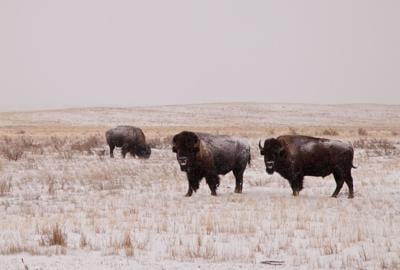
MISSOULA, Mont. — Western Watersheds Project, represented by the Western Environmental Law Center, has appealed the Bureau of Land Management’s decision to revoke American Prairie’s authority to graze bison on public lands in northeastern Montana.
BLM approved the permits in 2022 after a multi-year environmental review that found bison grazing was allowed on public lands and would be better for prairie grasslands than cattle. The groups said the agency later reversed course in five months and used a new “production-oriented” standard without defining it.
The legal challenge centers on whether privately owned bison qualify as livestock under federal law. The groups said BLM had already concluded in 2022 that bison met that standard under the Taylor Grazing Act, the Federal Land Policy and Management Act and the Multiple-Use Sustained Yield Act.
"BLM’s new interpretation has no basis in law and contradicts its own findings," said Pete Frost, attorney at the Western Environmental Law Center, in a joint release, "BLM reversed itself due to politics, not the law, nor the need to restore prairie grasslands."
The groups also pointed to Montana’s treatment of American Prairie’s herd as livestock through taxes and disease testing requirements. They said American Prairie has also provided thousands of pounds of bison meat to area food banks and supplied bison for food, commercial and cultural uses.



“The Trump administration’s revocation of these bison grazing permits is beyond bizarre because bison evolved with High Plains ecosystems and are better for land health, better for wildlife and better for the public than cattle,” said Erik Molvar. “Tribes also have bison herds for cultural, ecological and subsistence purposes, which this permit revocation would threaten if it went through.”
A Congressional Research Service report published January 22, 2026, found that 88% of BLM grazing authorizations were for cattle, yearlings and bison, and it reaffirmed the Interior Department’s conclusion that bison qualify as livestock under the Taylor Grazing Act, the release said.
The groups also said proposed grazing rules released days after the revocation used the same “production-oriented” requirement. If adopted, they said those rules could block bison restoration on 155 million acres of public land across the western U.S.
Western Environmental Law Center and Western Watersheds Project said they plan to keep pursuing administrative appeals and would file suit if needed.

(0) comments
Welcome to the discussion.
Log In
Keep it Clean. Please avoid obscene, vulgar, lewd, racist or sexually-oriented language.
PLEASE TURN OFF YOUR CAPS LOCK.
Don't Threaten. Threats of harming another person will not be tolerated.
Be Truthful. Don't knowingly lie about anyone or anything.
Be Nice. No racism, sexism or any sort of -ism that is degrading to another person.
Be Proactive. Use the 'Report' link on each comment to let us know of abusive posts.
Share with Us. We'd love to hear eyewitness accounts, the history behind an article.