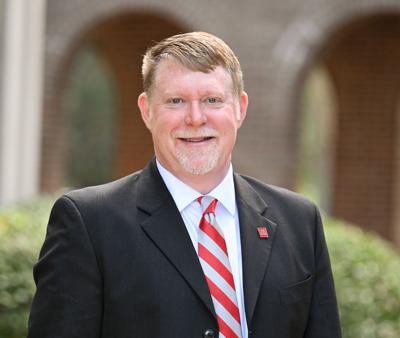

University of West Alabama’s new President Dr. Todd Fritch says the institution is poised for a decade of expansion, innovation and deeper service to the Black Belt, driven by a new strategic plan and a renewed commitment to rural students.
In a wide-ranging conversation as part of the Black Belt News Network's Voices & Visionaries series, Fritch reflected on his path to Livingston, the university’s evolving mission, and the opportunities emerging across West Alabama.
Fritch was installed as the 13th president of UWA in an inauguration ceremony on Sept. 12 after starting in January 2025.
He grew up in northern Michigan and spent nearly seven years as executive vice president and provost at the State College of Florida before accepting the presidency at UWA. He said the move felt natural from the moment he and his wife arrived in Livingston.
“The moment I stepped foot on the campus of UWA…we just felt very much at home here,” he said. “I felt it was an institution where I could offer quite a lot to help it realize its full potential.”
Shortly after taking office, Fritch led the development of a sweeping 10-year strategic plan that launched in January 2026. The plan includes new mission and vision statements, core values and broad institutional priorities designed to guide UWA through 2035.
The new vision: “To be an innovative and transformative leader in rural regional public higher education by empowering students, enriching communities and advancing knowledge.”
The mission emphasizes accessibility, affordability, and the unique opportunities of the region.
Fritch said he insisted on a plan that every employee could see themselves in—from academic affairs to IT to the physical plant.
UWA is preparing for significant growth tied to regional workforce needs, new academic programs, and major partnerships.
One of the most impactful collaborations is with the Alabama School of Healthcare Sciences, which will operate on UWA’s campus for its first year beginning this August. “We want to help them be successful, but we also see that as a pipeline and a feeder into some of our programs in nursing and health professions,” Fritch said.
He also meets regularly with Livingston Mayor James “Bird” Dial to coordinate on economic development and workforce initiatives.
While UWA is historically known for its College of Education, Fritch highlighted several other growing areas, including the Nursing and health professions, especially programs aligned with rural healthcare needs. Also the engineering technology and business as well as conservation, outdoor leadership and sustainability, which he described as a future “signature portfolio”
Fritch also talked about UWA’s large online education presence, which contributes to nearly $450 million in annual economic impact statewide
Fritch emphasized that UWA’s size and mission allow it to deliver a level of personal support that larger universities often cannot match. “Students are our purpose,” he said. “If they didn’t choose to pursue their education here, none of us would have jobs… We do student success better than most.”
He noted that many UWA students are first generation college students, making the university a catalyst for generational change.
Fritch encouraged prospective students and families to explore UWA’s programs and visit the Livingston campus. “There’s something about this place,” he said. “It truly is a special place, and I would encourage people to come experience that firsthand.”
Applications for Fall 2026 are already open at www.uwa.edu.
Watch the full Visions & Visionaries interview with Dr. Fritch here.

(0) comments
Welcome to the discussion.
Log In
Keep it Clean. Please avoid obscene, vulgar, lewd, racist or sexually-oriented language.
PLEASE TURN OFF YOUR CAPS LOCK.
Don't Threaten. Threats of harming another person will not be tolerated.
Be Truthful. Don't knowingly lie about anyone or anything.
Be Nice. No racism, sexism or any sort of -ism that is degrading to another person.
Be Proactive. Use the 'Report' link on each comment to let us know of abusive posts.
Share with Us. We'd love to hear eyewitness accounts, the history behind an article.