


The confusion between ADD and ADHD affects millions of families trying to understand attention-related challenges. Parents often wonder if their child has ADD or ADHD, while adults question whether their childhood diagnosis still applies under current medical terminology.
This distinction matters more than you might think. Using outdated terms can create confusion during medical appointments, insurance claims, and school accommodation meetings. Doctronic explains the current classification system to help you communicate effectively with healthcare providers and access the right treatment options.
Key takeaways
- ADD is now considered an outdated term. ADHD is the official medical diagnosis with three subtypes.
- Inattentive ADHD (formerly called ADD) focuses on attention difficulties without hyperactivity.
- Hyperactive-impulsive ADHD involves restlessness and impulsive behaviors but fewer attention problems.
- Combined ADHD presents both inattentive and hyperactive-impulsive symptoms together.
What Are ADD and ADHD? Understanding Current Medical Terminology
ADD, or Attention Deficit Disorder, was the original term used in psychiatric manuals until 1987. This classification separated attention problems from hyperactivity, creating categories like "ADD with hyperactivity" and "ADD without hyperactivity." However, medical understanding has evolved significantly since then.
ADHD (Attention-Deficit/Hyperactivity Disorder) became the official diagnosis in 1987 and remains the current medical standard today. This change wasn't just cosmetic — it reflected new research showing that attention and hyperactivity symptoms are more interconnected than originally thought. The modern ADHD diagnosis encompasses three distinct presentations: inattentive type, hyperactive-impulsive type, and combined type.
Many healthcare providers and families still use "ADD" colloquially when referring to attention problems without obvious hyperactivity. While understandable, this can create confusion during medical consultations. When discussing symptoms with your doctor, it's helpful to use current ADHD terminology.
The shift to ADHD terminology also acknowledges that hyperactivity can manifest internally as restlessness or racing thoughts, not just external fidgeting or movement.
When ADD vs. ADHD Terminology Matters Most
Understanding current terminology becomes crucial in several important situations. School IEP meetings and 504 plan discussions require precise ADHD language for proper accommodations. Special education teams need to document specific ADHD presentations to justify classroom modifications, extended test time, or behavioral support plans.
Insurance claims and medical records exclusively use ADHD diagnostic codes from the Diagnostic and Statistical Manual of Mental Disorders (DSM-5). Using outdated ADD terminology on forms or during phone calls with insurance representatives can create processing delays or coverage denials. Healthcare billing systems recognize specific ADHD subtypes but may not process older ADD classifications correctly.
Research studies and clinical trials specify ADHD presentations when determining participant eligibility. If you're interested in new treatments or contributing to ADHD research, understanding your specific subtype helps match you with appropriate studies. This precision also matters for accessing specialized treatment programs.
Adult workplace accommodations under the Americans with Disabilities Act reference specific ADHD presentations in legal documentation. Employers and human resources departments need current diagnostic language to implement reasonable accommodations like flexible scheduling, written instructions, or modified work environments. Whether using telehealth to help with adhd treatment or in-person care, using proper terminology ensures smoother communication with all healthcare providers.
How ADHD Subtypes Work in Modern Diagnosis
Modern ADHD diagnosis relies on specific symptom criteria for each presentation type. Inattentive ADHD requires six or more symptoms of inattention lasting at least six months. These include difficulty sustaining attention in tasks, frequent careless mistakes, seeming not to listen when spoken to directly, and struggling to organize activities.
Hyperactive-impulsive ADHD needs six or more hyperactivity-impulsivity symptoms for the same duration. Common signs include fidgeting with hands or feet, leaving seats inappropriately, running or climbing excessively, talking excessively, and blurting out answers before questions are completed.
Combined ADHD meets the full criteria for both inattentive and hyperactive-impulsive presentations simultaneously. This is the most common ADHD subtype, affecting roughly 60-70% of people diagnosed with ADHD. Symptoms must be present before age 12 and significantly impair functioning in at least two settings, such as home and school.
Healthcare providers use standardized rating scales and behavioral observations to assess symptom severity. The diagnosis process often involves input from multiple sources, including parents, teachers, and sometimes the individuals themselves. Whether seeking urgent care help with mental health concerns or specialized ADHD evaluation, thorough assessment ensures accurate diagnosis and appropriate treatment planning.
Recognizing Symptoms Across Different ADHD Presentations
Inattentive ADHD symptoms often appear as daydreaming, losing important items like homework or keys, avoiding tasks requiring sustained mental effort, and making frequent careless mistakes in schoolwork. Children with this presentation may seem quiet or withdrawn in classroom settings, leading to delayed identification compared to their hyperactive peers.






Hyperactive symptoms manifest differently across age groups. Young children might climb furniture inappropriately, run when walking is expected, or struggle to play quietly. Teenagers and adults often experience internal restlessness, excessive talking, or difficulty engaging in leisure activities calmly.
Impulsive behaviors include interrupting conversations, difficulty waiting for turns in games or lines, making hasty decisions without considering consequences, and blurting out inappropriate comments. These symptoms can strain relationships and create social challenges across various environments.
Combined presentation shows fluctuating patterns of both attention and hyperactivity-impulsivity challenges throughout the day. A child might struggle with focus during morning math class but display hyperactive behavior during afternoon recess. Adults might experience attention difficulties at work while showing impulsive decision-making in personal relationships. Understanding these patterns helps families and educators provide appropriate support to help individuals succeed in school and other environments.
ADD vs. ADHD: Diagnostic Comparison
The evolution from ADD to ADHD reflects significant advances in understanding attention-related disorders. Here's how the old and new systems compare:
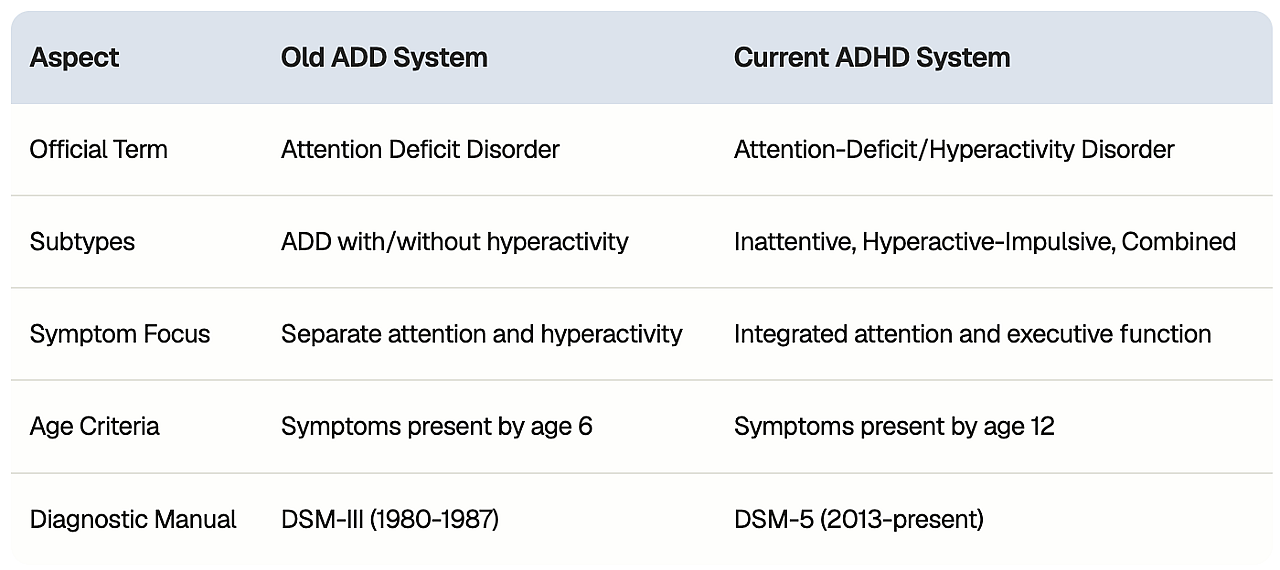
Research shows that what was once called "ADD without hyperactivity" often involves subtle hyperactive symptoms like internal restlessness, racing thoughts, or emotional reactivity. The current system better captures these experiences while maintaining clear diagnostic categories.
Modern ADHD understanding emphasizes executive function challenges rather than just attention span problems. This includes difficulties with working memory, cognitive flexibility, and inhibitory control that affect daily functioning beyond traditional "attention" measures.
Frequently Asked Questions
Is ADD still a valid medical diagnosis in 2024?
No, ADD is no longer an official medical diagnosis. Healthcare providers now use ADHD with specific subtypes (inattentive, hyperactive-impulsive, or combined). While some people still say "ADD" informally, medical records and treatment plans use current ADHD terminology for accuracy and proper documentation.
Can adults have inattentive ADHD without childhood hyperactivity?
Yes, many adults receive inattentive ADHD diagnoses without obvious childhood hyperactivity. Girls and women particularly may have been missed in childhood because inattentive symptoms are less disruptive than hyperactive behaviors. Adult evaluation focuses on current symptoms and retrospective childhood history.
Does insurance cover ADHD treatment regardless of subtype?
Most insurance plans cover ADHD treatment, including medication, therapy, and evaluations for all subtypes when medically necessary. Coverage depends on your specific plan benefits rather than ADHD subtype. Prior authorization may be required for certain medications, particularly newer or brand-name options.
What's the difference between ADHD medication for inattentive vs hyperactive types?
ADHD medications (stimulants and non-stimulants) work similarly across all subtypes by improving dopamine and norepinephrine function. Dosing and timing might be adjusted based on individual symptom patterns, but the same medications treat all ADHD presentations effectively. Mental health medication decisions depend on individual response rather than subtype alone.
How do doctors determine which ADHD subtype someone has?
Doctors use standardized rating scales, clinical interviews, and behavioral observations from multiple sources. They count specific symptoms in inattentive and hyperactive-impulsive categories, assess impairment levels, and review developmental history. The subtype reflects which symptom category predominates, though individuals may show mixed presentations over time.
The Bottom Line
Understanding the difference between ADD and ADHD terminology helps you navigate modern healthcare and educational systems more effectively. While ADD was the original term used until 1987, ADHD is now the official diagnosis with three distinct presentations: inattentive (formerly called ADD), hyperactive-impulsive, and combined types. This evolution reflects a better understanding of how attention and hyperactivity symptoms interconnect and affect daily functioning. Using current ADHD terminology ensures clear communication with healthcare providers, schools, and insurance companies while accessing appropriate treatment and accommodations for yourself or your loved ones.
This story was produced by Doctronic and reviewed and distributed by Stacker.
(0) comments
Welcome to the discussion.
Log In
Keep it Clean. Please avoid obscene, vulgar, lewd, racist or sexually-oriented language.
PLEASE TURN OFF YOUR CAPS LOCK.
Don't Threaten. Threats of harming another person will not be tolerated.
Be Truthful. Don't knowingly lie about anyone or anything.
Be Nice. No racism, sexism or any sort of -ism that is degrading to another person.
Be Proactive. Use the 'Report' link on each comment to let us know of abusive posts.
Share with Us. We'd love to hear eyewitness accounts, the history behind an article.