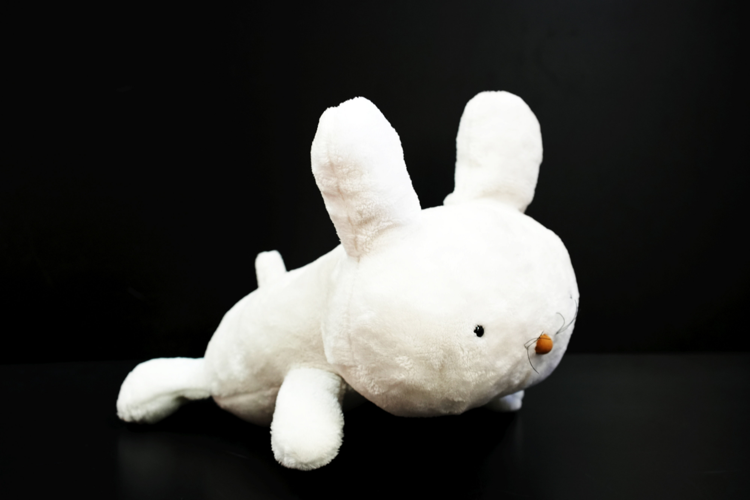
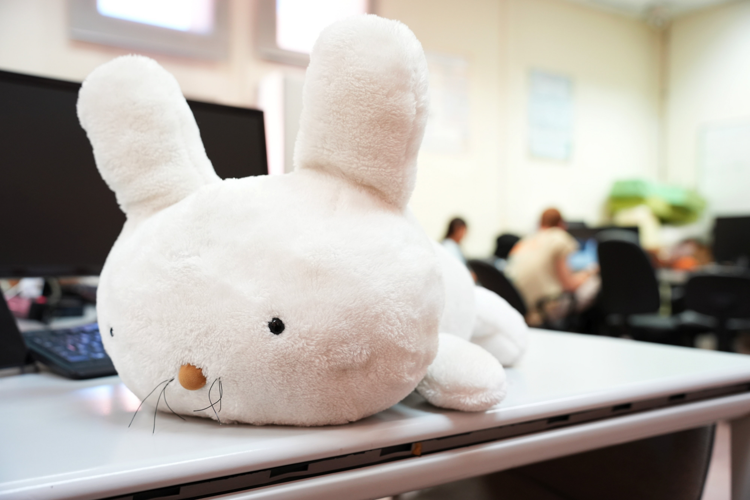


The AI rabbit toy is also known as Mia. (UC3M via SWNS)
By Stephen Beech
A new robotic rabbit plush toy can recognize who hugs it — just from their voice.
State-of-the-art artificial intelligence (AI) technology allows the prototype, named Mía, to recognize the people it interacts with.
It could help older people cope with the effects of stress and loneliness as well as be an entertaining toy for children, scientists say.
Mia was developed by researchers at the Universidad Carlos III de Madrid (UC3M) in Spain.
The robotic rabbit is currently being tested in Madrid City Council day centers for the personalized affective stimulation of elderly people with cognitive decline.
The research team explained that one of the biggest challenges in current social robotics is getting machines to interact with people in a natural and personalized way.
To do so, one approach is for the robot to know whom it is talking to.
The new user voice recognition system developed by this UC3M team, described in the journal Applied Sciences, operates "onboard" Mía.
Study co-author Professor José Carlos Castillo Montoya said, "We use this robot for affective stimulation for the elderly with cognitive decline, and user recognition is an important step toward the robot having a personalized behavior adapted to the needs of each individual."
Unlike other traditional recognition systems that rely on cameras and image processing, Castillo Montoya said the new system exclusively uses the robot's built-in microphone.

The toy is designed to recognize anyone who hugs it. (UC3M via SWNS)
He said, "It operates locally and incrementally, which offers two advantages. On one hand, greater privacy, as the voiceprints never leave the physical device itself. On the other hand, a sort of on-the-fly learning."
Co-author Arecia Segura Bencomo, from UC3M's Department of Systems Engineering and Automation, said, "The robot does not need a setup phase to learn your voice. It hears you speak for the first time and automatically generates a profile."





The researchers said the advancement implemented in Mía falls within the scope of animal robotics.
Castillo Montoya said it is a "therapeutic paradigm" designed to transfer the proven benefits of therapy with real animals — such as reducing stress and anxiety — to controlled environments where animal welfare or the patient's capacity for care limits their use.
He added, "In the specific case of the elderly with cognitive decline, the robot activates the need to care for something. We have verified in pilot tests at Madrid City Council day centers that, in addition to improving the elderly person's mood, the robot acts as a social catalyst. It breaks isolation, mitigates unwanted loneliness, and encourages users to start interacting more with each other."
He said the system's operation emulates human learning capacity as, every time someone speaks to the robot, the algorithm analyzes the nuances and patterns of the acoustic signal to create a unique "voice signature."
Castillo Montoya said, "Our proposal is simple because the robot's computing capacities are very limited. The algorithm generates a sort of map and, using open-source code that we have improved in our laboratory, groups together signatures that resemble each other. Ultimately, each group corresponds to a specific user."

Photo by Tara Winstead via Pexels
He said the system stands out especially for its ability to deal with unforeseen situations in real time.
If it interacts with an unknown person, the AI detects that their signature does not fit into any previous group.
And, if the interaction continues, it is capable of generating a completely new dynamic profile, learning that it is a new user.
In experimental tests, the software achieved a high success rate in identifying known users.
The researchers said the advance opens the door to a new generation of much more accessible assistive and companion robots, capable of entering a home and autonomously learning who its members are just by hearing the first "good morning."
Castillo Montoya said the technology also has the potential for future personalization.
He added, "We want the robot to be able to adapt by reacting differently depending on who is in front of it. If it detects a specific user who tends to be more restless, specific mechanisms and behaviors aimed at calming that person will be automatically activated."
The research team currently has several operational prototypes of Mía with which they continue to mature the technology in real clinical scenarios.
They are also seeking alliances with companies interested in bringing the assistive platforms to the general market.

(0) comments
Welcome to the discussion.
Log In
Keep it Clean. Please avoid obscene, vulgar, lewd, racist or sexually-oriented language.
PLEASE TURN OFF YOUR CAPS LOCK.
Don't Threaten. Threats of harming another person will not be tolerated.
Be Truthful. Don't knowingly lie about anyone or anything.
Be Nice. No racism, sexism or any sort of -ism that is degrading to another person.
Be Proactive. Use the 'Report' link on each comment to let us know of abusive posts.
Share with Us. We'd love to hear eyewitness accounts, the history behind an article.