


Is high blood pressure hereditary? Yes, in part. High blood pressure tends to run in families, but diet, activity, weight and shared habits also shape who gets it.
Thanksgiving, on Thursday, Nov. 26, 2026, is also National Family Health History Day, which the U.S. Surgeon General has marked since 2004. As Doctronic explains below, the holiday meal is a chance to learn which relatives have the condition and how old they were when it began.
About 48.1% of U.S. adults, or 119.9 million people, have high blood pressure (130/80 mm Hg or higher, or taking BP medicine). A review in the AHA journal Hypertension put heritability at roughly 30% to 60%. Heritability is the share of the differences in blood pressure between people that is linked to genes.
Key takeaways
- High blood pressure runs in families through both shared genes and shared habits
- A parent diagnosed before 55 is a stronger signal than a parent diagnosed later
- Most cases have no single genetic cause, so family history tells more than a genetic test
- Adults 40 and older, and younger adults at higher risk, should have their blood pressure checked every year
- Thanksgiving is a good time to ask relatives who has high blood pressure and when it started
How Common Is High Blood Pressure?
High blood pressure becomes more common with age. The CDC's National Center for Health Statistics measured rates by age in national survey data from 2021 to 2023. It found high blood pressure in 23.4% of adults ages 18 to 39, 52.5% of adults 40 to 59 and 71.6% of adults 60 and older. The CDC estimates that about 9 in 10 Americans will develop high blood pressure during their lifetime.
Many people with high blood pressure don't know they have it. In the same survey, 59.2% of adults with high blood pressure were aware of it. A relative who says nobody in the family has high blood pressure may never have been checked.
How Much of High Blood Pressure Is Genetic?
Genes matter, but no single gene explains most cases. A 2024 Nature Genetics study of more than 1 million people reported 2,103 independent genetic signals tied to blood pressure; people in the top tenth of genetic scores had systolic readings about 16.9 points higher on average.
These genetic differences affect how the body handles sodium, how blood vessels work and the hormone systems that control blood pressure. Each one adds only a small amount of risk.
According to MedlinePlus Genetics, the exact cause is unknown in about 95% of cases, and common high blood pressure has no simple inheritance pattern. A few rare forms come from a single gene.
What Parents' Blood Pressure Says About Yours
Whether a parent had high blood pressure matters, and so does the age it started. In a Framingham Heart Study analysis presented at the American Heart Association's Scientific Sessions in 2016, researchers followed adults without high blood pressure for 10 years. The share who developed it depended on their parents' history:
- 6% when neither parent had high blood pressure
- 8% when a parent was diagnosed at 55 or older
- 11% when one parent was diagnosed before 55
- 19% when both parents were diagnosed before 55, about 3.5 times the risk of those with neither parent affected
The findings were preliminary, but they show why it helps to ask when a parent was diagnosed, not only whether they were.
Genes or Habits? Why Families Share Risk
Family history includes shared genes and a shared environment. Children who grow up with parents who have high blood pressure often pick up the same eating habits, activity levels and ways of handling stress. That makes it hard to separate inherited risk from learned habits. Salt sensitivity, for example, often runs in families and reflects both genes and the food a family eats.
The CDC groups the risk factors for high blood pressure this way:
- Health conditions: elevated blood pressure, diabetes, overweight or obesity, and pregnancy
- Habits: diet, physical inactivity, alcohol use and tobacco use
- Factors that can't change: genetics and family history, age, sex, and race or ethnicity
About 3 in 4 people with diabetes also have high blood pressure, according to the CDC.
Black people are more likely than White, Hispanic or Asian people to develop high blood pressure and tend to develop it at younger ages. Women are about as likely as men to develop it over their lifetime, and the risk for everyone rises with age.
Questions to Ask Your Family This Thanksgiving






The CDC suggests collecting health history from parents, brothers and sisters (including half-siblings) and children, then from grandparents, aunts, uncles, nieces and nephews. The details worth noting are major conditions, the age each was diagnosed, causes and ages of death, and ethnic background.
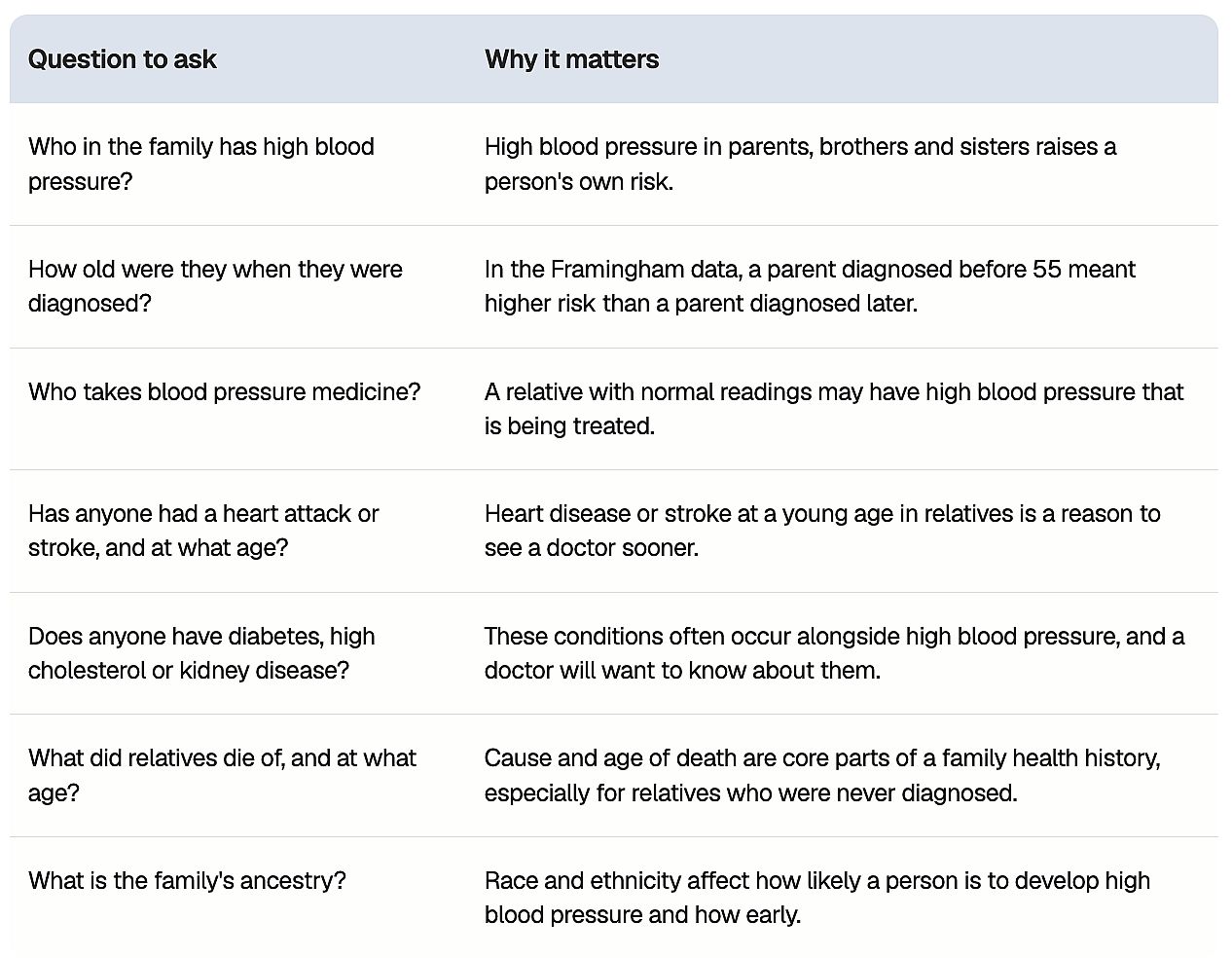
The Surgeon General's free web tool, My Family Health Portrait, can organize the answers and make them easy to share with relatives and a doctor.
What to Do With What You Learn
A family history of high blood pressure is a reason to check readings regularly, not a diagnosis.
The U.S. Preventive Services Task Force recommends screening all adults 18 and older. Adults 40 and older, and younger adults at increased risk, should be checked every year. Adults 18 to 39 at normal risk should be checked every 3 to 5 years. High readings in a doctor's office should be confirmed outside the office, for example by checking blood pressure at home.
Habits still count with a family history. The 2025 AHA/ACC high blood pressure guideline advises keeping sodium under 2,300 mg a day, with 1,500 mg as a better target for many adults. It also recommends DASH-style eating, potassium-rich foods, regular physical activity and limiting alcohol.
When to See a Doctor and When to Call 911
Book a visit with a doctor when:
- High blood pressure runs in the family and there has been no blood pressure check in the past year
- Home readings are often 130/80 or higher
- Relatives had heart disease or a stroke at a young age
- Readings are still high after several months of lifestyle changes
A doctor can review home readings at an office visit, or people can talk to a doctor online about high blood pressure.
Call 911 if a reading is above 180/120 and comes with chest pain, shortness of breath, back pain, numbness, weakness, vision changes or trouble speaking, the American Heart Association advises. Without those symptoms, wait a minute, check again, and contact a doctor if the reading is still that high.
Frequently Asked Questions
If both of my parents have high blood pressure, will I get it too?
Not necessarily, but the odds are higher. In the Framingham analysis, adults whose parents were both diagnosed before 55 were about 3.5 times as likely to develop high blood pressure within 10 years as adults with neither parent affected. Regular checks catch it early.
Can high blood pressure skip a generation?
It can seem to. Common high blood pressure has no simple inheritance pattern, so it may show up in a grandparent and a grandchild but not the parent in between. The parent may also have it without knowing, since many adults with high blood pressure have never been told.
Should I get a genetic test for high blood pressure?
For most people, no. Common high blood pressure comes from many genetic signals with small effects, so family history and regular blood pressure checks tell you more. A doctor may suggest testing if a rare single-gene form is suspected.
Can healthy habits cancel out a family history?
Not entirely, but they help. Family history can't change, while sodium, activity, weight and alcohol can. Some people with a strong family history still need medicine, and a doctor can prescribe it if readings stay high.
The Bottom Line
High blood pressure is partly hereditary. A family history raises the risk, and a parent diagnosed before 55 is a clear signal to start checking readings regularly. That history is a starting point, not a verdict, because habits and regular checks still shape what happens next. Asking relatives a few questions this Thanksgiving gives a doctor useful information.
This story was produced by Doctronic and reviewed and distributed by Stacker.
(0) comments
Welcome to the discussion.
Log In
Keep it Clean. Please avoid obscene, vulgar, lewd, racist or sexually-oriented language.
PLEASE TURN OFF YOUR CAPS LOCK.
Don't Threaten. Threats of harming another person will not be tolerated.
Be Truthful. Don't knowingly lie about anyone or anything.
Be Nice. No racism, sexism or any sort of -ism that is degrading to another person.
Be Proactive. Use the 'Report' link on each comment to let us know of abusive posts.
Share with Us. We'd love to hear eyewitness accounts, the history behind an article.