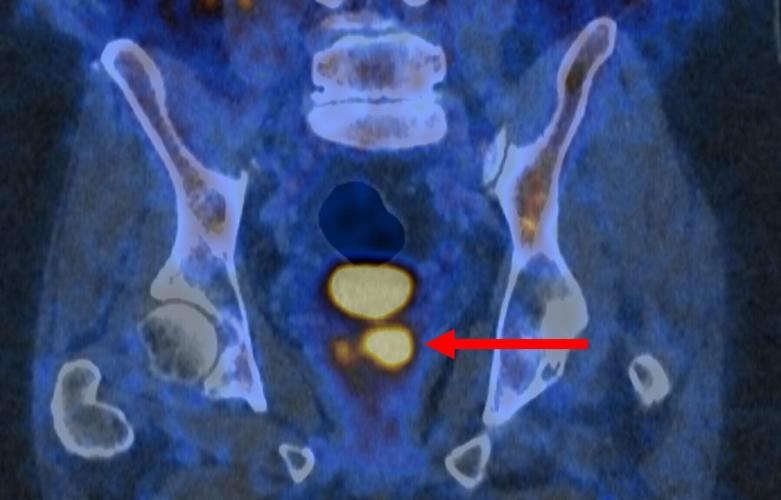


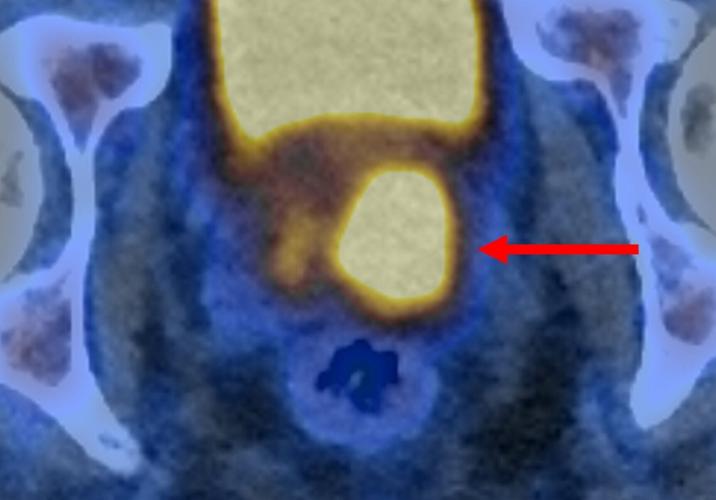


Glowing prostate cancer cells PSMA PET 2. (PRIMARY 2 via SWNS)
By Stephen Beech
Scans that makes prostate cancer cells "glow" could cut the need for invasive biopsies, according to new research.
The state-of-the-art imaging test could safely halve the number of men who need to undergo a biopsy for suspected prostate cancer following inconclusive results from an MRI scan, says scientists.
The PSMA PET/CT scan identifies more aggressive prostate cancer cells, which are potentially harmful and may need treatment.
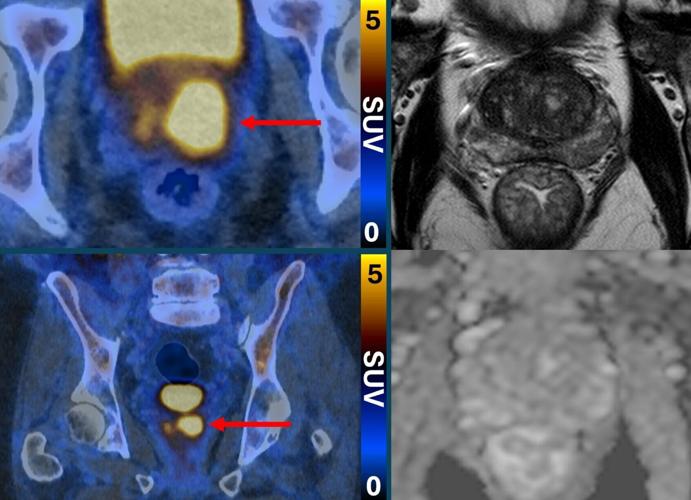
It does so with a molecule that binds to prostate cancer cells and causes them to "light up in a remarkable way" - appearing as bright spots in the scanning image.
Australian scientists say it could also help reduce the risk of overdiagnosis by determining which cancers are low-risk and will never cause harm.
Prostate cancer is currently the second most common cause of cancer deaths in men in the UK, responsible for more than 12,000 deaths every year.
Patients with suspected prostate cancer usually undergo an MRI scan to look for abnormal areas of the prostate.
If MRI results are suspicious or inconclusive, patients undergo a biopsy that takes small pieces of prostate tissue and looks for cancer cells.

Clinically significant prostate cancer (left, PSMA PETCT) despite normal MRI (right, MRI). (PRIMARY2 via SWNS)
But the invasive procedure can be uncomfortable and sometimes worrying for patients, and is also associated with side effects.
The Primary2 trial recruited men considered at higher risk of prostate cancer - such as a strong family history - who had a normal result on their MRI. Such patients often go ahead with prostate biopsy.
They were randomly assigned to have either a standard biopsy or a PSMA PET/CT scan.
Primary2 found that PSMA PET/CT scanning could identify people who either did not have cancer, or whose cancer was so low-risk or slow-growing it would likely never cause harm.
The patients did not need a biopsy.
Patients with a positive PSMA PET/CT scan result had a biopsy.
Researchers say the approach halved the number of pateints who needed a biopsy, without missing any harmful cancers.

Dr. James Buteau is a nuclear medicine physician at the Pter MacCallum Cancer Centre. (PRIMARY2 via SWNS)
For patients who still needed a biopsy, their scan results ensured the procedure was targeted to the suspicious areas identified in the test to minimise complications and improve accuracy.





The results are the first released from the Primary2 trial, which will follow the 660 patients for two years.
The trial is being led by researchers at the Peter MacCallum Cancer Centre in Melbourne and St Vincent’s Hospital in Sydney.
PSMA PET/CT scanning is widely available in Australia.
It is becoming increasingly accessible in the UK and Europe, primarily for diagnosing high-risk or recurrent prostate cancer.
But cost and availability remain limitations to widespread use.

Scans that makes prostate cancer cells "glow" could cut the need for invasive biopsies, according to new research. (PRIMARY2 via SWNS)
Dr. James Buteau, a nuclear medicine physician at the Peter MacCallum Cancer Centre, said: “PSMA PET/CT scanning makes prostate cancer cells light up in a remarkable way, particularly in more aggressive cancers.
"It’s rare to see such strong imaging that could be so powerful in the clinic.
"Incorporating this testing into clinical care could help to address the major challenge of prostate cancer overdiagnosis, which leads to at best unnecessary and at worst harmful treatment for cancers that would never cause any harm.”
Study co-leader Professor Louise Emmett said: “Getting told you have a risk of prostate cancer is a huge cause of anxiety and concern.
"Our findings show that PSMA PET/CT after MRI offers a 'belt and braces' approach that can determine which people have a clinically significant cancer, and which people are at low risk and don’t need a biopsy or further testing."

Professor Louise Emmett is the director of theranostics and nuclear medicine at St. Vincent's Hospital. (PRIMARY2 via SWNS)
Emmett, director of theranostics and nuclear medicine at St Vincent's Hospital, added: Primary2 is the largest of a series of studies undertaken by this group, exploring whether PSMA PET/CT scanning could improve prostate cancer diagnosis and reduce unnecessary biopsies for patients.”
Dr. Buteau is due to present the findings of the trial at the European Association of Urology Congress in London Friday, March 13.
Professor Dr. Derya Tilki, an EAU Scientific Congress Office member, welcomed the findings.
Dr. Tilki, a senior consultant urologist at Martini-Klinik Prostate Cancer Centre in Germany, said: “This well-conducted trial shows that incorporating PSMA PET/CT in men with low or intermediate risk lesions significantly reduced the number of unnecessary biopsies and the diagnosis of clinically insignificant prostate cancer."
"Importantly, this didn’t compromise the detection of clinically significant disease."
She added: "These results support consideration of PSMA PET/CT in the diagnostic work-up of appropriately selected patients.
"I congratulate the investigators on their study.”



(0) comments
Welcome to the discussion.
Log In
Keep it Clean. Please avoid obscene, vulgar, lewd, racist or sexually-oriented language.
PLEASE TURN OFF YOUR CAPS LOCK.
Don't Threaten. Threats of harming another person will not be tolerated.
Be Truthful. Don't knowingly lie about anyone or anything.
Be Nice. No racism, sexism or any sort of -ism that is degrading to another person.
Be Proactive. Use the 'Report' link on each comment to let us know of abusive posts.
Share with Us. We'd love to hear eyewitness accounts, the history behind an article.