
(NHSGGC via SWNS)
By Elizabeth Hunter
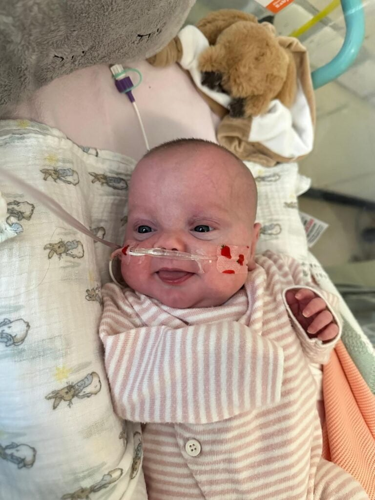
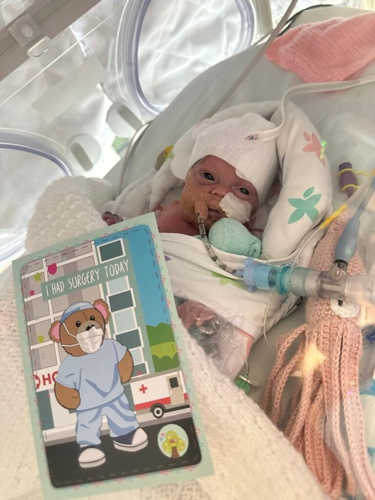
A premature baby born weighing just 500g has returned home after becoming the first in Scotland to undergo a new heart procedure.
Aribella Duncan arrived extremely early in July last year - at just 23 weeks and one day.
Doctors told parents Caitlin and Jack Duncan that Aribella had a Patent Ductus Arteriosus (PDA) - a condition where vital blood vessels fail to close naturally.
While commonly seen in premature babies, the condition places strain on the heart and lungs, making breathing, growing and recovering difficult.
Weeks after her birth, Aribella became the first baby in Scotland to undergo a minimally invasive keyhole heart procedure to close the PDA,
She has now been allowed to return home at a healthy weight of eight pounds and nine ounces.
Mom Caitlin said: "There was nothing in my scans to suggest I’d go into preâterm labour or that Aribella had any issues.
"I arrived at Aberdeen Maternity Hospital at 22 weeks and 6 days, and Aribella was born at 23 weeks and 1 day.
“Surprisingly, she was born still inside her waters. They say that’s good luck.
"She even gave a little cry when she arrived, and we got the chance for a snuggle.”
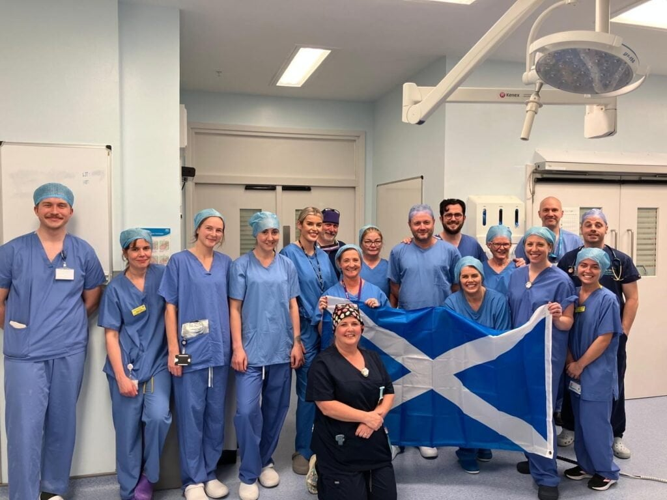
After a few weeks of monitoring, and once she was strong enough for transfer, Aribella was moved to The Scottish Paediatric Cardiac Service at the Royal Hospital for Children (RHC), Glasgow to be given specialized treatment.

(NHSGGC via SWNS)
Her parents were given the choice between undergoing an open-heart surgery, or the keyhole operation.
Since performing the successful surgery on Aribella, the team at the RHC have carried out the operation on a further three babies.
“There were a couple of attempts to close the PDA using medication,” said Caitlin.
“But we were told that if the medicine didn’t work, surgery would be the next step.
"We were given two options, openâheart surgery or a minimally invasive keyhole approach.
"The doctors told us that because of her weight and size, Aribella was the perfect candidate for the less invasive option.”
Using a tiny device called an Abbott Amplatzer Piccolo, the cardiologists enter through a small incision in the baby’s leg, through the ductus, to seal the opening in the heart.




This technique significantly reduces invasiveness, lowers risk, and speeds up recovery for fragile babies.
Dr. Mohammad Ryan Abumehdi, Consultant Interventional Paediatric and Congenital Cardiologist, explained: “With this minimally invasive technique, the interventional cardiology team in close conjunction with neonatal medicine and anaesthetics, were able to close Aribella’s PDA.
"It meant she underwent a much less invasive procedure had a much gentler recovery.
"For premature babies, those benefits are hugely important.”

(NHSGGC via SWNS)
Caitlin said the difference in her daughter was immediate.
She said: “We didn’t know what to expect when Aribella came back from Theatre, but she looked right up at us with bright eyes and was playfully kicking her legs.
"We couldn’t believe how quickly she bounced back.
“Over the next days and weeks, she started gaining weight and growing so much faster. She was like a completely different baby.
"It’s amazing to think how much energy she must have been using just to cope with the PDA.
"Once it was closed, she finally had the chance to focus on growing and developing.”
Aribella was transferred back to Aberdeen neonatal unit five days after the procedure where she continued her development.
She was then transferred to Royal Aberdeen Children’s Hospital in January 2026 to continue her road towards home.
Dr. Abumehdi added: “We’re delighted to hear how well Aribella is doing.
"Being able to offer this minimally invasive surgery to premature babies is an exciting step forward for neonatal and cardiac care in Scotland.
"It shows what collaboration, innovation and compassion can achieve for our smallest patients.
“A huge thankâyou to everyone involved across neonatal care, cardiology, physiology and anaesthetics.”
Dr. Natalie Smee, who has been part of the team caring for Aribella in Aberdeen, commented: “It is fantastic to see the progress Aribella has made over the last few months.
"We have a lot of strong partnership working between Glasgow and Aberdeen and this new procedure has undoubtedly made a huge difference to Aribella’s recovery and development.
"Many staff across our Neonatal Unit and Royal Aberdeen Children’s Hospital have got to know Aribella and her family, and we’re all so pleased she is thriving.”



(0) comments
Welcome to the discussion.
Log In
Keep it Clean. Please avoid obscene, vulgar, lewd, racist or sexually-oriented language.
PLEASE TURN OFF YOUR CAPS LOCK.
Don't Threaten. Threats of harming another person will not be tolerated.
Be Truthful. Don't knowingly lie about anyone or anything.
Be Nice. No racism, sexism or any sort of -ism that is degrading to another person.
Be Proactive. Use the 'Report' link on each comment to let us know of abusive posts.
Share with Us. We'd love to hear eyewitness accounts, the history behind an article.