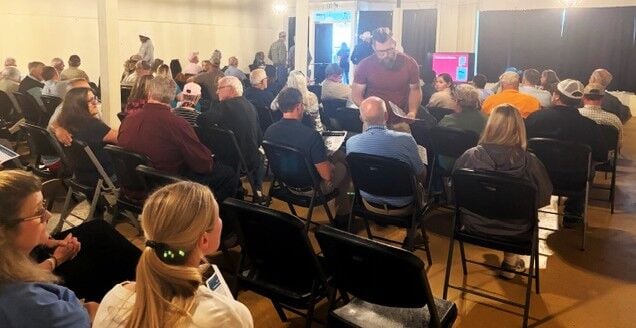


Almost 100 people gathered in downtown Demopolis on April 30 to get more information about a proposed data center in Marengo County.
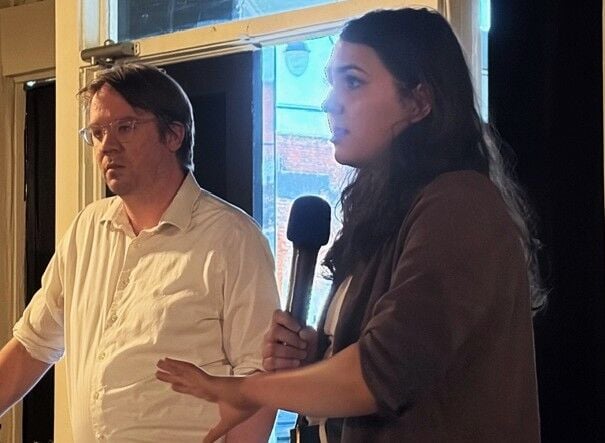
Black Belt Women Rising hosted a town meeting at the Hangout on Washington Street with Southern Environmental Law Center and Alabama Rivers Alliance representatives to discuss how to prevent a data center from coming or at least make sure the community’s concerns are addressed.
Data centers are big, and they are controversial in many communities where they are proposed, including Lowndes County where an 800-acre site is being considered in the Burkville area. Lowndes held a public meeting about that data center Tuesday night.
The centers are known for using lots of water and lots of power.
Cattle rancher Alan Martin told the Black Belt News Network that one of his neighbors has sold hundreds of acres off Marengo County Road 2 for a data center off Highway 80. He said he knows it’s for a data center because he was approached to sell his land as well, but he turned them down.
Others have heard about the sale, too. One attendee said she heard the data center will be 100 acres of building on 1,000 acres of land.
“My understanding is that several landowners have a contract for a new steam plant. Are we behind?” an attendee asked.
“It’s never too late until it’s in the ground running and operating,” replied Charles Miller with the Alabama River Alliance.
Attorney Ryan Anderson with the Southern Environmental Law Center said she and Miller were in Demopolis to give Marengo and Hale county residents background about data centers and the questions to ask officials about the project.
Here is a definition of a data center, ironically, from AI: “A data center is a centralized physical facility that contains an organization’s IT infrastructure — including servers, storage systems, networking hardware, and security systems — all designed to support applications, data processing and business operations. Because it holds an organization’s most important digital assets, a data center is built for security, reliability and continuous uptime.” (The bold face is from AI.)
The growth of artificial intelligence, or AI, has spurred the growth of gigantic data centers. Perhaps because the land is less expensive or because of lax environmental laws, 65% of the new data centers are being built in the South, Miller said.






Anderson said a data center is basically a warehouse filled with powerful computers, and computers generate lots of heat. Water cools better than air, so these data centers pump millions of gallons of water through the system to carry off heat. A proposed data center in Bessemer will use about 2 million gallons of water a day, Anderson said.
Some data centers continuously flush water through the building. Others have a closed system that uses less water, but even those must be flushed periodically. Some systems use chemicals to help with cooling, and those chemicals could be discharged into the water.
The water that comes out of the plant will be warmer than the water in the waterway, which can impact the ecology of the river, Miller said.
That means that residents need to ask officials if the proposed data center will use ground water or river water. Residents should ask how many millions of gallons the data center will use, and how the discharge will be treated.
Computers run on electricity, and a data center filled with computers needs lots of power. A proposed data center in Bessemer may need 1,200 megawatts, enough electricity to serve 760,000 homes, or 9% of Alabama Power Company’s output, Anderson said.
If APC must add generating capacity to serve a data center, that cost could be passed on to consumers, Anderson said.
That means that residents need to ask officials about the power needs of a proposed data center and how that need will be met.
Data centers must run all the time, so they need massive diesel generators to provide backup power. Those generators are noisy, and they could pollute the air.
Along with concerns about electricity and water, many worry the massive building would change the character of the area and take hundreds of acres of farmland out of service. The centers don’t require a lot of labor, so there the area won’t see much of an increase in jobs, Anderson said.
Courtney Turner, an environmental engineer and owner of Keystone Infrastructure Partners, said that residents should also demand that any data center contribute to the community in ways other than just paying property taxes.
No Marengo County or city of Demopolis officials attended the meeting.
(0) comments
Welcome to the discussion.
Log In
Keep it Clean. Please avoid obscene, vulgar, lewd, racist or sexually-oriented language.
PLEASE TURN OFF YOUR CAPS LOCK.
Don't Threaten. Threats of harming another person will not be tolerated.
Be Truthful. Don't knowingly lie about anyone or anything.
Be Nice. No racism, sexism or any sort of -ism that is degrading to another person.
Be Proactive. Use the 'Report' link on each comment to let us know of abusive posts.
Share with Us. We'd love to hear eyewitness accounts, the history behind an article.