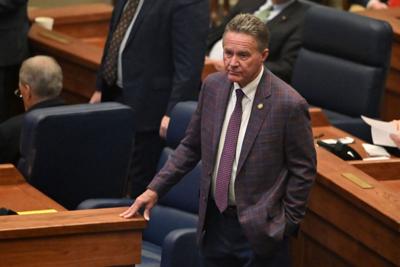

Republican lawmakers are rushing a bill that could weaken the state’s environmental laws through the Legislature, alarming Democrats and critics who warn the legislation could seriously affect pollution controls and Alabamians’ health.
SB 71, sponsored by Sen. Donnie Chesteen, R-Geneva, passed the Senate on Feb. 3 and won approval in the House Agriculture and Forestry Committee just two days later in an uncommon Thursday morning meeting.
Chesteen said in an interview Friday was an attempt to get the bill on the House floor on Tuesday. It is not on the House’s agenda for Tuesday, but it could be pulled for a vote at any time.
At the public hearing Thursday, Chesteen said the bill is good for Alabama businesses.
“If we’re going to be able to compete with states in the Southeast to attract and bring some of these businesses in, we need to have these standards adopted so that it’s clearly defined what our companies are working with,” Chesteen said.
Tim Howe, chief advocacy officer for the Business Council of Alabama (BCA), spoke in favor of the bill.
“We are glad this morning that you have an opportunity to consider what is a common sense approach to Alabama’s regulatory environment,” Howe said. “We support it because it will contribute to a stable and predictable business climate for Alabama.”
Multiple messages seeking comment were left with Howe and others at BCA.
The bill would allow the Alabama Department of Environmental Management (ADEM) to adopt emergency rules if it can prove there is immediate danger to public health, safety or welfare. But the bill requires ADEM in those cases to use what the bill defines as “best available science” and the “weight of scientific evidence.”
Multiple messages seeking comment from ADEM were left Friday.
Part of the definition of “best available science” includes collecting data, which can be site-, area- or state-specific studies. Rep. A.J. McCampbell, D-Linden, expressed concern Thursday that there is no requirement that those studies would be done, and if they were, it might be too late for people whose lives could be put at risk by pollution or neglect.
“The only way you can verify that this science or this causation of cancer is once people are dead,” McCampbell said. “What then are we going to say to the people when they are dead?”
The bill would also require ADEM to establish a “direct causal link” between exposure to a harmful chemical or pollutant and bodily harm in humans. Sarah Stokes, an attorney at the Southern Environmental Law Center, says that kind of science does not exist.
“We know that these chemicals cause problems. We know that there’s an increased risk of problems with these chemicals. Science has shown us that,” Stokes said in an interview Monday. “Instead of using actual sound science, this bill rejects sound science and asks us to use impossible science, which is not even science. It asks us to use witchcraft.”
Chesteen said in an interview that Stokes and others’ arguments against direct causal link is a theory, not science.






“They’re really pushing for Alabama to follow a path of unreasonable possibilities and theories,” Chesteen said. “There’s a difference in a theory and direct causal links. This is based on the science, not a theory.”
He also said that he was not aware of any current ADEM regulations that were not based on what the bill defines as “best available science.”
In a letter to Chesteen and Rep. Troy Stubbs, R-Wetumpka, the House sponsor of the bill, the Southern Environmental Law Center and 30 physicians, professors, pharmacists and environmentalists asked them to reconsider the legislation. The letter said the bill was vague and could cause unintended consequences to Alabamians’ health.
“There are currently no placebo-controlled double-blind studies showing that lead exposure ‘causes’ developmental neurotoxicity or that smoking ‘causes’ cancer, yet those substances are worthy of health advisories and regulation,” the letter reads.
Rep. Napoleon Bracy, D-Prichard, said during the meeting Thursday that the bill limits states’ rights, saying he is worried what would happen if the Trump Administration rolled back federal regulations.
“I’m just trying to understand when the administration changes, would ADEM’s regulations change based off of us attaching ourselves to what the federal standards are?” Bracy said.
Currently, businesses get a permit from ADEM based on what they are likely to discharge into Alabama’s rivers. ADEM sets standards for the levels of chemicals and pollutants businesses are allowed to discharge, which water treatment plants are then responsible for cleaning, Stokes said. That water ends up in Alabama homes, restaurants and waterways.
“It gives businesses a free for all for being able to discharge whatever they want,” Stokes said after the meeting. “It’s a blank check to businesses, and we’re basically sacrificing human health for businesses. That doesn’t seem like the best calculation for our citizens.”
Multiple messages seeking comment from Lanier Brown, a member of the Alabama Environmental Management Commission, were left Friday and Monday. The commission is the governing body of ADEM and sets environmental rules and regulations.
Stokes said there are certain regulations that ADEM sets that the U.S. Environmental Protection Agency (EPA) does not, like those for water quality. The EPA sets standards for drinking water, but not for rivers or other bodies of water, Stokes said.
The Clean Water Act of 1972 requires states to set their own water quality standards so that the state’s water is “fishable” and “swimmable,” according to the EPA. The federal government does not set standards for how much arsenic and cyanide can be discharged into Alabama waterways, Stokes said.
She said that if the bill is passed and the current regulations are rolled back, water treatment plants would have to spend more time and resources cleaning the water to meet federal standards for drinking water.
“If they’re cleaning up, the dirtier the water you clean, the more money it costs,” Stokes said. “It passes that burden and that cost on to the consumer.”
Justinn Overton, executive director of the Coosa Riverkeeper, said in an interview after the meeting Thursday that the bill also limits Alabamians’ ability to be involved in the process of making the state’s rules like they can now.
“This is not only limiting for us as Alabama citizens to think about the ways that this bill detrimentally impact public health, and questioning the sound science and being able to use science to make these decisions for a lively and open debate is part of one of the most important things that elected officials need to do is listen to their constituents,” Overton said.


(0) comments
Welcome to the discussion.
Log In
Keep it Clean. Please avoid obscene, vulgar, lewd, racist or sexually-oriented language.
PLEASE TURN OFF YOUR CAPS LOCK.
Don't Threaten. Threats of harming another person will not be tolerated.
Be Truthful. Don't knowingly lie about anyone or anything.
Be Nice. No racism, sexism or any sort of -ism that is degrading to another person.
Be Proactive. Use the 'Report' link on each comment to let us know of abusive posts.
Share with Us. We'd love to hear eyewitness accounts, the history behind an article.