


Alabama has made strides to bring broadband internet to all 67 counties, but much of the Black Belt remains on the other side of the digital divide.
That’s the conclusion of a report released Tuesday by the Education Policy Center at The University of Alabama.
Since 2018, nearly $2.5 billion in federal and state funds have been directed toward bringing high-speed internet (at least 100/20 megabytes per second) to all Alabamians.
That money and effort have brought some success. According to the report, 87% of Alabama residents now have access to high-speed internet. Nationwide, 94% have access to broadband internet, compared to 93% for folks who live in the South.
But as with many other measures, the numbers are not as favorable in the Black Belt. Only 76% of Black Belt residents have access to high-speed internet, compared to 89% of Alabamians who live outside the Black Belt, according to the report.
The report shows that the Black Belt has seen considerable improvement in internet access in the last five years. In 2020, only 67% of residents in the Black Belt could connect to high-speed internet compared to today’s 76%.
In 2020, seven of 24 Black Belt counties were below 20% coverage. Today no Black Belt County stands below 27%, and 21 of the 24 Black Belt counties are above 40%.






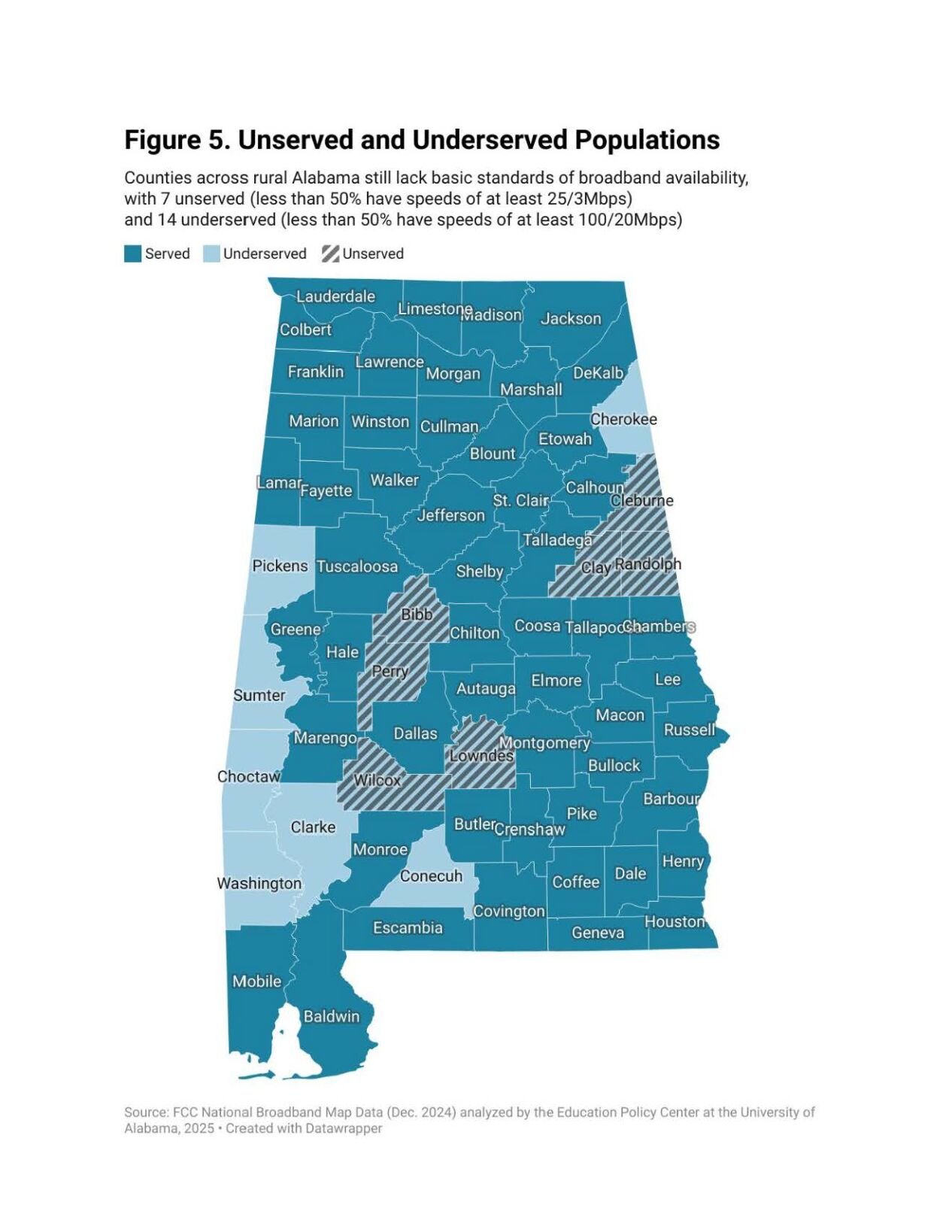
And the report tells some internet success stories. In Choctaw County, broadband access increased from 0% to 35%, in Perry County from 0% to 27% and in Greene County from 0% to 58%.
But there are still internet issues in the Black Belt. Eight Black Belt counties’ high-speed coverage is still less than 50%, nearly 30 points lower than the rest of the state. Of the seven counties with very slow internet service (below 25/3 megabytes per second), four are in the Black Belt, and of the seven with mediocre service, six are in the Black Belt.
Addressing the persistent digital divide is a foundational element for enabling telehealth services, facilitating equitable educational opportunities and driving economic development and improved quality of life across the Black Belt region, the report states.
Investing in broadband “creates the conditions for residents to thrive where they live, for businesses to compete more effectively and for communities to build a more resilient and prosperous future,” the report says.
Gov. Kay Ivey made broadband access one of her priorities when she took office in 2017. She brought agencies together and put the Alabama Department of Economic and Community Affairs in charge of using federal and state funds to complete the Alabama Fiber Network. The AFN now consists of 3,500 miles of fiber optic cable in all 67 counties.
“This progress is largely attributable to decisive policy actions, starting with assigning leadership to ADECA, passage of the Alabama Broadband Accessibility Act, and the landmark Connect Alabama Act, which established a comprehensive statewide broadband plan and dedicated administrative entities,” the report states.

(0) comments
Welcome to the discussion.
Log In
Keep it Clean. Please avoid obscene, vulgar, lewd, racist or sexually-oriented language.
PLEASE TURN OFF YOUR CAPS LOCK.
Don't Threaten. Threats of harming another person will not be tolerated.
Be Truthful. Don't knowingly lie about anyone or anything.
Be Nice. No racism, sexism or any sort of -ism that is degrading to another person.
Be Proactive. Use the 'Report' link on each comment to let us know of abusive posts.
Share with Us. We'd love to hear eyewitness accounts, the history behind an article.