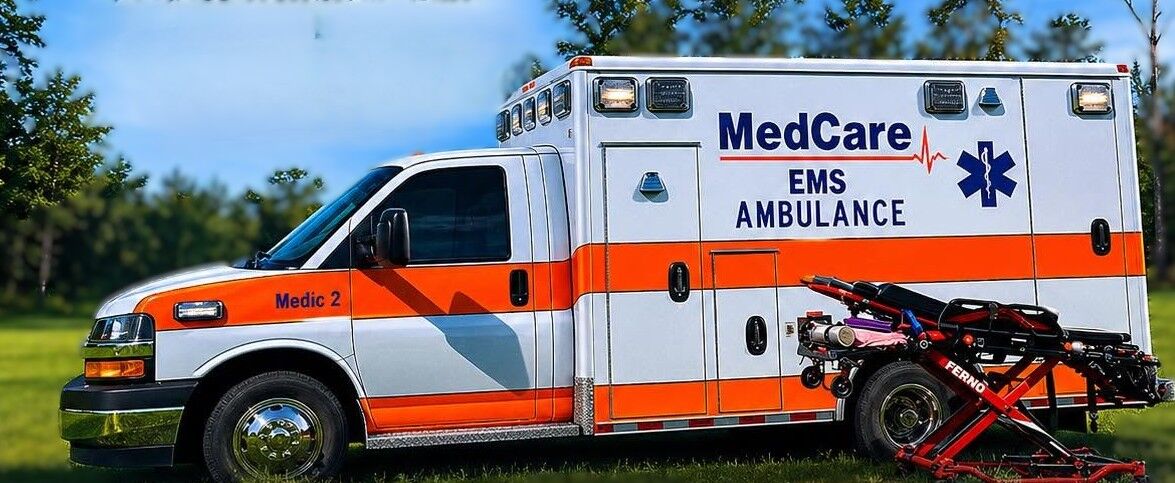


Wilcox County's ambulance service is in better shape than it has been in years, according to the manager and the longest-serving medic of MedCare EMS.
Two vehicles are staffed and running most of the time, which is a major accomplishment in one of the state’s smallest and poorest counties.
But that’s not the story everywhere in rural Alabama.
The ambulance service in Greene County, a county slightly smaller and poorer than Wilcox 80 miles to the northwest, was out of operation for about a week in early July because they didn’t have an ambulance that met state standards. Pickens County, which is just north of Greene County, was without ambulance service for months last year when the private ambulance company pulled out.
Jessica McGraw, CEO of both J. Paul Jones Rural Emergency Hospital and MedCare, said that while she’s proud that the Camden-based ambulance service is running well, what happened in Greene County “could be any of us any day.”
“We (rural emergency medical service providers) are all one crisis away from near death,” McGraw said with a chuckle. “I don’t think anyone is any different who’s in rural EMS.”
State EMS Director Jamie Gray agreed.
“Everybody is in the same boat,” Gray said. “(EMS) is struggling throughout the state. Everybody has funding issues.”
Gray and Alabama Sen. Bobby Singleton helped Greene County EMS get two new ambulances through a grant that was matched by the Greene County Healthcare Authority.
Gray said solving the vehicle issue “is a positive step in the right direction,” but Greene County EMS, like every other ambulance service in Alabama, has issues paying for staff and supplies as well.
Singleton authored a new law that goes into effect on Oct. 1 that he said should give EMS providers a financial booster shot. The law sets the minimum reimbursement for an ambulance transport at twice the highest Medicare rate in the state. Coincidentally, that rate is the rate paid in Eutaw, the county seat of Greene County.
The law also allows EMS providers to be reimbursed for treating patients that don’t have to be transported to a hospital. Currently ambulance crews aren’t paid if they don’t transport a patient.
Singleton said he is proud of the law, but ambulance services need to find local support as well.






McGraw said rural EMS providers need all the help they can get. Running an ambulance service isn’t for the weak of heart anywhere, but providing EMS in a rural county has additional challenges.
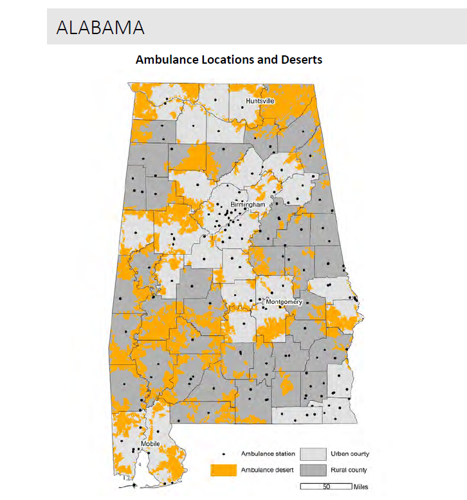
A report issued by the Maine Rural Health Research Center in 2023 bears that out. The report defined the term “ambulance desert,” which it described as any area 25 minutes away from an ambulance station.
The report says that in 2022 Alabama had 172 ambulance stations for a population of just over 5 million people, giving it a rate of 3.4 ambulances per 100,000 residents. That’s the fifth worst rate in the U.S. For comparison, Nevada was the worst with 1.8 ambulances per 100,000, followed by Utah, North Carolina and Tennessee. For comparison, Mississippi had 4.7 ambulances per 100,000 and Louisiana had 5.5.
Sixty-four of Alabama’s 67 counties contained an ambulance desert in 2022, including every county in the Black Belt. Every county had ambulance coverage, but the ambulance desert showed up as you moved away from the town where the ambulance was based.
More than 144,000 Alabamians – almost 46% of Alabama’s rural residents – live in an ambulance desert, according to the report.
In her office in Camden, McGraw works with numbers that are more close to home, volume and revenue numbers that will determine if MedCare’s units can continue to serve Wilcox County.
“In rural areas volume is unpredictable,” McGraw said. “You have days where you have zero or very few transports. You can’t pay for the truck or the staff if you’re parked all day.”
“The hardest part from a management perspective is trying to figure out volume versus reimbursement versus staffing,” McGraw said.
MedCare ambulances answer between 60 and 75 calls a month, including hospital transfers, McGraw said. The service operates two units two or three days a week.
“It’s the first time in 10 years we’ve done that,” McGraw said.
The distances rural ambulances travel is another challenge, McGraw said. Out-of-town transports take a unit out of service for hours, and it wears out the crew and the truck.
J. Paul Jones Rural Emergency Hospital tries to keep all the patients it can, which is one reason why the hospital operates the ambulance service. But many patients must be transported to full-service hospitals in Demopolis or Selma or even to what David Johnson, the most senior medic on the MedCare team, called “that place that starts with a B.”
“We never say the place out loud, because if we do, we end up having to transport someone there,” Johnson joked. It may be a superstition and an inside joke, but a transport to Birmingham will tie up one of the ambulances for most of the day, he said.
(0) comments
Welcome to the discussion.
Log In
Keep it Clean. Please avoid obscene, vulgar, lewd, racist or sexually-oriented language.
PLEASE TURN OFF YOUR CAPS LOCK.
Don't Threaten. Threats of harming another person will not be tolerated.
Be Truthful. Don't knowingly lie about anyone or anything.
Be Nice. No racism, sexism or any sort of -ism that is degrading to another person.
Be Proactive. Use the 'Report' link on each comment to let us know of abusive posts.
Share with Us. We'd love to hear eyewitness accounts, the history behind an article.