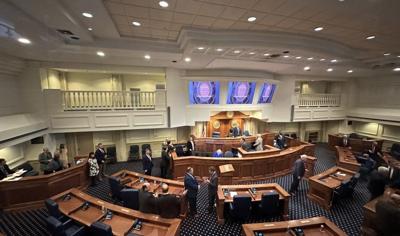
Senate Majority Leader Steve Livingston says the Alabama Legislature has a concise list of objectives for its annual session that starts Tuesday.
“I have told people I think we’ll do five things: Education budget, General Fund budget, local bills, confirmations and adjourn,” Livingston, R-Scottsboro, told Alabama Daily News recently.
He later rattled off a list of bills and issues that are priorities to Senate members, but legislative leadership seems to agree that this election-year session will be speedy. Several lawmakers have May 19 primaries and want to avoid any controversy following them home.
“We’ve had a lot of success in this quadrennium, so it’s certainly important to give our members who have challengers an opportunity to get out and campaign,” Speaker of the House Nathaniel Ledbetter, R-Rainsville, told ADN.
The state’s two operating budgets are the only items the Legislature is required by law to pass each year.
“I think we will focus on the budgets and there will be other pieces of important legislation passed,” Sen. Arthur Orr, R-Decatur, said. “But I don’t see this being a grind of a session, where there are a lot of bills on a lot of direct topics that take up a lot of floor time in either chamber.”
Here’s a few things to know as the session starts.
Timing
A regular legislative session can be as many as 30 legislative days — meaning when the House and Senate meet in chambers to vote on bills — over a 105 calendar day period. That means the session must be done by late April.
A typical legislative week sees the House and Senate meeting on Tuesday and Thursday, with Wednesday designated as a committee day. But in recent years, legislative leaderships have called for what is known as “three day weeks,” with the House and Senate gaveling in late Wednesday after committee meetings are concluded.
That kind of schedule is expected this session as well, especially in the month of January.
Ledbetter said the plan is to “move the needle a little quicker” earlier in the session.
And unlike the previous two years, there will be only one week-long spring recess, set for late March.
“We’re going to use all 30 days, but we may use them a lot quicker than the 105 days we have available to us,” Livingston said.
Local bills and rules
Senate President Pro Tem Garlan Gudger, R-Cullman, said local bills will be a priority and move earlier this session.
Dozens of non-controversial local bills, those that only apply to one county or municipality, died without votes at the end of the 2025 session amid a Democrat-led slowdown that led to discussions about rules changes in the future.
“We’re focusing on any local bills, any type of bills that are important to the individual districts,” Gudger said. “… That’s our main focus.”
Meanwhile, those discussions about rule changes have continued, Gudger said.
“That is something that the body is going to address as we move forward,” he said. “Are we addressing that now or in the transitional period next year? I’m not sure.”
Whenever it happens, Gudger said he won’t let Democrats get blindsided by changes.
Senate Minority Leader Bobby Singleton, D-Greensboro, slowed votes in the Senate after the House wouldn’t vote on his bill affecting gambling in Greene County. Singleton told ADN he’s bringing that bill back this session.
Singleton said he expects rule changes at some point and it will be a sad day.
“We’re a deliberative body,” he said. “We’re a body that gives the public an opportunity to hear the debate, to understand what is going on with the issues.”
Budgets
Currently, there are declines in some major revenue streams to both the Education Trust Fund and the General Fund, making Alabama’s conservative spenders even more cautious. The General Fund has seen about 2% growth so far this fiscal year; the ETF has seen a 2% decline, including dips in income and sales tax receipts.
But because Gov. Kay Ivey and the Legislature haven’t spent all available funds in recent years and built reserves, there is some fiscal flexibility in the 2027 budget.
Orr said he expects lawmakers to consider raises for educators as well as bonuses for retirees. And the state is prepared to help with about half of an expected $380 million shortfall in the teachers’ health insurance program.
For the General Fund, House budget chairman Rep. Rex Reynolds, R-Hazel Green, said revenues are actually better than expected, but interest on state deposits is declining steadily. An influx of COVID-19 federal relief funds and higher-than-normal interest rates made growth in state trust fund deposits a boon for the General Fund in recent years. But interest rates are declining and the federal funds are being exhausted, per federal law. About $500 million remains, Reynolds said.
He said most General Fund agencies will be level-funded in 2027.
“We’ve got to save some of the surplus funds and push them to the 2028 budget because I think when all the (American Rescue Plan Act) funds are spent at the end of 2026, we will definitely see a drop in revenue,” Reynolds said.
Senate General Fund Chairman Greg Albritton, R-Range, said he plans to “hold the line” on General Fund expenses while interests on state deposits decline and a lawsuit over online income tax distribution plays out in court.





Meanwhile, the state employees’ insurance board is requesting a major funding increase to address rising health care costs in 2027.
Asked about the possibility of pay raises for state employees, Albritton said addressing the insurance shortfall is his first priority.
“I know it’s an election year, I know there will be pressure, but I am extremely cautious about being able to do either and certainly not both,” he said.
Budget hearings with State Employees Insurance Board members and some state agencies are Jan. 26. Education agency budget hearings are Feb. 2.
Economics and affordability
Recent polling of likely Republican primary voters suggests that the economy, including addressing inflation and cost of living, should be state leaders’ focus.
“The polling tells us exactly what we think as well,” Gudger said when asked about it. “We see inflation going up. We see costs and fees going up, whether you’re a small business or you’re a large corporation, and that takes money out of the hard-working Alabamians’ pockets.”
This term, approved tax cuts included two percentage points off the state’s sales tax on food. Lawmakers and Ivey also approved in 2023 $393 million in tax rebates – $150 to single filers and $400 to joint filers – to Alabamians.
“… We’re going to continue to look at tax cuts, tax credits and make sure that we’re being as vital as possible for people that are on fixed incomes.”
Singleton and House Minority Leader Anthony Daniels, D-Huntsville, both listed affordability issues as high on their party’s priority list.
“We as a Legislature have to do what it takes to help make things affordable in our state,” Singleton said. “We have 750,000 people that we realize are on (federal food benefits) and other benefits across this state, and we have to make sure that each and every Alabamian becomes whole.”
Job creation, especially in rural Alabama, and access to health care are also among Democrats’ priorities.
Lawmakers will approve a bill this session authorizing the spending of the $203 million federal rural health care grant announced last month. But because the state outlined spending in an application for the funds, lawmakers aren’t expected to deviate from the plan.
Daniels also said he expects the return of legislation to remove state income tax on hourly workers’ overtime pay, putting more money in Alabamians’ pockets. Daniels passed a similar bill in 2022, but the law was allowed to expire when the loss of revenue to the education budget far exceeded expectations. Lawmakers have been discussing a way to bring it back, Daniels said.
“We’re certainly looking at bringing the elimination of the income tax (on overtime) back,” Daniels told Todd Stacy on Capitol Journal Friday.
Potential issues
Two issues that may impact moods and movement in the State House this session are the ongoing lawsuit over the state’s collection and distribution of online sales tax revenue and a major highway construction project in west Alabama.
Legislative leaders said they expect the Simplified Sellers Use Tax conflict now before a state judge will be sent back to them to resolve, though the timing is unclear.
“There will be a point where everyone needs to sit at the table and iron out the best way forward,” Ledbetter said.
Albritton fiercely opposes some municipalities’ attempt to change the distribution of those funds, of which the General Fund received more than $300 million last year. He has filed two bills that would allow people to opt out of paying municipal sales tax in cities where they don’t reside.
And House Speaker Pro Tem Chris Pringle, R-Mobile, plans to file a bill creating an appointed board to oversee the Alabama Department of Transportation. Pringle has previously sponsored this bill and is bringing it back amid frustration over the state’s borrowing of $730 million, to be repaid with state dollars, to finish four-laning a north-south route in from Mobile to Tuscaloosa.
The West Alabama Corridor is a priority of Ivey and supporters say it will create economic opportunity in the region.
While those opposed to the corridor have said their issue is the funding mechanism and debt, not the project itself, Singleton said he thinks some just don’t care about growth in rural west Alabama.
He said the project will give the area a chance to attract more and better jobs.
“We want to be part of the growth and the economics of Alabama just like everyone else,” Singleton said. “To my colleagues who continue to want to fight against it, you know, get a life.”
Ivey’s last State of the State
Ivey, governor since spring 2017, will give her ninth and final state of the state address Tuesday evening, laying out her priorities for the session.
“We are coming into this legislative session with serious momentum,” Ivey said in a statement last week. “Just last month, we announced Lilly Medicine would be investing some $6 billion dollars to build a new manufacturing facility in our state, and this is only one of our most recent wins that will further strengthen Alabama’s future. I am proud to work with our legislators this session to get good work done for the people of Alabama. We will continue building on our success in education, bolstering public safety, conservatively budgeting and preparing for Alabama’s strong future.”
The speech from the Old House Chamber of the State Capitol will be broadcast live on Alabama Public Television beginning at 5:30 p.m. Tuesday. It will also be live-streamed on the Capitol Journal YouTube channel.
This story is from aldailynews.com.

(0) comments
Welcome to the discussion.
Log In
Keep it Clean. Please avoid obscene, vulgar, lewd, racist or sexually-oriented language.
PLEASE TURN OFF YOUR CAPS LOCK.
Don't Threaten. Threats of harming another person will not be tolerated.
Be Truthful. Don't knowingly lie about anyone or anything.
Be Nice. No racism, sexism or any sort of -ism that is degrading to another person.
Be Proactive. Use the 'Report' link on each comment to let us know of abusive posts.
Share with Us. We'd love to hear eyewitness accounts, the history behind an article.