MONTGOMERY, Ala. – The House could soon vote on the three-bill Alabama Affordability Protection Plan targeting data centers and changing utility governance, which the House Committee on Transportation, Utilities and Infrastructure approved Tuesday morning.
The legislation was introduced by a bipartisan coalition from both chambers last Thursday and is moving quickly. The sponsors said the package is designed to protect Alabamians from rising utility costs and “undue political influence.”
It targets the Alabama Public Service Commission – the board tasked with regulating Alabama’s utilities – as well as large data centers, which are popping up across the country because of artificial intelligence’s data processing needs.
The majority of Tuesday’s meeting was spent on a public hearing on House Bill 392. Introduced by Rep. Chip Brown, R-Hollingers Island, and Senate Minority Leader Bobby Singleton, D-Greensboro, it would change the three-member Public Service Commission to an appointed panel rather than an elected one.
Introducing the bill to committee members, Brown highlighted the fact that Alabama is one of only ten states that elects its utility regulators. He said an appointed panel could help lower utility rates.
“I think that if we move towards an appointed Public Service Commission, we have an opportunity to reset things, and at least have an opportunity to get our rates low,” Brown said.
WBRC reported in November that Alabama has the third highest residential monthly electric bills in the country, averaging $173 dollars, according to data from the U.S. Energy Information Administration.
The bill’s appointment process was amended by the committee. Originally, the bill required the Governor, Speaker of the House and Senate President Pro Tem to each have one direct appointment. An amendment from Ranking Minority Member Rep. A.J. McCampbell, D-Demopolis, altered the process so the appointments would all flow through the governor. The governor would have one appointment and would select the two other board members from lists provided by the Speaker of the House and Senate President Pro Tem.
A similar process is used to select members of the Alabama Board of Pardons and Parole.
The bill requires that appointees have experience relevant to the commission, including fields like infrastructure, policy and engineering. It also mandates that those lists of three names be created in consultation with the Minority Leader from each chamber.
Though overshadowed by the election conversation in committee, the bill also changes current practice by requiring each utility to hold at least one public hearing per year. Another part of the bill prohibits utility companies like Alabama Power and Spire from using rate-payer dollars on lobbying or other political activity.

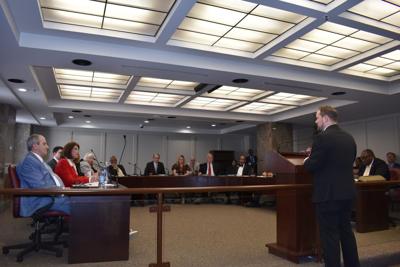
Daniel Tait, executive director of Energy Alabama, responds to questions from lawmakers.
Members of the public had the chance to speak on the bill during a public hearing section of the meeting. Eight people spoke – two in favor and six against.
Opponents argue the bill creates a loophole because those with appointment power under the bill can still receive donations from utility companies. Current law bars these companies from donating to candidates for the PSC.
Daniel Tait, executive director of Energy Alabama, a non-profit advocacy group that has opposed the package from the start, argued the bill allows the regulated to choose their regulators.
“Alabama Power can donate practically unlimited sums to all of you, the Speaker, the Senate Pro Tem and the Governor – the very people who would now control the entire appointment process,” Tait said. “If this bill becomes law, by passing this legislation, you are essentially legalizing bribery.”






Brown, the bill sponsor, strongly disputed that accusation saying the legislation improves transparency.
“A core component of this is ensuring transparency, which is why this legislation would require the Public Service Commission to hold annual meetings and ban utility providers from passing lobbying expenses on to customers,” Brown told ADN.
“Like every other supporter of this bill, my only goal is to strengthen oversight of utility providers and ensure Alabama families are treated fairly.”
For its part, Alabama Power told ADN it doesn’t have a position on the bill but it respects the role of the PSC, whether they are elected or appointed.
“…We support healthy policy making and the legislative process that determines what’s good for Alabama,” a statement from the company said.
Reps. Margie Wilcox, R-Mobile, and Donna Givens, R-Loxley, later grilled Tait about Energy Alabama’s board and its funding sources, including so-called “dark money” networks like Mutliplier and the Tides Center, which have given $285,000 and $150,000 to Energy Alabama, respectively. Brown had earlier alleged that Energy Alabama is funded by progressive investor George Soros, but Tait denied that claim.
Wilcox and Givens both said they had not heard of Energy Alabama and questioned why Tait was just now making appearances, but Tait responded that he has been active in the Alabama energy scene since 2015.
Rep. Napoleon Bracy, D-Saraland, interrupted the lengthy questioning to share his opinion that no matter how anyone felt about the bill, it wasn’t fair to grill a participant in the public hearing.
“I don’t know the gentleman either, but I’ve never been in a committee meeting or a public hearing when we’ve had more questions for a speaker than for the actual bill sponsor,” Bracy said to applause from some in attendance.
House Bill 392 passed by a vote of 10-4, with nays from Reps. McCampbell; Brett Easterbrook, R-Fruitdale; Rolanda Hollis, D-Birmingham; and Curtis Travis, D-Tuscaloosa.
The committee also passed the other two bills in the package with minimal discussion.
House Bill 399 would reform tax incentives for data centers. Alabama already has over 20 data centers, and many fear building more will lead to higher utility costs for those living in those areas if action is not taken.
House Bill 403 would require those centers to pay for any grid or infrastructure upgrades needed to support their large electricity pull as well as ensure that existing utilities customers do not pay more because of private development.
Gov. Kay Ivey on Tuesday lent her support to the package, saying “we are taking steps to protect energy costs for Alabamians while keeping our state competitive for further economic development.”
This morning, the House Committee on Transportation, Utilities and Infrastructure will consider a package of bills — 403, 399 & 392. I am proud to lend my support to protect energy costs for Alabamians and keep our state competitive for further economic development. #alpolitics pic.twitter.com/OMijMQfaiD
— Governor Kay Ivey (@GovernorKayIvey) February 10, 2026
The package now heads to the House floor where each of the bills are scheduled to be considered Thursday.

(0) comments
Welcome to the discussion.
Log In
Keep it Clean. Please avoid obscene, vulgar, lewd, racist or sexually-oriented language.
PLEASE TURN OFF YOUR CAPS LOCK.
Don't Threaten. Threats of harming another person will not be tolerated.
Be Truthful. Don't knowingly lie about anyone or anything.
Be Nice. No racism, sexism or any sort of -ism that is degrading to another person.
Be Proactive. Use the 'Report' link on each comment to let us know of abusive posts.
Share with Us. We'd love to hear eyewitness accounts, the history behind an article.