




The Prodigy lead singer Keith Flint died in 2019. (SWNS)
By Stephen Beech
A newly discovered 99-million-year-old snail has been named after The Prodigy's Keith Flint.
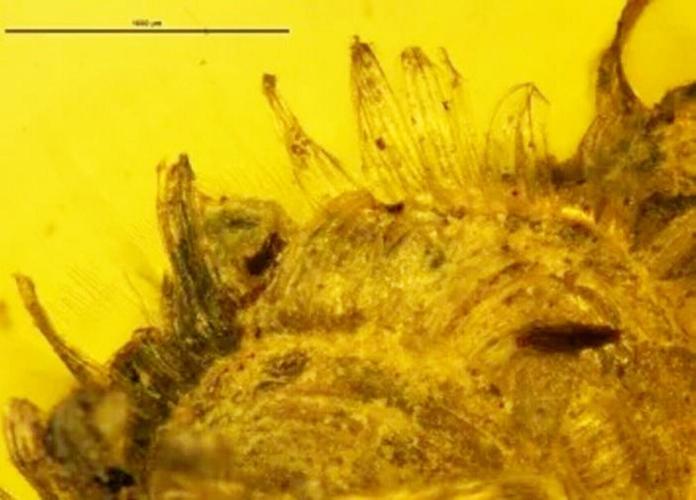
Scientists honored the charismatic Firestarter frontman because the hairs covering the shell of the "bizarre-looking" ancient species reminded them of his distinctive spiked hairstyle.
Flint was found dead at his Essex home in 2019, having taken his own life, aged 49.
But now his name will live on in the form of a snail who was alive alongside dinosaurs such as sauropods almost 100 million years ago.
The snail was named Archaeospirostoma flinti after being found preserved in Burmese amber by paleontologists from Eotvos Lorand University (ELTE) in Budapest, Hungary.
They explained that Myanmar amber — more commonly known as "burmite" — is one of the most important sources of information about biodiversity during the Mesozoic Era.
The amber dates back to the age of the dinosaurs and is around 99 million years old, according to a study published in the journal Ecologica Montenegrina.

Close-up of the hairs of Archaeospirostoma flinti. (Páll-Gergely et al., 2026 via SWNS)
Burmite preserves numerous now-extinct organisms — including animals, plants and fungi — as inclusions, often in astonishing detail.
Amber can preserve even soft tissues, which would otherwise decompose rapidly, and do so in three dimensions.
The shell of the new snail species, which belongs to the snail family Cyclophoridae. is low-spired and circular when viewed from above, and is covered with hair-like appendages.
The appendages are part of the shell's outer, protein-based layer, known as the periostracum.
The piece of amber containing the snail was scanned at the University of Szeged, Hungary.






That enabled the research team to obtain as much information as possible about the snail by creating a digital model of the specimen.
Márton Szabó, a researcher at ELTE and the Hungarian Natural History Museum, said: "Research on snails preserved in Burmese amber has experienced a renaissance in recent years, partly thanks to the increasingly widespread use of micro-CT scanning in scientific research.
"This technique allows us to scan and examine an otherwise extremely fragile and tiny amber inclusion as a three-dimensional model without putting it at any risk whatsoever.
"The work of our colleagues at the micro-CT laboratory of the University of Szeged was therefore instrumental in enabling us to describe the new snail species in detail."
He added: "The new species is the ninth member of the snail family Cyclophoridae to have been discovered in Burmese amber.
"Seven of these species have 'hairs,' while the shell surfaces of the other two are smooth.

The Prodigy lead singer Keith Flint performing at T in The Park in Strathallan, Perthshire on July 12, 2015. (SWNS)
"Archaeospirostoma flinti differs from the other 'hairy' snails discovered in burmite in the arrangement of its shell hairs.
"Whereas the hairs of the previously known species consist of individual, longer or shorter projections, those of the new species are grouped into flat 'fringes', each composed of several elements of equal length."
Study leader Barna Páll-Gergely, from the HUN-REN Centre for Agricultural Research, said: "It is particularly exciting that the aperture of the best-preserved specimen of the new species has the so-called operculum preserved in situ.
"Essentially, this is a door that the snail uses to close the aperture of its shell.
"Its shape is entirely unique among the Burmese amber members of this family: it is conical in side view."
He added: "The function of this conical operculum is not yet entirely clear, although there are living aquatic snail species known to use their cone-shaped opercula somewhat like a plunger, forcing oxygen-rich water through their respiratory organs.
"Evidently, this is not what we are suggesting in this case, given that the newly described snail species was terrestrial."
(0) comments
Welcome to the discussion.
Log In
Keep it Clean. Please avoid obscene, vulgar, lewd, racist or sexually-oriented language.
PLEASE TURN OFF YOUR CAPS LOCK.
Don't Threaten. Threats of harming another person will not be tolerated.
Be Truthful. Don't knowingly lie about anyone or anything.
Be Nice. No racism, sexism or any sort of -ism that is degrading to another person.
Be Proactive. Use the 'Report' link on each comment to let us know of abusive posts.
Share with Us. We'd love to hear eyewitness accounts, the history behind an article.