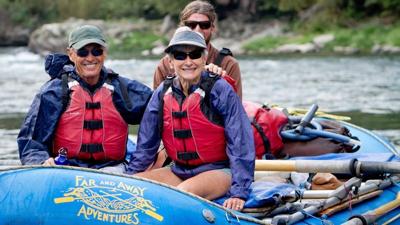
Rivers are among the most at-risk ecosystems on the planet despite their importance to society. That pressure is also visible across the United States, where rivers face pollution, drought, mining, or aging infrastructure. But not every American river story is about decline. In Idaho, the Middle Fork of the Salmon River offers a blueprint for success, one shaped by protection and decades of responsible use.
Why America’s Rivers Are Under Pressure
American Rivers is a national conservation organization working to safeguard 4.4 million miles of rivers and streams in the United States since 1973.
It publishes the annual America's Most Endangered Rivers Report; the 41st edition comes out this year; to highlight waterways where communities, wildlife, and clean water are at risk.
This year's report notes 80% of American rivers lack adequate protection and half of them contain unsafe levels of pollution.
Rapid development of data centers, mining, fossil-fuel pipelines, sewage spills, excessive water withdrawals, and agricultural pollution all contribute.
Several rivers face risks to drinking water supplies, while others are threatened by toxic pollution, "forever chemicals," habitat loss, failed dams, or weakened land protections.
Why The Middle Fork Of The Salmon River Is A Success Story
The 425-mile Salmon River is one of the longest free-flowing rivers in the Lower 48 states. The Middle Fork of the Salmon River is a more than 100-mile section in central Idaho that flows through the Frank Church–River of No Return Wilderness, the largest contiguous wilderness area in the Lower 48.
It is also one of the eight original rivers designated for protection under the Wild and Scenic Rivers Act. This landmark 1968 conservation law drew broad bipartisan support and passed the Senate unanimously.
"Middle Fork is a strong example of what happens when a river has the utmost protection without even a remote chance for anything to change," says Steve Lentz, who co-founded Far and Away Adventures with his wife, Annie, in 1980, and has spent decades guiding and shaping wilderness trips on Idaho's Middle Fork of the Salmon River.
"I was 13 years old when my father, a former World War II pilot, brought me to Middle Fork. We floated down the river that had very low regulation," Lentz recalls in a telephone interview. "But after the Act, all trash disappeared since a carry-out system became mandatory."
It is exactly that shift from loosely managed recreation to strictly regulated tourism that is central to the Middle Fork's success story today.
How Strict Rules Keep The Middle Fork Wild
"We lead by example, but we are also very fortunate that people who live here and come here appreciate Middle Fork and are responsible by nature," Lentz says.
He also adds that a close partnership with the U.S. Forest Service has been another important factor in keeping the river protected while still allowing people to experience it.




The Forest Service requires a permit year-round to float the river, allowing a maximum of 7 launches per day. Groups are capped at 24 people. During the Chinook salmon spawning season, a 12-boat limit is in place to reduce impacts on fish habitat.
Since the Middle Fork of the Salmon River flows through the Frank Church–River of No Return Wilderness, boat motors and other motorized equipment are not allowed.
But the rules do not end here. Groups must carry portable toilets, fire pans, ash containers and mesh strainers. Everyone should pack out garbage, micro-trash, ashes and human waste.
"We strain dish water above the high waterline to avoid anything reaching the water," Lentz notes. "Leaving no trace is a major focal point for everyone here.”
Far and Away Adventures Goes Beyond The Rules
For Far and Away Adventures, responsible tourism on the Middle Fork goes beyond complying with Forest Service rules. It also means actively working to safeguard one of the qualities that makes wilderness increasingly rare: the chance to be fully disconnected.
"Our goal is to make guests feel comfortable in the outdoors, while showing them that the real magic comes from being fully present in nature," Lentz says. "We ask our guests to put their phones in airplane mode and only use them to take photos."
That belief also led the company to work alongside fellow Idaho outfitter Steve Zettel, founder of Not In Wilderness Coalition, a nonprofit focused on preserving the traditional wilderness experience as smartphones, satellite service and constant connectivity push farther into remote places.
Lentz offers advice on how to best experience being outdoors: "Leave the technology at home and open your eyes and mind to the sound of nature."
Far and Away Adventures also champions stewardship. Guides introduce guests to the Middle Fork's natural and cultural history, including Native American heritage, early fur-trapper routes, mining remnants and homestead history.
How Can A Luxury River Journey Leave No Trace
Responsible river travel does not have to be a bare-bones experience. Far and Away Adventures' American Safari program adds luxury and comfort to the journey without leaving a permanent mark on the wilderness.
During these small-group excursions, guests can paddle, fish, hike along the river, or ride in a lounge-style sweep boat through the canyon, while cargo boats carry camp equipment separately.
At camp, walk-in tents, elevated beds, hot showers, full-service meals and candlelit dinners await guests along the river corridor. But these comforts remain temporary. The camp is assembled, used and then removed, leaving the wilderness of the Middle Fork intact.
Far and Away Adventures believes a success story is not necessarily a river no one visits. It is a river where access is limited, rules are strict and enforced, while visitors go beyond compliance, leaving with a stronger reason to protect what they came to experience.
Sponsored by Far and Away Adventures. The Roam Report maintains full editorial independence. The brand did not review or approve our content before publication.
(0) comments
Welcome to the discussion.
Log In
Keep it Clean. Please avoid obscene, vulgar, lewd, racist or sexually-oriented language.
PLEASE TURN OFF YOUR CAPS LOCK.
Don't Threaten. Threats of harming another person will not be tolerated.
Be Truthful. Don't knowingly lie about anyone or anything.
Be Nice. No racism, sexism or any sort of -ism that is degrading to another person.
Be Proactive. Use the 'Report' link on each comment to let us know of abusive posts.
Share with Us. We'd love to hear eyewitness accounts, the history behind an article.