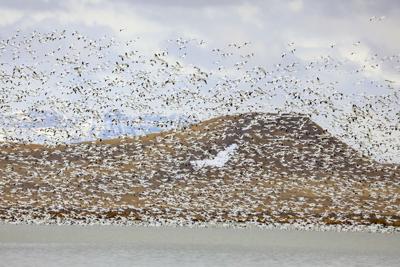
Montana in March may mark the tail end of ski season, but it also brings one of North America's most extraordinary wildlife spectacles.
At Freezout Lake, roughly 300,000 snow geese and around 10,000 tundra swans descend on the wetlands during March, turning a quiet stretch of prairie between Great Falls and Choteau into a "snowstorm of wings."
When The Prairie Sky Turns White
Every spring, snow geese and tundra swans travel thousands of miles along the Pacific Flyway from their wintering grounds in the southern United States toward their breeding areas in Alberta and Saskatchewan in Canada.
The 12,000-acre Freezout Lake Wildlife Management Area in Montana is one of the most important stops along the route because the wetlands allow birds to rest safely from predators to rebuild energy, and the surrounding barley and wheat fields provide an essential food supply.
Migration at Freezout Lake begins in early March, but the largest concentrations typically occur between mid-March and the end of the month.
The first hundred arrivals were spotted on March 1, although the first large flock of 5,400 light geese had arrived on March 9, 2026, followed by an even larger flock of 11,400 yesterday.
Bird counts grow rapidly as new flocks arrive daily from the south. According to the Montana Fish, Wildlife & Parks Story Map, in previous years, during the peak migration window between March 23 and March 26, an average of 45,000 to 52,000 light geese arrived in a single day.
Watching the Snow Goose Migration at Freezout Lake
At sunrise, snow geese leave the lake in massive waves to feed in nearby grain fields. At sunset, the process reverses as flocks glide back to the safety of the water to roost overnight.
Due to the sheer number of birds, this wildlife event is one of the most beginner-friendly spectacles in the United States.
To stand on the shores of Freezout in March, visitors need a Montana Conservation License: $8 for residents and $10 for out-of-staters. It is valid from March 1 through the end of February the following year.
The Freezout Lake Wildlife Management Area lies about 45 minutes northwest of Great Falls, Montana, along U.S. Highway 89 between Fairfield and Choteau.






It has approximately 6 miles of gravel roads that circle several wetland units. Visitors can walk around with multiple opportunities to stop at pullouts and observation points.
Because birds spread across different lake basins during the day, moving around the area often increases the chances of seeing large concentrations.
Warm clothing is often more important, as early mornings on the prairie can still be cold in March.
Visitors are encouraged to remain on designated roads and viewing areas and avoid approaching flocks too closely. Sudden disturbances can force birds to take flight unnecessarily, depleting their energy reserves.
Wild Wings Festival
The nearby town of Choteau celebrates the migration through its annual Wild Wings Festival on March 20–22, 2026.
The festival offers free guided tours of Freezout Lake, wildlife photography workshops and talks from bird experts such as Rob Domenech, Executive Director of Raptor View Research Institute.
Early morning tours are particularly popular, giving visitors a chance to witness the massive sunrise "blast-off" when geese leave the lake to feed.
The festival also includes film screenings such as the 'Flight of the Swans' at Roxy Theatre, educational programs, food trucks and a raffle.
What Else to Do Near Freezout Lake in March
Great Falls, Montana, is home to the Lewis and Clark Interpretive Center, one of the most detailed museums dedicated to the expedition, and C.M. Russell Museum, which celebrates the American West through the work of cowboy artist Charles M. Russell.
Montana is a popular hiking destination. Visitors stopping in Great Falls can also explore the five waterfalls, one of which gave the city its name. The scenic River's Edge Trail offers easy access to all waterfalls along the Missouri River.
The small town of Choteau is a gateway to the eastern edge of the Rocky Mountain Front, which stretches for roughly 200 miles along the eastern side of the Rockies. Travelers can also visit the Old Trail Museum to learn about dinosaurs and Montana's geological wonders.



(0) comments
Welcome to the discussion.
Log In
Keep it Clean. Please avoid obscene, vulgar, lewd, racist or sexually-oriented language.
PLEASE TURN OFF YOUR CAPS LOCK.
Don't Threaten. Threats of harming another person will not be tolerated.
Be Truthful. Don't knowingly lie about anyone or anything.
Be Nice. No racism, sexism or any sort of -ism that is degrading to another person.
Be Proactive. Use the 'Report' link on each comment to let us know of abusive posts.
Share with Us. We'd love to hear eyewitness accounts, the history behind an article.