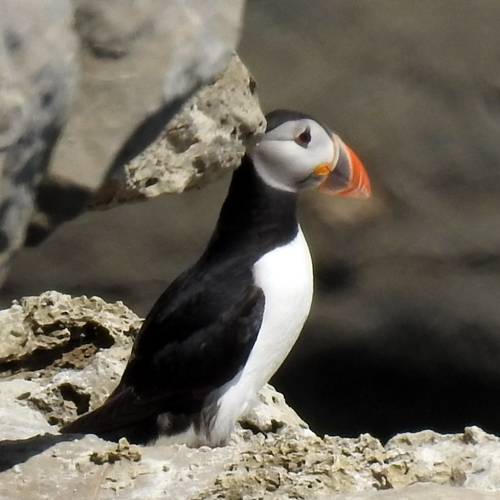
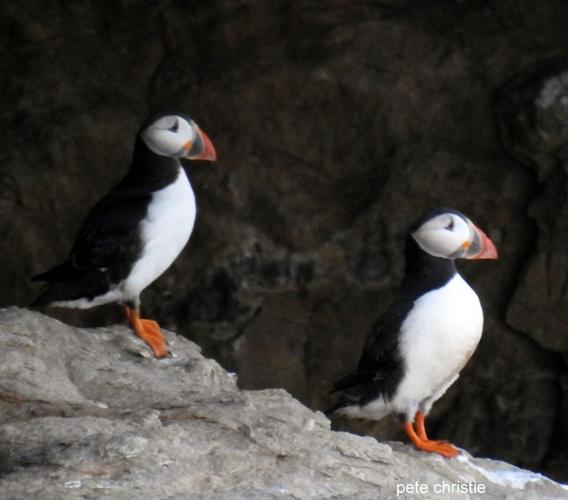
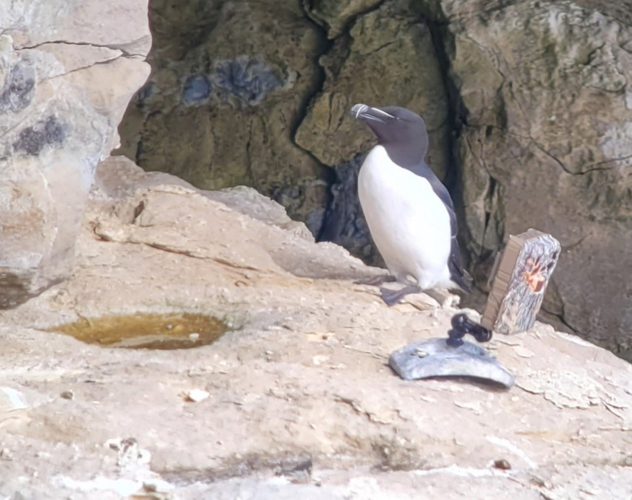

A puffin fledgling at the last colony on mainland England’s south coast has been spotted for the first time in 30 years. (Richard Caldow via SWNS)
By Lauren Beavis
A puffin fledgling at the last colony on mainland England’s south coast has been spotted for the first time in 30 years.
The rare discovery of the puffling emerging from its nest on the cliffs in Purbeck in Dorset has given conservationists hope for its population.
Volunteers say they have left have been left "thrilled" by the sighting after spending the last 15 weeks monitoring the cliffs and observing the adult puffins courting, mating, carrying nesting material, and since late-May, repeatedly delivering fish to the nests hidden deep within the crevice.
In March 2026, the National Trust renewed its efforts to understand why the last colony of these iconic birds on mainland England’s south coast has been failing to produce chicks.
Motion-sensor trail cameras were placed to look into the puffins’ deep crevice, with the aim of establishing whether predators are the problem.
Dr. Richard Caldow, who is leading the project, said: “Seeing the puffling was a great thrill, the first puffling that’s been recorded in Purbeck for a long time.
"With only three breeding pairs remaining, every chick matters.

(Richard Caldow via SWNS)
"It tells us that Purbeck puffins can still lay fertile eggs, hatch them and, at least in some years, find enough food to rear a chick and escape the attention of predators.
"One puffling alone won’t save this colony, but one is a whole lot better news than none."
Only three breeding pairs of puffins remain in Dorset - compared to more than 40 pairs in the 1950s.






The species are now one of the rarest breeding birds in Dorset and in danger of becoming extinct as a breeding bird in the county.
Dr Richard said the volunteer team from the Purbeck Natural History Forum, who spent around 150 hours monitoring the ledges, first observed fish being taken into the ledge on 31 May, with the last fish delivery recorded on 5 July.
Based on this, they have estimated the puffling to be 38 to 40 days old.
Dr. Richard, who holds a PhD in seabird ecology and has nearly 40 years’ experience researching and conserving coastal bird populations, said: "Puffins typically fledge between 38 and 44 days after hatching, so it had reached the minimum age at which it could leave the nest.”
The puffling is expected to leave the ledge and its parents under the cover of darkness and spend the next several years alone at sea.

(Richard Caldow via SWNS)
If it survives, it may return to Purbeck from around two years of age, although puffins do not usually breed until they are around four years old.
This positive news comes after the National Trust installed motion-sensor trail cameras to look into the puffins’ deep crevice in March 2026 in a bid to understand why the last colony of these birds had been failing to produce chicks.
The cameras, powered by solar panels, will be recovered after the seabird breeding season, and volunteers will then review the thousands of images taken.
Ben Cooke, Rivers and Coast project officer for the National Trust in Purbeck, said the images should hopefully reveal more of the nesting, feeding and fledging activity of the puffins.
He said: "Understanding what is happening inside the nesting crevice is the missing piece of the puzzle.
"If we can identify the reasons why chicks and eggs are being lost, we can begin to explore what conservation measures might help.
“Puffins are such an iconic bird, we want to do everything in our power to help them survive in Purbeck."

(0) comments
Welcome to the discussion.
Log In
Keep it Clean. Please avoid obscene, vulgar, lewd, racist or sexually-oriented language.
PLEASE TURN OFF YOUR CAPS LOCK.
Don't Threaten. Threats of harming another person will not be tolerated.
Be Truthful. Don't knowingly lie about anyone or anything.
Be Nice. No racism, sexism or any sort of -ism that is degrading to another person.
Be Proactive. Use the 'Report' link on each comment to let us know of abusive posts.
Share with Us. We'd love to hear eyewitness accounts, the history behind an article.