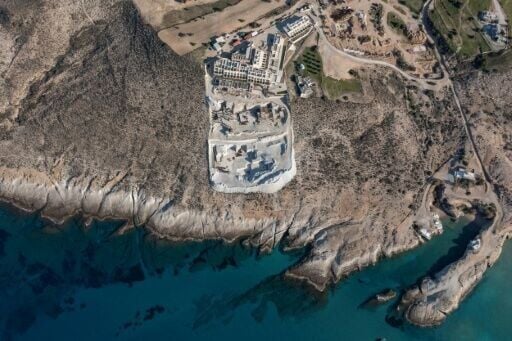
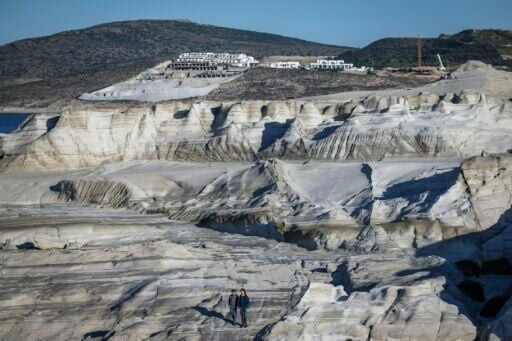
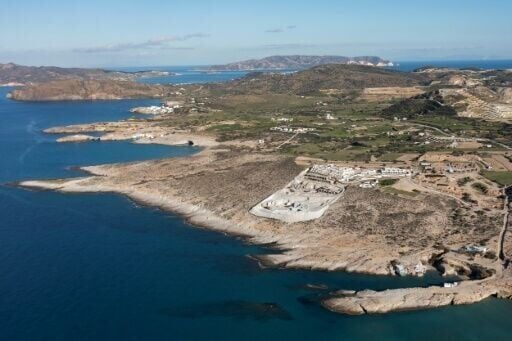
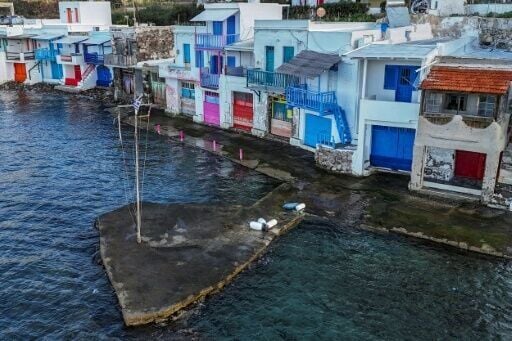
On the sloping shoreline of the Greek Aegean island of Milos, a vast construction site has left a gaping wound into the island's trademark volcanic rock.
The foundations are for a hotel extension that attracted so much controversy last year that the country's top administrative court ended up temporarily blocking its building permit.
Construction machinery still dots the site for a planned 59-room extension to the luxury resort, some of whose suites have their own swimming pools.
Milos Mayor Manolis Mikelis calls the project an "environmental crime".
"The geological uniqueness of Milos is known worldwide. We don't want its identity to change," he told AFP in his office, adorned with a copy of the island's most famous export, the Hellenistic-era statue of the love goddess Venus.
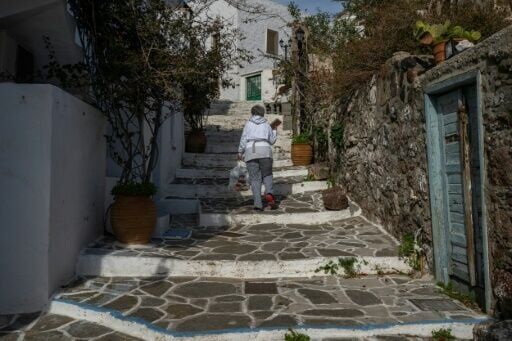
Fuelled by a tourism boom, real estate fever has broken out across the Cyclades archipelago, threatening to destroy iconic landscapes of whitewashed houses and blue church domes.
In December, several mayors from the Cyclades as well as the Dodecanese -- which includes the highly touristic islands of Rhodes and Kos -- sounded the alarm.
"The very existence of our islands is threatened," they warned in a resolution initiated by the mayor of Santorini, Nikos Zorzos.
Tourism has become "a field for planting luxury residences to sell or rent," said Zorzos, whose island -- a top global destination -- welcomes roughly 3.5 million visitors for a population of 15,500.
- Rejecting 'plunder' -
The "Cycladic islands are not grounds for pharaonic projects", the mayors continued.
V Tourism, the company operating the hotel, argues that the expansion was approved in 2024 with "favourable opinions from all competent authorities".
But Mikelis, the mayor, noted that there are legislation "loopholes" when it comes to construction.
Like Santorini, Milos is a volcanic isle that is home to one of Greece's most unique beaches, Sarakiniko.
With its spectacular white formations rounded by erosion, the so-called 'moon beach' has bathers packed tighter than an astronaut's suit during summertime.
Yet Sarakiniko is not protected under Greek law.
Another hotel project there was blocked last year, and the environment ministry has given the owners a month's time to fill in its construction dig.
- 'Voracious' -
Ioannis Spilanis, emeritus professor at the University of the Aegean, says what is happening in the Cyclades "is voracious, predatory real estate".






Once marginal land intended for grazing "have become lucrative assets. (Locals) are offered very attractive prices that are still low for investors."
"Then you build or resell for ten times more," he said.
In Ios, a small island with a vibrant nightlife, a single investor -- a Greek who made a fortune on Wall Street -- now owns 30 percent of the island, the mayors said in their December statement.
Tourism contributes between 28 and 33.7 percent of GDP, according to the Greek Tourism Confederation (SETE), making it a key sector that has propped up the country's economy for decades.
Arrivals have been breaking record after record with more than 40 million visitors in 2024, a performance that was likely surpassed in 2025.
In Milos, which has more than 5,000 inhabitants, 48 new hotel projects are currently underway, according to the mayor, and 157 new building permits were awarded from January to the end of October 2025, according to the state statistical body.
On Paros, which has also experienced a real estate frenzy for several years, 459 building permits were granted over the same period, and on Santorini, 461.
The most ambitious projects in Greece are classified as "strategic investments", a fast-track procedure created in 2019 to facilitate investments deemed priorities.
But "there's often no oversight," said Spilanis, the academic.
- Golden goose -
And many of the new constructions are far removed from traditional Cycladic architecture.
But the tourism industry is a vital source of income on islands which are usually deserted in winter, and offering few other job prospects.
"This island is a diamond, but unfortunately in recent years it’s become nothing but money, money, money," fumes a resident who spends half the year in Germany.
"But if I say that in public, everyone will jump down my throat!" she said.
In a 2024 report, the state ombudsman of the Hellenic Republic stressed the deterioration in quality of life on islands where residents can no longer find housing, as many owners prioritise lucrative short-term rentals, while waste management and water resources are also under major strain.
But there are signs of a slowdown in the Cyclades.
Santorini last year saw a 12.8-percent drop in air arrivals between June and September, while Mykonos had to settle for a meagre 2.4-percent increase.
yap/jph/gv/cc



(0) comments
Welcome to the discussion.
Log In
Keep it Clean. Please avoid obscene, vulgar, lewd, racist or sexually-oriented language.
PLEASE TURN OFF YOUR CAPS LOCK.
Don't Threaten. Threats of harming another person will not be tolerated.
Be Truthful. Don't knowingly lie about anyone or anything.
Be Nice. No racism, sexism or any sort of -ism that is degrading to another person.
Be Proactive. Use the 'Report' link on each comment to let us know of abusive posts.
Share with Us. We'd love to hear eyewitness accounts, the history behind an article.