



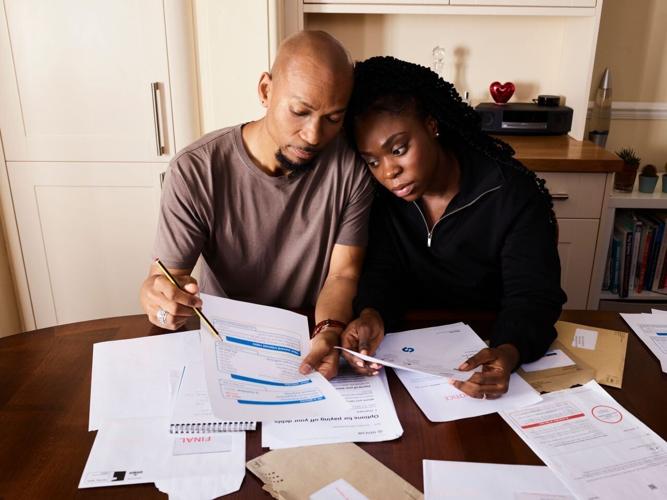


Photo by Mikhail Nilov via Pexels
By Lauren Wilkin
A couples therapist is warning people that "money scripts" might be ruining their relationships, as prices continue to rise.
Kristine Anthis, a licensed therapist and matchmaker, says: "Money scripts are the unconscious beliefs about money we absorb early in life."
She says they often come from watching our parents or caregivers, long before we ever earned a salary.
"They show up as automatic rules like 'money is for saving, not spending' or 'if you have it, enjoy it,' and most people never examine them until they collide with a partner who was raised on a different script entirely," she says.
And as bills rise, couples who are struggling financially may begin to realize their different money scripts are straining their relationship.
Kristine says there are a few common types, including:
Money avoidance - looking at how much is coming in and how much is going out feels stressful or shameful, so it's kept at arm's length
Money vigilance - safety comes from constant tracking and saving

Photo by https://kaboompics.com/ via Pexels
Money status - self-worth is tied to how much you earn or appear to have
Money worship - believing more money would finally solve your problems or make you happy.
And Kristine explains that these scripts aren't necessarily just tied to habits - but also self-worth.
"A common one is a belief that financial status determines lovability: 'I need to earn enough, spend enough, or appear successful enough to be worth staying with.'
"Underneath that script is often a part of someone that feels fundamentally not good enough or unlovable, and uses money, generosity, gifts, grand gestures, picking up every bill, as a way to try to earn love it doesn't trust it already has," explains Kristine, who runs her own therapy clinic in New Haven, Connecticut.
Because of this, Kristine believes that money decisions in a relationship are rarely just about money.






"They're about safety, trust, and whose instincts get to lead.
"What looks like a disagreement over a purchase is often really two different nervous systems reacting from two different scripts, one geared toward vigilance, one toward ease, and neither partner usually realizes that's what's happening," she adds.
And Kristine says they can be incredibly damaging, "especially when a couple keeps treating the disagreement as being about the money itself rather than what's underneath it."
Because of this, Kristine recommends you start thinking about your own script before you're even in a relationship.

Photo by Vodafone x Rankin everyone.connected via Pexels
"Get curious about your own money script, and the different parts of you that hold it.
"I always assess my matchmaking client's money scripts before introducing them to people, and inquire about such in those to whom I introduce them," she says.
"Notice whether you lead with a saving, vigilant part or a spending, generous part, and whether you can access the other one when it's actually needed, or whether you're stuck defending one no matter the situation.
"Then, as you're getting to know someone new, ask about theirs too, not as an interrogation, but as a genuine 'tell me where your instincts around money come from.'"
And it's important to remember that opposite money scripts are not necessarily a problem, Kristine - who also founded the IFS Dating & Matchmaking service - says.
"It is the rigidity (versus flexibility) to which each person holds them that contributes to major conflicts.
"I see so many couples years into a relationship who never had this conversation, and the pain that's caused.
"Months or years of one partner's generosity being read as pressure, or one partner's caution being read as rejection, could have been avoided entirely if they'd simply known this about each other, and themselves, from the start."
Offering her advice, Kristine says: "Don't assume your way of handling money is the 'normal' one and your partner's is the problem.
"And watch for the trap of trying to earn love or prove your worth through money, whether that's over-spending to feel valued or over-saving to feel safe."
The therapist says neither actually resolves the fear driving it, and both tend to pull a partner into reacting from their own fear instead of meeting the real issue.
"And if you notice yourselves swapping roles over time... that's often a sign the couple has been managing each other's anxiety instead of talking about what's actually going on underneath."
(0) comments
Welcome to the discussion.
Log In
Keep it Clean. Please avoid obscene, vulgar, lewd, racist or sexually-oriented language.
PLEASE TURN OFF YOUR CAPS LOCK.
Don't Threaten. Threats of harming another person will not be tolerated.
Be Truthful. Don't knowingly lie about anyone or anything.
Be Nice. No racism, sexism or any sort of -ism that is degrading to another person.
Be Proactive. Use the 'Report' link on each comment to let us know of abusive posts.
Share with Us. We'd love to hear eyewitness accounts, the history behind an article.