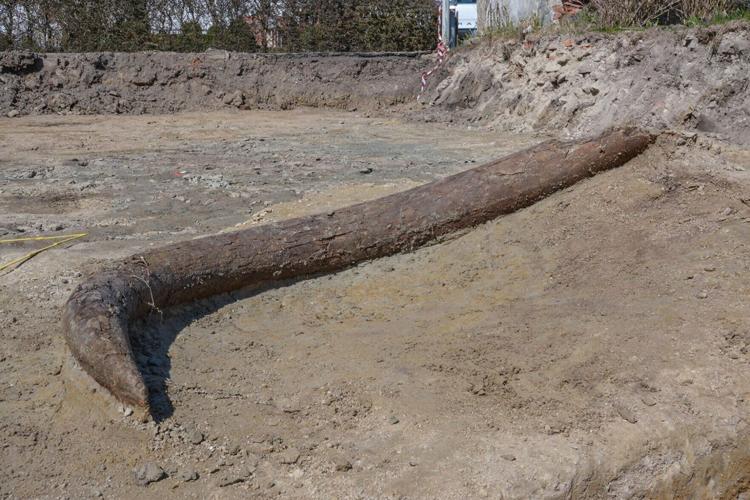

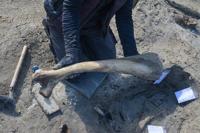

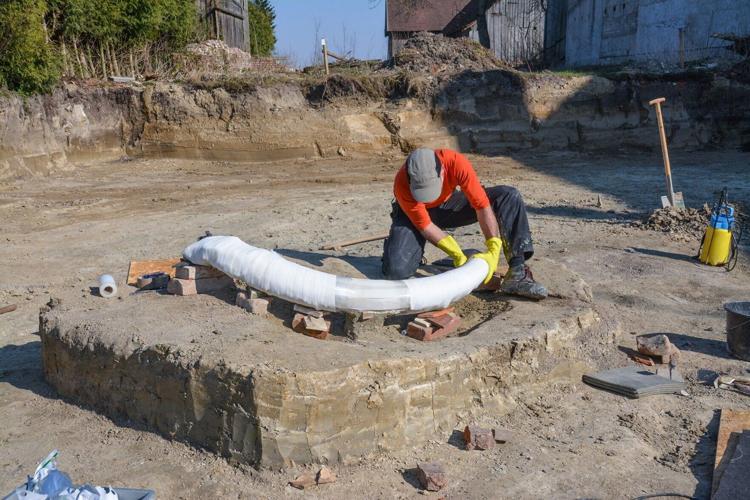

The mammoth’s tusk at the excavation site in Taimering, Germany. (BLfD via SWNS)
By Stephen Beech
A recently discovered woolly mammoth was likely butchered by Ice Age hunters around 25,000 years ago, according to new research.
They even used one of the rib bones as a cutting board, scientists say.
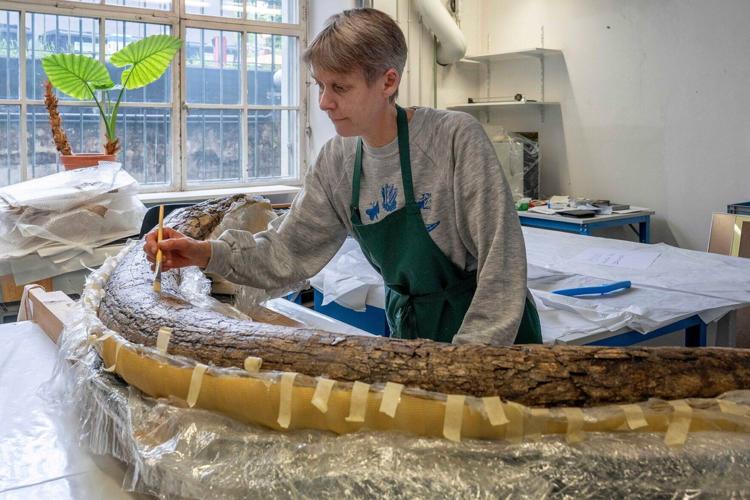
The remains — including an "exceptionally well-preserved" nearly 2.5-meter-long (8.2-foot) spirally twisted tusk — were discovered six years ago during building work in the village of Taimering in Bavaria, Germany.
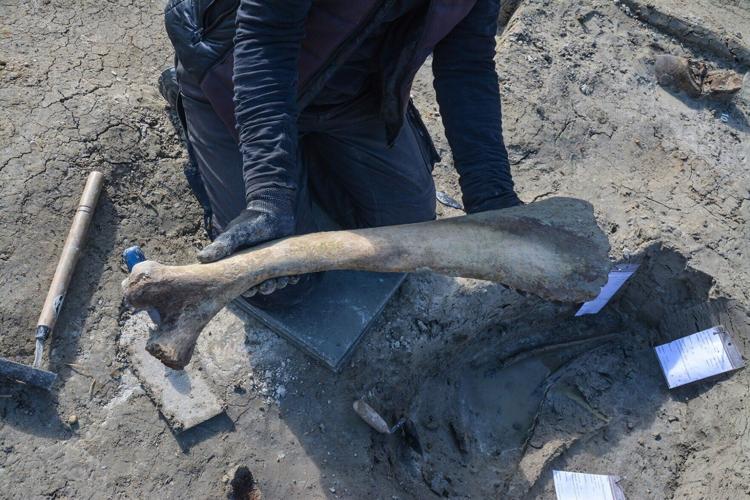
Archaeologists also found more than 70 additional bones and bone fragments nearby, primarily from the rib cage as well as hand and foot bones.

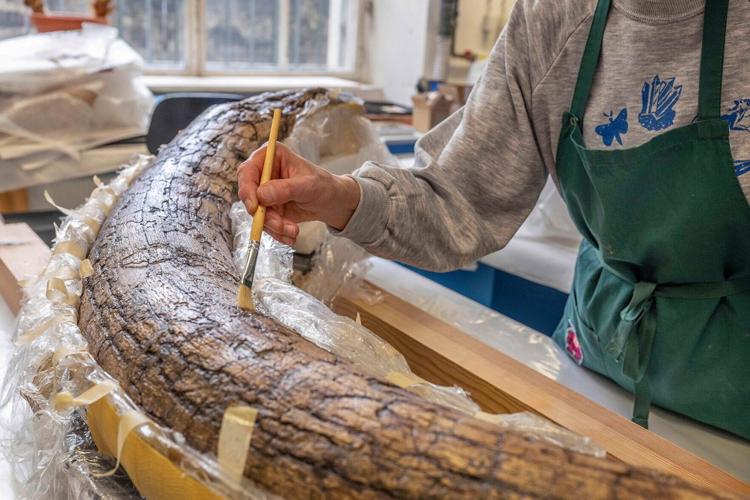
The mammoth’s tusk in the paleontological preparation laboratory of the Bavarian State Collections of Natural History. (K. Hagemann / SNSB via SWNS)
Most of the long bones of the large mammal are missing.
But Dr. Christoph Steinmann, from the Bavarian State Office for the Preservation of Historical Monuments, said: “The mammoth’s tusk and bones were exceptionally well-preserved due to their millennia-long conservation in the wet soil environment."
Following their recovery, the remains were taken to the Bavarian State Collections of Natural History, and further scientific investigations were coordinated from there.
The paleontological assessment revealed that all the bones, as well as the tusk, belong to a single, "very large but not yet fully grown" individual with a shoulder height of around 3 meters (9.8 feet).

Recovery of the first left rib from the mammoth’s ribcage. (BLfD via SWNS)
The findings, published in the Journal of Archaeological Science, suggest that the Taimering woolly mammoth likely died directly at or at least near its discovery site.
Study lead author Dr. Kerstin Pasda said: "The bone surfaces, which have been preserved intact down to the finest detail, rule out both prolonged transport by water and disarticulation by predators.
"The animal was buried in the sediments of a pond or a slow-flowing tributary of the prehistoric Danube River during the Ice Age."
Radiocarbon dating indicates a geological age of the bones between 27,000 and 25,000 years ago.






The mammoth’s tusk in the paleontological preparation laboratory of the Bavarian State Collections of Natural History. (K. Hagemann / SNSB via SWNS)
Pasda, who conducted the osteoarchaeological analysis of the anthropogenic modifications, said: "Unusual markings on the surface turned out to be cut marks and provide clear evidence of human activity.
"Numerous such indentations are found exclusively on the ribs — made by Paleolithic hunters and gatherers who butchered the animal.
"One of the broad rib bones was even used as a cutting board."
Pasda, from the Institute of Prehistory and Early History at the Friedrich-Alexander-University Erlangen-Nürnberg, added: "Whether the mammoth was killed by humans or had already been dead when people processed the carcass remains unclear."

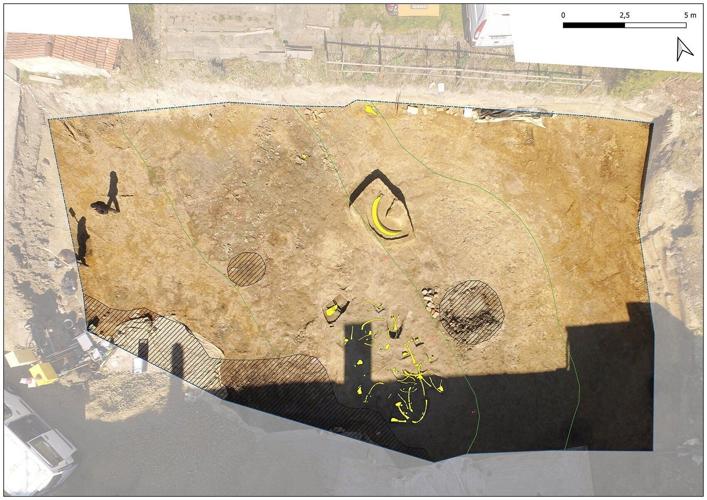
View of the excavation site; the mammoth’s bones and tusk are marked in yellow. (Kreisarchäologie Landshut, edited by BLfD via SWNS)
Pollen analysis conducted by Dr. Philipp Stojakowits, from the University of Augsburg, revealed a lot to the research team about the habitat in which the mammoth lived and died.
It indicated a herbaceous, tundra-like steppe vegetation with scattered dwarf shrubs.
The so-called "Mammoth Steppe" was a vast treeless ecosystem in Eurasia that, during the peak of the last glacial period between 30,000 and 20,000 years ago, stretched across Europe between the Scandinavian ice sheet and the southern glaciers of the Alps.
Its nutrient-rich grasses and dwarf shrubs provided food for a range of large mammals, including the Taimering mammoth.

A staff member of the Bavarian State Office for the Preservation of Historical Monuments (BLfD) recovering the mammoth’s tusk. (BLfD via SWNS)
Dr. Gertrud Rössner, a paleontologist at the Bavarian State Collections of Natural History, says the discovery is "exceptional" in many respects.
She said: “First of all, mammoth skeletal remains are extremely rare in our latitudes.
"We are familiar with finds mainly from regions of Eurasia further to the east."
Archaeology Professor Andreas Maier, of the University of Cologne, added: “On the other hand, there is virtually no evidence of human activity in this region from that peak period of the Ice Age.
"Due to climate change, hunter-gatherer communities in Europe retreated southward and eastward.”

(0) comments
Welcome to the discussion.
Log In
Keep it Clean. Please avoid obscene, vulgar, lewd, racist or sexually-oriented language.
PLEASE TURN OFF YOUR CAPS LOCK.
Don't Threaten. Threats of harming another person will not be tolerated.
Be Truthful. Don't knowingly lie about anyone or anything.
Be Nice. No racism, sexism or any sort of -ism that is degrading to another person.
Be Proactive. Use the 'Report' link on each comment to let us know of abusive posts.
Share with Us. We'd love to hear eyewitness accounts, the history behind an article.