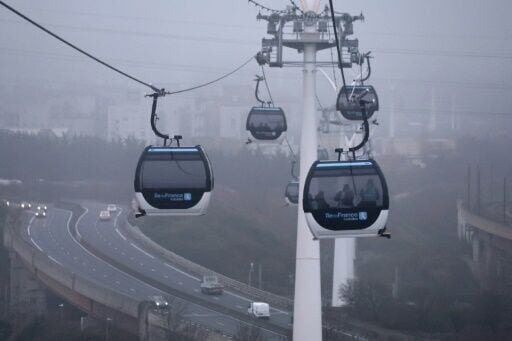

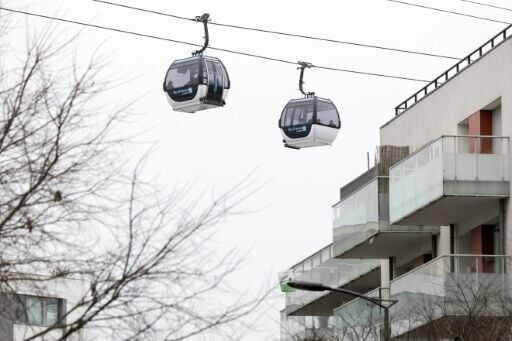
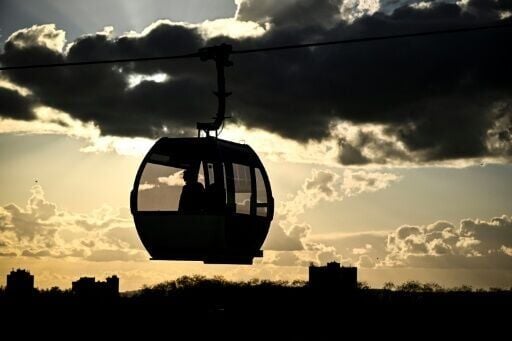



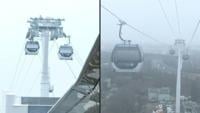
Gondolas floated above a cityscape in the southeastern suburbs of Paris on Saturday as officials unveiled the first urban cable car in the French capital's region.
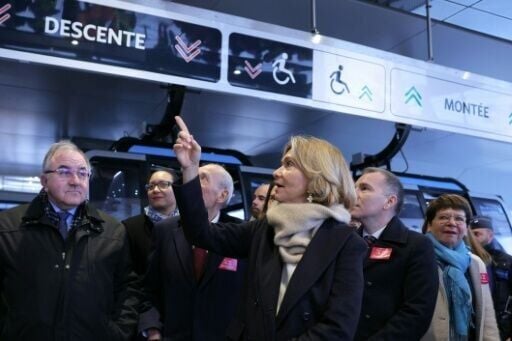
Authorities inaugurated the C1 line in the suburb of Limeil-Brevannes in the presence of Valerie Pecresse, the head of the Ile-de-France region, and the mayors of the towns served by the cable car.
The 4.5-kilometre route connects Creteil to Villeneuve-Saint-Georges and passes through Limeil-Brevannes and Valenton.
Historically used to cross rugged mountain terrain, such systems are increasingly being used to link up isolated neighbourhoods.
"It's like skiing!" joked Ibrahim Bamba, a 20-year-old student who lives in Limeil-Brevannes which is not served by the Paris metro or any rail network.
"It's the Alps on the Marne!" said Pecresse, referring to the department of Val-de-Marne located in the Grand Paris metropolis.
The cable car will carry some 11,000 passengers per day in its 105 gondolas, each able to accommodate ten passengers.
The total journey will take 18 minutes, including stops along the way, compared to around 40 minutes by bus or car, connecting the isolated neighbourhoods to the Paris metro's line 8. A ride requires a bus ticket or travel pass used for the Paris metro.
"This is a great step forward in terms of transportation. The roads are often congested in the morning," said Salimatou Bah, 52, who has lived in Limeil-Brevannes for thirteen years.
"We wondered if people would be hesitant, but I think it just takes a little time to adapt."
- 'Urban divides' -





Pecresse said the project was the result of "a 10-year obstacle course."
"We had to find the funding, convince local residents," she said. "For the inhabitants of Val-de-Marne, it's a sign of consideration."
The 138-million-euro project was cheaper to build than a subway, officials said.
"An underground metro would never have seen the light of day because the budget of more than billion euros could never have been financed," said Gregoire de Lasteyrie, vice-president of the Ile-de-France regional council in charge of transport.
Each cabin can accommodate ten seated passengers as well as wheelchairs, bicycles, and strollers. Inside, video surveillance and emergency call buttons have been installed to ensure passenger safety in addition to staff at each station.
The cable car is a response to "urban divides" in neighbourhoods that were "lacking in terms of public transport," said Metin Yavuz, mayor of Valenton, a town of 16,000 inhabitants.
It is France's seventh urban cable car, with aerial tramways already operating in cities including Brest, Saint-Denis de La Reunion and Toulouse.
France's first urban cable car was built in Grenoble, nestled at the foot of the Alps, in 1934. The iconic "bubbles" have become one of the symbols of the southeastern city.
Cable cars are considered one of the safest means of transport in the world.
In France, the last fatal accident occurred in 1999 in the Hautes-Alpes, when 20 people lost their lives.
bur-rr-im-as/gv


(0) comments
Welcome to the discussion.
Log In
Keep it Clean. Please avoid obscene, vulgar, lewd, racist or sexually-oriented language.
PLEASE TURN OFF YOUR CAPS LOCK.
Don't Threaten. Threats of harming another person will not be tolerated.
Be Truthful. Don't knowingly lie about anyone or anything.
Be Nice. No racism, sexism or any sort of -ism that is degrading to another person.
Be Proactive. Use the 'Report' link on each comment to let us know of abusive posts.
Share with Us. We'd love to hear eyewitness accounts, the history behind an article.