
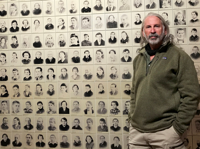
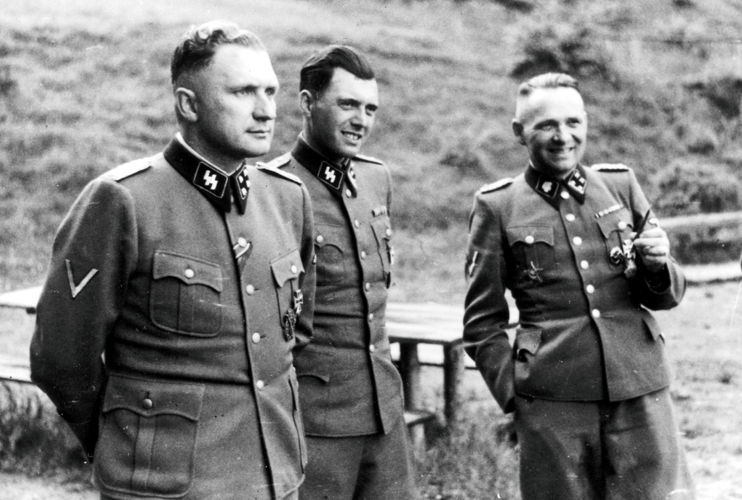

(Richard K. Lowy via SWNS)
The Nazis secretly used blood from Jewish prisoners to keep their wounded alive in a practice that has stayed hidden for more than 80 years, according to a new book.
Hitler’s henchmen received life-saving transfusions from inmates at Auschwitz in what has been described as the Holocaust’s “cruellest irony of them all”, the new research claims.
Around 1.1 million people were murdered at Auschwitz between 1940 and 1945 as part of the Nazis’ plan to eradicate Europe’s Jewish population in pursuit of racial purity.
But despite the regime denouncing Jews as the “parasites” and “bacilli” of Europe, their blood was forcibly taken to save German soldiers’ lives, according to new accounts from prisoners.
The transfusions were never recorded by camp authorities — including its so-called “Doctor Death,” Josef Mengele — and there is no trace of the practice in Nazi documentation.
Now, a 25-year research project by Canadian historian and filmmaker Richard K. Lowy claims that such a transfusion took place inside Mengele’s medical compound, where twins and dwarves were subjected to blood procedures, measurements, and other experiments.
Lowy uncovered the revelation during interviews with his late father, Auschwitz survivor and Mengele twin Leopold Lowy, for a TV documentary.
Leopold describes lying on a table in the camp’s medical block as blood was forcibly taken from him and transfused into a severely injured SS guard.
The testimony appears in Lowy’s new book,â¯Kalman & Leopold: Surviving Mengele’s Auschwitz, recently published to coincide with Jewish Book Week.

(Richard K. Lowy via SWNS)
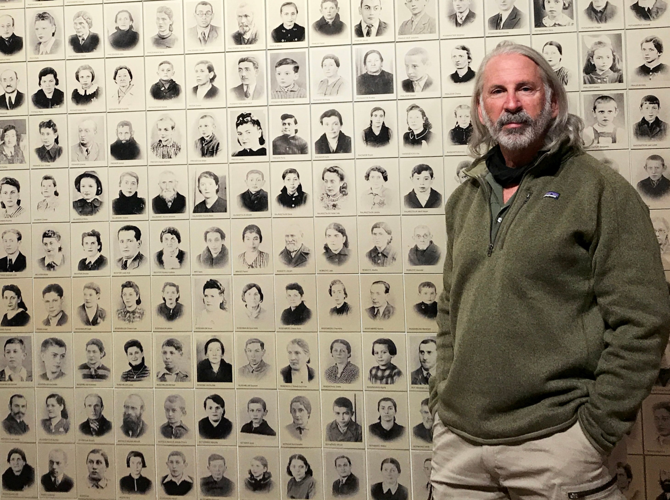
Speaking from his home in Vancouver, Canada, Lowy said: “The Nazi regime was built on the doctrine of removing what it called non-Aryan blood from Europe. For decades that belief went unchallenged.
“We now have proof, from inside Auschwitz at least, Jewish blood was taken from a prisoner to keep an SS guard alive.”
He added: “It’s hard to believe this was a one-time event. Until now, there has been no documented evidence that the Nazis systematically used Jewish blood donors, but the fact that my father’s blood was used to keep an SS guard alive makes you wonder how many others may have been similarly forced.
“That is the cruellest irony of all.”
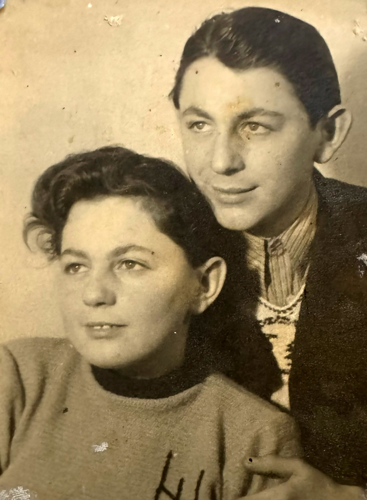
Leopold and another boy, Kalman Braun, spent more than nine months at Auschwitz and were among roughly 3,000 twins kept alive for study by Josef Mengele.
Mengele’s aim was to advance the regime’s obsession with racial purity by identifying, comparing, and categorising what it called “non-Aryan blood.”
He carried out measurements, blood draws, X-rays, and other experiments in pursuit of Hitler’s racial programs.
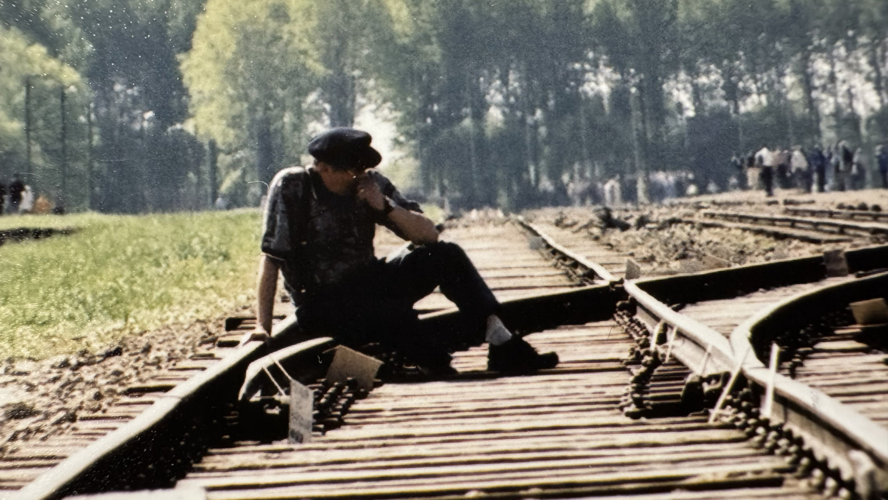
Aged 16 and 14, the boys were thrown together and worked for six months in an SS guard shack beside the crematoria and the open-air fire pit.
From there they watched camp selections, trucks carrying prisoners to the gas chambers and fire pit, bodies taken to the Leichenhalle, the morgue serving the ovens, the only uprising in the camp, and the liquidation of the Roma (Gypsy) camp.
They endured Mengele’s procedures themselves, subjected to repeated blood lettings, anatomical inspections, and injections, and witnessed the results of unanesthetized operations on other prisoners from their barracks, who did not survive their encounters with the doctor.
By the time Auschwitz II-Birkenau was liberated by Soviet forces, almost everyone who had entered the camp with the boys was dead, including Kalman’s grandparents and Leopold’s entire family.
Remarkably, Kalman’s twin sister Judith and Leopold’s twin sister Miriam also survived.
Very little testimony survives from the medical camp and laboratories inside Birkenau, and almost none comes from teenagers. Until now, no survivor testimony had emerged from an SS guard shack — let alone from the guard shack at Mengele’s hospital camp.

(Richard K. Lowy via SWNS)
Detailed first-hand accounts from Mengele’s twins are rarer still. It was during these interviews that the Nazis’ secret blood transfusions emerged in full.




Leopold revealed his own blood had been used to keep an SS guard — likely responsible for the deaths of thousands of Jews — alive. The guard had been critically injured during the Sonderkommando uprising on 7 October 1944, when prisoners attacked guards and damaged part of the crematoria complex.
Leopold recalled being taken into a medical room at Crematorium II where the wounded guard lay on one of two stone tables fitted with drains for blood. Leopold was placed on the other. A doctor then inserted a tube into his arm and another into the guard, and for more than an hour his blood flowed directly into the man beside him until he became too weak to stand.
“There’s no discussion, no notice. I’m cleaned up and laid out on one of the tables. On the other, already lying down, is an SS,” Leopold says.
“He must have been injured in the uprising, brought here for medical treatment. A doctor takes my arm and puts a needle with a tube in me. The other end of this tube also has a needle and is put into the SS. They start transferring my blood. Lying here I’m scared, not batting an eyelash, getting weaker, shaking, so frightened. Nothing is said to me.”
“For over an hour they drain me dry to save his life. I don’t see the SS guard’s face. He doesn’t see mine. Just two tables, side by side with two tubes, me to him.”
“When there’s no more to give, they take the tubes out. I am so weak I can’t get off the table. I’m picked up and carried out to the van then literally dropped in front of my barrack with an extra piece of bread. I wonder if I’m going to die right here.”
There is no Nazi documentation of this, or of any similar transfusion — something that would have been kept secret to protect the regime’s “pure Aryan blood” doctrine and avoid exposing the contradiction it created.
Lowy said: "When blood is incompatible, transfusions trigger immediate, life-threatening reactions.
“But my father gave his blood to a wounded SS guard for over an hour, and the guard survived, proving that Jewish blood was fully compatible with the pure Aryan German blood.
“Despite the lies of hatred, our blood is the same — proof that no race, faith, or people is ever ‘less than’ another.”
Leopold’s account is corroborated by Miklós Nyiszli, a Jewish prisoner-doctor forced to work under Mengele, who wrote in his 1946 memoir of treating badly wounded SS guards inside the same medical complex after the uprising.
It is also supported by Kalman’s testimony, which confirms the layout of the Birkenau hospital camp, the presence of medical barracks used for blood procedures, the position of the guard shack beside the crematoria, and the constant movement of twins in and out of the medical rooms for examinations and blood draws.

(Richard K. Lowy via SWNS)
Historian Dr. Linda Parker said the strength of Leopold’s testimony, Kalman’s description of the setting, and Nyiszli’s memoir placed the incident firmly within the known geography and routines of Birkenau’s medical compound.
She added: “SS guards at Auschwitz were routinely injured by prisoners and in construction and engineering accidents, so when you line up the eyewitness testimony with what we know about how that part of the camp functioned, it is entirely plausible that Leopold’s transfusion was one of a great many.”
After liberation, Leopold and Kalman were separated and settled in different parts of the world, losing contact for decades. By chance, Kalman saw Lowy’s documentary on Israeli TV and recognised the boy he had last seen and had been searching for since January 1945.
The two men were finally reunited in Canada in 2002, at Leopold’s home in Vancouver, after nearly 60 years. Leopold died six months after the reunion, and Kalman — who recorded his own testimony with Lowy — passed away in 2019.
His father’s death prompted Lowy to begin the painstaking work of documenting, organising, and verifying their memories — work he has pursued for more than two decades.
Between 2002 and 2025, Lowy transcribed countless hours of testimony from the two men about their experiences and cross-checked their recollections against records held at Auschwitz, Yad Vashem, the US Holocaust Memorial Museum, and historical archives to confirm names, dates, procedures, and locations.
Now Lowy has finally published their unchanged testimonies in the hope that future generations will understand how easily racial hatred grows and the devastating consequences if it is left unchecked.
His book,â¯Kalman & Leopold: Surviving Mengele’s Auschwitz, has been described as a work of Holocaust testimony that sits alongsideâ¯The Diary of Anne Frankâ¯in the importance of preserving a rare eyewitness record.
He is now encouraging people from all religions, communities, and backgrounds to use the simplest tools available — a smartphone or basic recorder — to preserve audio and visual conversations with those who witnessed historic events before they pass away.
These recordings can then be sent to archives, museums, and memorial organisations that collect testimony, or simply passed on within the family, ensuring descendants know the family’s history and their stories are never lost.
He said: “The discovery of this secret Nazi transfusion is why preserving testimony matters.
“If we don’t record these voices while we still can, other revelations — perhaps even more shocking than this — will be lost forever.”



(0) comments
Welcome to the discussion.
Log In
Keep it Clean. Please avoid obscene, vulgar, lewd, racist or sexually-oriented language.
PLEASE TURN OFF YOUR CAPS LOCK.
Don't Threaten. Threats of harming another person will not be tolerated.
Be Truthful. Don't knowingly lie about anyone or anything.
Be Nice. No racism, sexism or any sort of -ism that is degrading to another person.
Be Proactive. Use the 'Report' link on each comment to let us know of abusive posts.
Share with Us. We'd love to hear eyewitness accounts, the history behind an article.