American travelers set records in France last year, yet most never made it past the Riviera coastline to Cotignac, a Provence village at the foot of a sheer rock face. Those who drive an hour inland find hotel rooms carved into the cliff, a Michelin-recognized kitchen and the rosé producer whose bottles already sit on U.S. shelves.
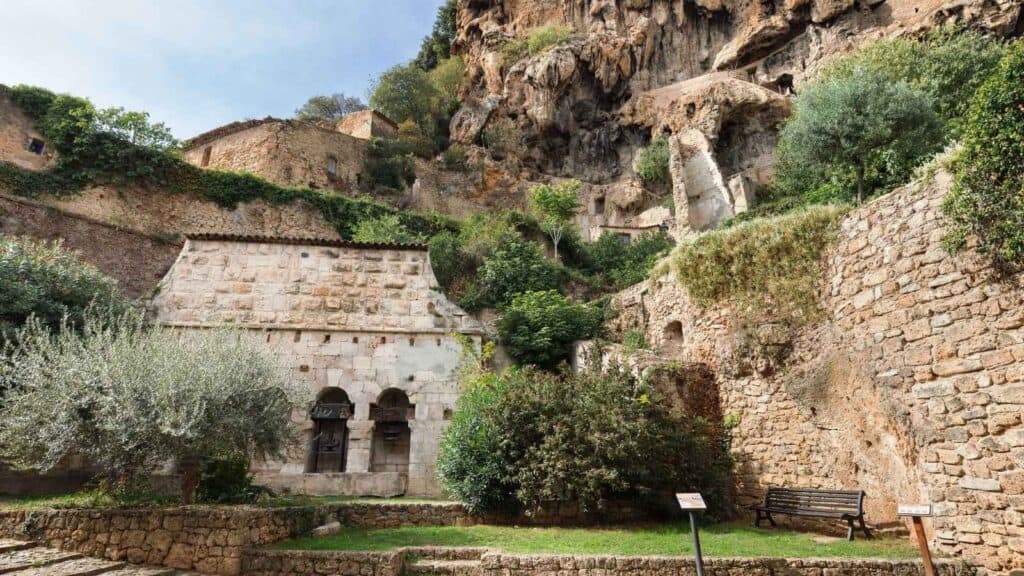
Cotingnac is in the South of France, about an hour from the Mediterranean, and its oldest homes are dug straight into the stone. Saint-Tropez gets the crowds down on the coast; Cotignac has spent 50 years quietly hosting famous names who didn’t want to be found.
The Provence village most American itineraries miss
France welcomed a record 102 million international visitors in 2025, and arrivals from the United States grew by more than 10%. Traditionally, international visitors gravitate toward Paris, the Riviera and the lavender country around Aix-en-Provence, leaving the green interior largely to the French.
Cotignac joined Les Plus Beaux Villages de France, the independent association that maintains France’s best-known list of its most beautiful villages, in 2022. It remains 1 of only 7 in the surrounding Var region to hold the label, and one look explains why: the buildings back directly onto the rock.
The cliff, cut by the Cassole river, runs 1,300 feet long and 260 feet high, with two medieval watchtowers at the summit and a secured path behind the town hall that climbs past the old cave homes. Below, the Cours Gambetta stretches through the village center under ancient plane trees, with cafes along its length and a Tuesday market selling local produce and crafts.
Sleeping inside the rock at Lou Calen
Guests at La Troglodyte sleep with a 260-foot-high cliff for a headboard. The bedroom and shower are cut into the bare limestone, the same rock that hid villagers during medieval raids, and a glass-walled living area opens the cave to the Provence sun. It is the closest a luxury hotel gets to living the way Cotignac’s first residents did, minus the invading armies. A second cave room is in the works at Lou Calen, whose 7-acre estate holds more than 30 rooms and gardens, with olive trees and vegetable beds supplying the kitchens a few steps away.
The hotel has been attracting notable guests since it opened in 1971: Yvonne de Gaulle, widow of French President Charles de Gaulle, stayed for a month in 1972, and singer Joe Dassin held his 500-guest wedding here in 1978. It closed in 1999 and sat dark until Canadian entrepreneur Graham Porter bought it in 2015. He reopened it in stages, finishing in June 2024 with the last guest rooms and O Fadoli, a bar on the main square devoted to pastis, the anise-flavored aperitif of southern France. The full history, including the nuns who ran the building before it ever took a paying guest, is told in the story of Lou Calen.
A Michelin chef who said no to the stars
The estate’s fine dining restaurant holds a Michelin Green Star, an award the guide created for restaurants leading the way in eco-responsible cooking. The chef behind it trained in Lyon under Paul Bocuse and spent more than 15 years with Alain Ducasse, including the three-star Louis XV in Monaco and the Bastide de Moustiers, before running kitchens at Monaco’s Hotel Hermitage. He says that when Michelin contacted him about his Cotignac kitchen, he asked to be left out of the star rankings; the Green Star was the only recognition he wanted.






Benoit Witz, chef of Jardin Secret at Lou Calen, says, “The biggest challenge is to make people happy with simple products coming from this area.”
Dinner at Jardin Secret comes with no printed menu. Witz proposes the evening’s dishes and swaps courses for guests who prefer fish over meat or vegetables over both. The kitchen wastes almost nothing; asparagus peels go into stocks, and trimmings turn into butters and sauces. A weekly three-course lobster lunch changes every time it appears. Meals run two, three or four hours, and early arrivals get a glass of wine and a walk in the gardens instead of a rushed table.
The rosé Americans already drink comes from this corner of Provence
In 2009, Stephen and Jeany Cronk sold their London home, packed up three children and moved to Provence, barely speaking a word of French. The rosé brand they launched from a spare room the next year, Maison Mirabeau, now sells in more than 40 countries, sits on Forbes’ list of the world’s top 50 wine brands and drew a majority investment from Chilean wine giant Concha y Toro in February 2026.
Americans don’t need a plane ticket to taste it; the wine is available across the United States. The bigger reason to visit is the family’s tasting room in the center of Cotignac, which pours the full lineup, including wines from Domaine Mirabeau, the first vineyard in France to earn both Regenerative Organic Certification and Certified Regenerative status.
Plan a trip from the United States
Marseille Provence Airport is the most direct gateway; Cotignac is about an 80-minute drive via the A8 highway. Nice works for travelers pairing the trip with the Riviera coast, and high-speed TGV trains stop at Les Arcs-Draguignan, roughly 50 minutes away by car.
A rental car is essential for both the transfer and the day trips to the limestone canyons of the Verdon Gorge, hilltop neighbors like Tourtour and the surrounding wine country. Spring and fall bring mild weather without the crowds. Summer brings markets, festivals and open-air concerts at the base of the cliff.
Cotignac won’t stay quiet
Gordes and Saint-Paul-de-Vence were quiet villages once, before the day-trip buses found them. Cotignac now has the finished hotel, the recognized restaurant, the globally backed wine brand and the official label that tends to precede that kind of discovery. What it does not yet have is the crowd, and that is unlikely to last.
Mandy Applegate is a luxury travel and fine dining journalist who has covered destinations across 47 countries, with a focus on high-end experiences and distinctive adventures. She is a co-founder of Food Drink Life, where she writes about travel, food and culture for a global audience. Her work is distributed through the Associated Press wire and appears in major U.S. outlets, including NBC, the Chicago Sun-Times, the Boston Herald and the Daily News.
The post Sleep in caves in Cotignac, the French town you’ve never heard of appeared first on Food Drink Life.

(0) comments
Welcome to the discussion.
Log In
Keep it Clean. Please avoid obscene, vulgar, lewd, racist or sexually-oriented language.
PLEASE TURN OFF YOUR CAPS LOCK.
Don't Threaten. Threats of harming another person will not be tolerated.
Be Truthful. Don't knowingly lie about anyone or anything.
Be Nice. No racism, sexism or any sort of -ism that is degrading to another person.
Be Proactive. Use the 'Report' link on each comment to let us know of abusive posts.
Share with Us. We'd love to hear eyewitness accounts, the history behind an article.