Fear starts to grip lorry driver Zakeriya Hersi whenever he reaches the edge of the central Somalian plains.
The 36-year-old must constantly scan the desolate, drought-ravaged terrain for loose wires and suspicious debris. Decades of war have left these plains littered with landmines and unexploded ordnance.
Lately, there is an additional fear for Hersi, whose name has been changed to protect him from reprisals.
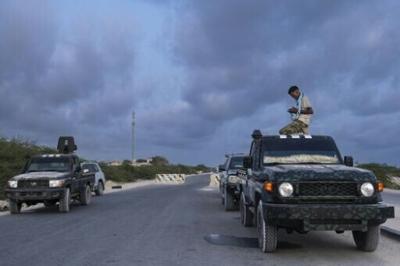
In 2022, the government started arming clan militias to fight off Al-Shabaab, the local Al-Qaeda affiliate that has waged war against the state for two decades.
The offensive saw major successes against the insurgents, but locals like Hersi say the militias that replaced them proved to be even worse.
"We can't even breathe because of the fear of the militias," said Hersi, who regularly drives goods lorries from Bosaso port in the far north of Somalia to Hiiraan province where he lives.
"At every checkpoint, we are forced to stop at gunpoint, we are extorted, and we risk losing our lives even when we pay," he told AFP.
"These were the same ones we supported, but now we fear them more than anything."
- Drunken militias -
Al-Shabaab runs a parallel state in many parts of Somalia, collecting taxes, running courts and public services.
They are often brutal to those who oppose them, and the Hawadle clan who dominate Hiiraan enthusiastically joined the government's offensive in 2022 and 2023, helping drive Al-Shabaab out of dozens of towns and villages.
Yet what came next was even worse, say some locals.
Under Al-Shabaab, "we would pay taxes and be able to transport our goods without issue," said another driver, Bashar Ali, whose name has also been changed.
Now, Ali performs "wudu" -- the Islamic cleansing ritual -- before every drive, in the hope of divine protection.
In December 2024, a militiaman opened fire towards his passenger bus as he approached a checkpoint near the town of Mataban.
"He demanded $200. I could smell the alcohol on his breath," said Ali. When he gave $20, the militiaman grabbed his phone and shot it to pieces.




"He raised the AK47 to my chest. When he pulled the trigger no shot came out. He lost his balance and collapsed to the floor because he was so drunk."
- Somali clans' influence -
The government's offensive against Al-Shabaab emulated the "Sunni Awakening" strategy of the United States in Iraq in the 2000s, when it backed Sunni Arab tribes against Al-Qaeda.
In Somalia, the biggest beneficiary was the Hawadle clan, which formed militias known as Macwiisley after the traditional sarongs they wore, and were showered with weapons and logistical support by the government.
Arming the Hawadle yielded vital local intelligence, manpower and legitimacy to the government, but pushed rival clans further into the arms of Al-Shabaab, and gave the Macwiisley free rein over the local population.
"Clans are the essential currency of Somali politics and you cannot fight without them, but that doesn't mean you can build a state through them either," said Jethro Norman, a researcher with the Danish Institute for International Studies.
In February 2025, the head of the military court in Mogadishu told local reporters that rights abuses by the Macwiisley, including killings and sexual violence, now dominated its caseload.
And when Al-Shabaab launched a counter-offensive last year, the government did little to help, having shifted the focus of its military strategy to other regions.
The government did not respond to a request for comment for this article.
- Al-Shabaab tactics -
Al-Shabaab took back at least 14 towns and districts in Hiiraan last year, and 28 more in neighbouring Middle Shebelle, according to a tally by an AFP journalist in Somalia.
"The government exploited local resentment towards Al-Shabaab but left us when it was needed the most," said Amina Hussein, 23, a resident in Beledweyne, Hiiraan's capital.
Al-Shabaab used new, softer tactics during the counter-offensive, said Norman.
"Rather than collectively punishing communities... the group contacted clan elders by phone before retaking areas, offered reconciliation, and let Macwiisley fighters keep their weapons in exchange for standing down."
This has created Al-Shabaab's "most powerful narrative in years: the government cannot protect you, cannot hold territory, cannot deliver on its promises," Norman said.
str-er/rlp/lb



(0) comments
Welcome to the discussion.
Log In
Keep it Clean. Please avoid obscene, vulgar, lewd, racist or sexually-oriented language.
PLEASE TURN OFF YOUR CAPS LOCK.
Don't Threaten. Threats of harming another person will not be tolerated.
Be Truthful. Don't knowingly lie about anyone or anything.
Be Nice. No racism, sexism or any sort of -ism that is degrading to another person.
Be Proactive. Use the 'Report' link on each comment to let us know of abusive posts.
Share with Us. We'd love to hear eyewitness accounts, the history behind an article.