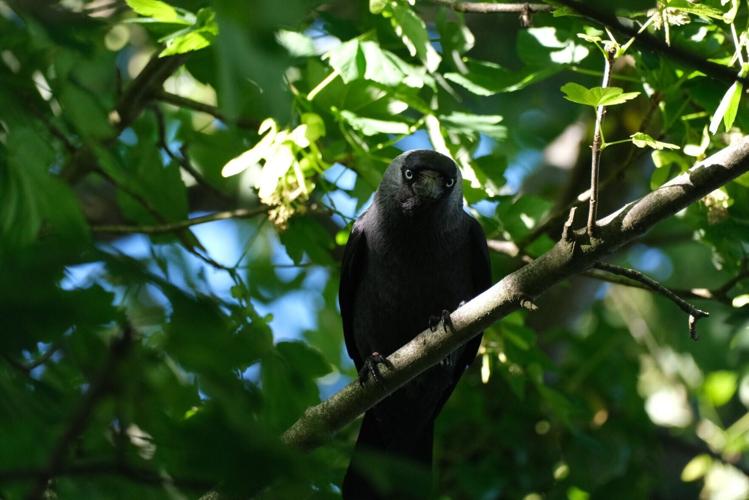
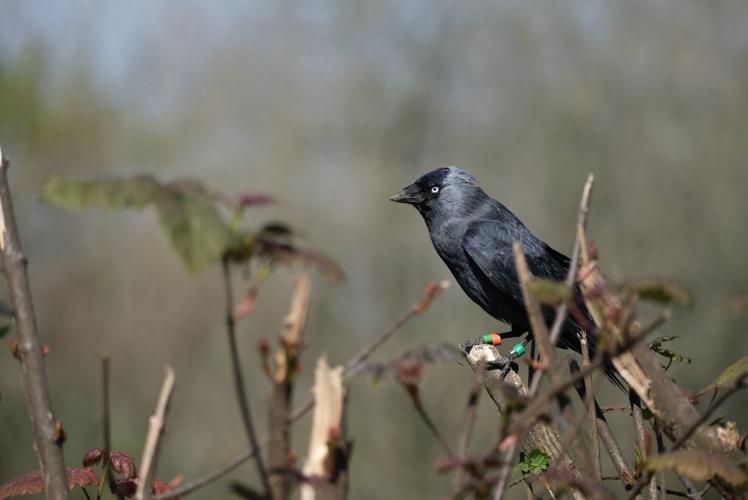
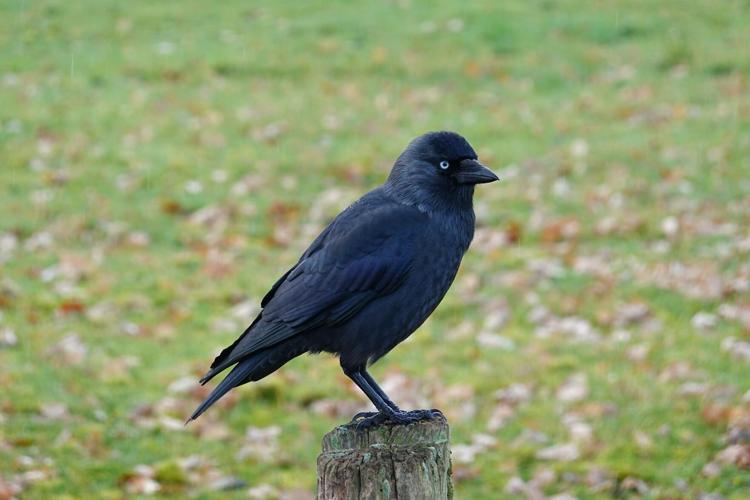

Adult jackdaw showing anti-predator vigilance. (Céline Giorgetti via SWNS)
By Stephen Beech
Jackdaw chicks learn about predators by listening to adults, reveals new research.
Scientists played recordings of predator calls to chicks in their nests – and paired the sounds with either adult jackdaw “alarm” calls or “contact” calls that indicate no danger.
Chicks that heard predator sounds paired with alarm calls learned to fear the predator – becoming more vigilant on hearing that sound again – while chicks that heard contact calls did not.
The study, by researchers from the University of Exeter’s Centre for Ecology and Conservation, also tested the effects of a non-predatory birdcall.
The chicks involved were 20- to 30-days-old, and sounds were played at 39 nests.
The findings, published in the journal Biology Letters, showed that chicks didn’t learn to fear the call - even when it was paired with alarm calls.
That suggests evolution has shaped learning processes to ensure only “biologically meaningful” links are learned – so animals don’t waste energy responding to things that pose no threat, according to the researchers.
Project leader Hannah Broad said: “Our study shows that nestling jackdaws can learn about dangers they might encounter in the future by listening to adults.

Adult jackdaw in the wild. (Céline Giorgetti via SWNS)
“As they nest in cavities, jackdaws are fairly safe as nestlings.






"However, learning through trial-and-error after leaving the nest can be dangerous – so social learning as a chick could be highly valuable.”
The recorded birdcalls came from a potential predator of jackdaws, the Eurasian goshawk, and a non-predator, the American golden plover.
The study took place in Cornwall where sightings of the species are exceptionally unlikely – so the jackdaw chicks wouldn't have heard their calls before.
But the reaction to the goshawk call - when combined with adult jackdaw alarm calls - suggests jackdaws have an evolved predisposition to learn about birds of prey.
Jackdaw chicks became around twice as vigilant in response to goshawk calls – with vigilance measured by chicks raising their heads above their shoulders.
Professor Alex Thornton, from Exeter’s Centre for Ecology and Conservation, said: “Learning to associate events that occur together by chance – for example becoming scared of any birdcall heard at the same time as alarm calls – could cause chicks to learn the wrong information.

Peter Hoogmoed
“The chicks in our study learned to fear goshawk calls due to social learning from adults, but our findings suggest evolutionary processes may tailor what can be socially learnt.”
With goshawks expanding their range in the UK, Cornwall’s jackdaws could soon be exposed to those predators.
Thornton added: “As a result of rapidly changing environments, the ranges inhabited by many species are changing.
“Learning processes like the one examined in this study might give species a chance to adapt to new threats.”
The study, funded by the Leverhulme Trust, was part of the Cornish Jackdaw Project.



(0) comments
Welcome to the discussion.
Log In
Keep it Clean. Please avoid obscene, vulgar, lewd, racist or sexually-oriented language.
PLEASE TURN OFF YOUR CAPS LOCK.
Don't Threaten. Threats of harming another person will not be tolerated.
Be Truthful. Don't knowingly lie about anyone or anything.
Be Nice. No racism, sexism or any sort of -ism that is degrading to another person.
Be Proactive. Use the 'Report' link on each comment to let us know of abusive posts.
Share with Us. We'd love to hear eyewitness accounts, the history behind an article.