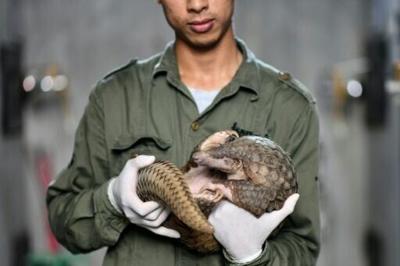

The United States on Monday moved to extend federal protections to all species of pangolins -- a step that would tighten trade restrictions and highlight the urgent conservation plight of the world's only scaly mammals.
Found in the forests, woodlands, and savannas of Africa and Asia, pangolins are small, nocturnal creatures known for their distinctive appearance, slow and peaceful demeanor, and habit of curling into a ball when threatened.
Often likened to a walking pinecone, they use long, sticky tongues to feast on ants and termites, give birth to a single pup each year -- and are the most heavily trafficked mammals on Earth. Their keratin scales are coveted in traditional medicine, and their meat is also considered a delicacy in some regions.
Despite steep population declines driven by poaching, habitat loss, and inbreeding, only one species — Temminck's pangolin of Africa -- is currently protected under the US Endangered Species Act. Monday's proposal by the US Fish and Wildlife Service would extend that status to all eight known species.
In a statement, the agency said it intends to list the four Asian species -- Chinese, Indian, Sunda, and Philippine -- as well as the three other African species: white-bellied, black-bellied, and giant pangolins.
"I'm delighted the United States is doing its part to save these adorably odd creatures," said Sarah Uhlemann, international program director at the Center for Biological Diversity.





"Pangolins are on the razor's edge of extinction, and we need to completely shut down any US market for their scales. There's no good reason for anybody to ingest any part of a pangolin."
Pangolins are currently protected under the Convention on International Trade in Endangered Species of Wild Fauna and Flora (CITES), which prohibits international trade for commercial purposes and allows it only under exceptional circumstances.
Still, the illegal trade persists.
In April, Nigerian authorities seized nearly four tons of trafficked pangolin scales — representing the slaughter of some 2,000 animals. In November 2024, Indonesian officials intercepted another 1.2 tons.
US demand remains a factor. Between 2016 and 2020, border officials intercepted 76 shipments of pangolin parts, including scales and products marketed for traditional medicine, according to public data.
ia/sms

(0) comments
Welcome to the discussion.
Log In
Keep it Clean. Please avoid obscene, vulgar, lewd, racist or sexually-oriented language.
PLEASE TURN OFF YOUR CAPS LOCK.
Don't Threaten. Threats of harming another person will not be tolerated.
Be Truthful. Don't knowingly lie about anyone or anything.
Be Nice. No racism, sexism or any sort of -ism that is degrading to another person.
Be Proactive. Use the 'Report' link on each comment to let us know of abusive posts.
Share with Us. We'd love to hear eyewitness accounts, the history behind an article.