Where Are Vacation Home Purchases Declining the Most?

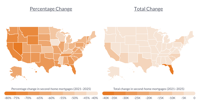
Florida led the U.S. with over 38,000 fewer vacation home purchases, but Nevada, Hawaii, and Wyoming saw the sharpest percentage declines
Source: SellMyTimeshareNow analysis of FFIEC’s Home Mortgage Disclosure Act data | Image Credit: SellMyTimeshareNow
Many of the same states that lead in timeshare demand also appear to be among those experiencing the sharpest pullbacks in traditional vacation-home purchases, pointing to a broader shift in how consumers access vacation properties. The decline in second-home buying has been widespread across the United States, though the scale and intensity vary significantly by state. In absolute terms, Florida recorded the largest decrease, with 38,465 fewer vacation-home purchases with a mortgage between 2021 and 2025, reflecting its outsized role in the second-home market during the pandemic-era surge.
Other high-volume vacation-home states also saw substantial declines in raw numbers. California recorded 13,516 fewer purchases, while Texas and North Carolina posted declines of 9,900 and 9,575, respectively. These figures suggest that states with the largest second-home markets during the pandemic boom have experienced the most pronounced pullbacks in absolute terms.
However, the steepest declines on a percentage basis were concentrated in smaller, tourism-dependent states—several of which also rank among the top timeshare destinations. Nevada saw the sharpest drop, with vacation-home purchases falling by 78.3%, followed by Hawaii (-77.8%) and Wyoming (-74.5%). These sharper contractions indicate that, in some destination markets, demand has fallen back more dramatically relative to its pandemic peak, underscoring the sensitivity of these regions to shifts in affordability and discretionary spending.
At the metro level, the sharpest declines were widespread across both large population centers and smaller destination markets. Among large metros, Austin, TX saw the steepest drop, with vacation-home purchases falling 80.4%, followed closely by major leisure markets such as Las Vegas (-79.4%), Orlando (-79.4%), and Miami (-78.8%). Similar patterns are evident in well-known vacation destinations, including Breckenridge, CO (-63.9%), Naples, FL (-76.1%), and Kahului, HI (-85.2%), all of which are heavily tied to tourism-driven housing demand. These declines suggest that even in large metropolitan areas and high-demand leisure markets alike, elevated costs and shifting consumer preferences have significantly curtailed second-home purchasing activity.
For more information about the datasets and calculations used in this analysis, see the methodology section. For complete results, see U.S. Cities Where Vacation Home Demand Has Declined the Most on SellMyTimeshareNow.
As featured on


The pandemic-era vacation-home boom appears to be unraveling. A new analysis found that U.S.…

(0) comments
Welcome to the discussion.
Log In
Keep it Clean. Please avoid obscene, vulgar, lewd, racist or sexually-oriented language.
PLEASE TURN OFF YOUR CAPS LOCK.
Don't Threaten. Threats of harming another person will not be tolerated.
Be Truthful. Don't knowingly lie about anyone or anything.
Be Nice. No racism, sexism or any sort of -ism that is degrading to another person.
Be Proactive. Use the 'Report' link on each comment to let us know of abusive posts.
Share with Us. We'd love to hear eyewitness accounts, the history behind an article.