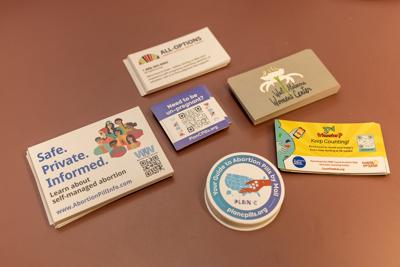
Reproductive rights groups have resumed helping Alabamians seeking out-of-state abortions after a ruling earlier this year from a federal judge.
U.S. District Judge Myron H. Thompson in April ruled that Alabama Attorney General Steve Marshall’s threats to prosecute those who provide out-of-state abortion assistance violated both the First Amendment and the right to travel. The decision has not been appealed. Marshall’s office did not return a request for comment.
“Literally within the hour of us finding out that the lawsuit was decided and that we could resume opening, we had already provided funding assistance for our first client that we knew was in the works, because even while we were closed, people were still traveling to receive care. They just weren’t having as much assistance,” said Kelsea McLain, executive director of the Yellowhammer Fund, an organization in Alabama providing abortion funding and support.
Moments into the interview Tuesday, the call was briefly interrupted. It was someone calling for assistance, McLain said.
While the decision has brought a sense of relief to some, the landscape of abortion access remains complex, marked by financial hurdles and logistical challenges, such as affording airfare, lodging, the procedure itself while taking time off work, and a state attempting to promote pro-birth policies.
The Yellowhammer Fund was one of the plaintiffs who sued Marshall following the prosecution threat, made on a right-wing radio show in 2022. Marshall’s office later defended his power to do so in a court filing in August 2023, saying that “a conspiracy formed” in Alabama and performed in another state is a criminal act in Alabama.
Thompson disagreed.
“At its core, this case is simply about whether a state may prevent people within its borders from going to another state, and from assisting others in going to another state, to engage in lawful conduct there,” the judge wrote in his decision. “The court now answers no, a state cannot.”
Despite the legal victory, the volume of requests for out-of-state abortion assistance has not returned to pre-Dobbs levels, McLain said. As of a recent count, the organization has supported 215 people since April 1, pledging out approximately $78,000 for clinic costs, hotels, flights and direct cash assistance for expenses like gas and child care.
“What’s crazy is we used to get 10 to 15 calls a day. We really were expecting for more and surprised that it hasn’t been higher,” she said.
The cost of out-of-state abortion care varies significantly depending on the gestational stage and travel distance. For later-term abortions (late second or early third trimester), which require travel to one of the few clinics offering such care in the country, costs can range from $10,000 to $15,000 for the procedure alone, with an additional $2,000 for travel and lodging in cities like Washington D.C.





Earlier trimester care, often sought in nearby states like Georgia or North Carolina, can cost between $100 to $400 for the procedure, with average pledges from the Yellowhammer Fund around $150-$200 to cover travel and associated expenses.
The journey itself is fraught with stress and logistical challenges.
“It’s significant. And I think that’s by design,” McLain said, suggesting that the difficulties are intentionally built into the system to deter people.
McLain said the emotional toll is significant, with many individuals traveling alone and grappling with feelings of loneliness and distress. Clients also face challenges ranging from securing time off work and finding child care to navigating airports and dealing with unexpected travel delays, as she has had people miss appointments and had to travel to a different state for timely care.
Following the states near-total abortion ban came into effect following the Dobbs decision, Alabama has actively pursued policies aimed at promoting childbirth within the state. Recent legislative efforts have included increasing the number of “baby boxes” at fire stations, designed for safe surrender of newborns, and providing tax cuts for baby diapers and maternal supplies. Critics argue these measures do not address the systemic issues that lead individuals to seek abortion care. Rep. Donna Givens, R-Loxley, who sponsored the “baby box” bill, and Sen. Arthur Orr, R-Decatur, who sponsored the tax cut for maternity supplies, did not return requests for comment.
“If you look at the WeCount surveys that keep coming out and show what’s happening with the telemed from shield laws states, the amount of medication that is being taken is fairly close to what we were seeing in the amount of abortions that were happening here, pre-Dobbs,” said Robin Marty, executive director at WAWC, formerly known as the West Alabama Women’s Center.
McLain pointed to the data on childbirth in Alabama, saying that “the state is increasingly dangerous to birth in.” She also pointed out the state’s challenges addressing drug use during pregnancy, which has led to the state leading nation in criminalizing pregnant people after Dobbs.
“If someone is an addict and they are pregnant, the safest option for them is seeking termination to avoid jail time, because if there’s any detected drugs in your system at any of your prenatal visits or during delivery, you will be thrown in prison for child endangerment,” she said.
Despite the challenges, McLain said the Yellowhammer Fund remains committed to its mission and plans to increase the budget for abortion aid to $350,000 towards Alabama and neighboring southeastern states, saying that for most people, abortion care is often not a choice.
“They aren’t choosing to have an abortion. They’re making a choice to survive, because they know how hard a child makes it to survive. They are someone who wants to have a child. They are someone who wants to grow their family, but they know they functionally can’t,” she said.
(0) comments
Welcome to the discussion.
Log In
Keep it Clean. Please avoid obscene, vulgar, lewd, racist or sexually-oriented language.
PLEASE TURN OFF YOUR CAPS LOCK.
Don't Threaten. Threats of harming another person will not be tolerated.
Be Truthful. Don't knowingly lie about anyone or anything.
Be Nice. No racism, sexism or any sort of -ism that is degrading to another person.
Be Proactive. Use the 'Report' link on each comment to let us know of abusive posts.
Share with Us. We'd love to hear eyewitness accounts, the history behind an article.