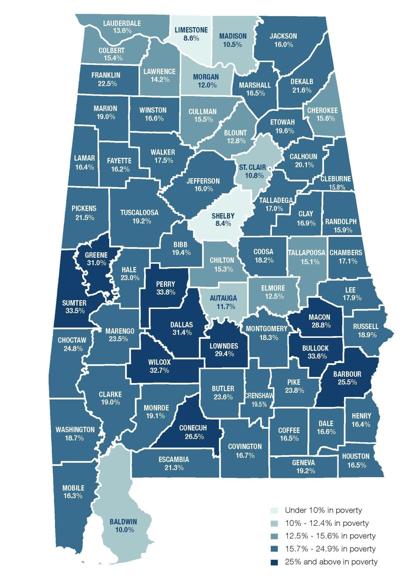

Ten Black Belt counties are the poorest counties in Alabama, according to figures released by a poverty advocacy group this week.
Alabama Possible released their latest Barriers to Prosperity report on Wednesday. The report, which aggregates statistics from a variety of publicly available sources, shows that Alabama is the seventh poorest state.
The report shows that Alabama’s poverty rate, the percent of persons or families whose cash income is below the federal poverty threshold as calculated by the Census Bureau, is 15.7% compared to the U.S. rate of 12.5%. More than one in five (21.3%) of Alabama’s children live in poverty, compared to 16% of children in the U.S.
That means more than 780,000 Alabamians, including 236,000 children, live at or below the poverty level. The poverty level ranges from $15,480 for one person up to $31,200 for a family of four.
Alabama’s median income is $62,248 compared to the U.S. median income of $77,719.
The poverty rate varies by race. Slightly more than 11% of Alabama’s white citizens live at or below the poverty line. The poverty rate for Black Alabamians is 25.1%, and for Hispanics the rate is 24.6%. This is the first year that the poverty rate for Hispanics is lower than the poverty rate for Blacks, according to Mae Whiting of Alabama Possible.






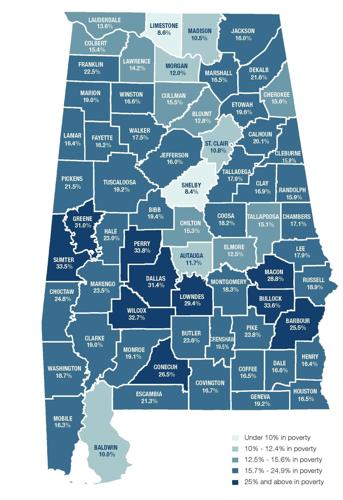
Looking at Alabama’s 67 counties, 10 counties have a poverty rate of 25.5% or higher. All of those counties are in the Black Belt, including six in the Black Belt News Network service area.
Perry County has the state’s highest poverty rate at 33.8%. The poverty rate is 33.5% in Sumter County, 32.7% in Wilcox County, 31.4% in Dallas County and 29.4% in Lowndes County. In Marengo County, 23.5% of the population lives in poverty, and in Montgomery the rate is 18.3%.
Greene, Macon, Bullock, Barbour and Conecuh counties are the other counties with poverty rates of 25.5% or higher. The two counties with the state’s lowest poverty rates are Shelby with a rate of 8.4% and Limestone County with a rate of 8.6%.
The report also tracks food insecurity, which is defined as multiple indications of disrupted eating patterns and reduced food intake or reduced quality of diet. Whiting said those statistics will be harder to get in the future because the federal government has stopped collecting some of that data.
In Perry County, 23.0% of its residents live with food insecurity, and 33.2% receive SNAP benefits. In Wilcox County, 22.2% live with food insecurity, and 33.8% receive SNAP benefits. In Dallas County, 21.9% live with food insecurity, and 30.7% receive SNAP benefits. In Marengo County, 20.1% live with food insecurity, and 20.3% receive SNAP benefits. In Lowndes County, 20.7% live with food insecurity, and 28.4% receive SNAP benefits. And in Montgomery County, 17.7% live with food insecurity, and 19.5% receive SNAP benefits.
You can access the Alabama Possible report here.
(0) comments
Welcome to the discussion.
Log In
Keep it Clean. Please avoid obscene, vulgar, lewd, racist or sexually-oriented language.
PLEASE TURN OFF YOUR CAPS LOCK.
Don't Threaten. Threats of harming another person will not be tolerated.
Be Truthful. Don't knowingly lie about anyone or anything.
Be Nice. No racism, sexism or any sort of -ism that is degrading to another person.
Be Proactive. Use the 'Report' link on each comment to let us know of abusive posts.
Share with Us. We'd love to hear eyewitness accounts, the history behind an article.