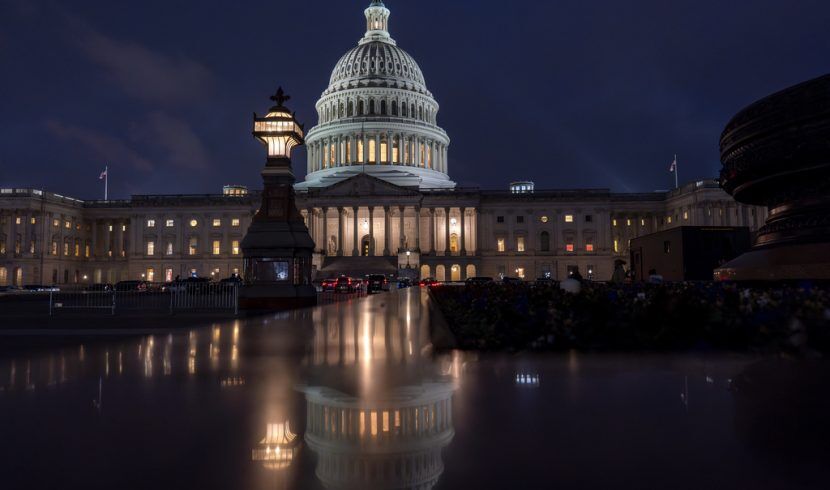

WASHINGTON – Alabama’s Republican lawmakers said the House budget plan to implement President Donald Trump’s agenda is a step in the right direction, while the state’s Democrats are worried about possible cuts to social programs including Medicaid and food assistance.
The House budget resolution, which sets federal spending for the next decade, was narrowly adopted Tuesday night by a vote of 217-215. All House Republicans except for one voted for it and all Democrats opposed it.
The budget plan calls for $4.5 trillion in tax cuts and sets a goal for $2 trillion in cuts to mandatory spending. The resolution calls for $880 billion in cuts from the House Energy and Commerce Committee, which oversees health care spending. It also sets $230 billion in cuts from the House Agriculture Committee, which oversees the Supplemental Nutrition Assistance Program.
Republicans are pushing for the bill to extend Trump’s tax cuts and bolster defense and border funding. Democrats are honing in on concerns about possible cuts to Medicaid. House Republicans are pushing for the resolution to give Trump his “one big, beautiful bill” to tackle all of his priorities. While the Senate passed its own budget resolution last week that increased spending for the border and defense, but did not include tax cuts. Those would be in a separate bill under the Senate plan.
Rep. Dale Strong, R-Huntsville, explained that passing the House budget resolution is just the first step in enacting Trump’s agenda.
“We get this piece of the puzzle done, it leads to the opportunity to get a budget rolling where it needs to be,” Strong told Alabama Daily News.
Sewell and Figures joined House Democrats outside the Capitol Tuesday to express their opposition to the budget plan and the possible Medicaid cuts that could come from it. Sewell called the budget resolution an “abomination” and said Democrats will fight back.
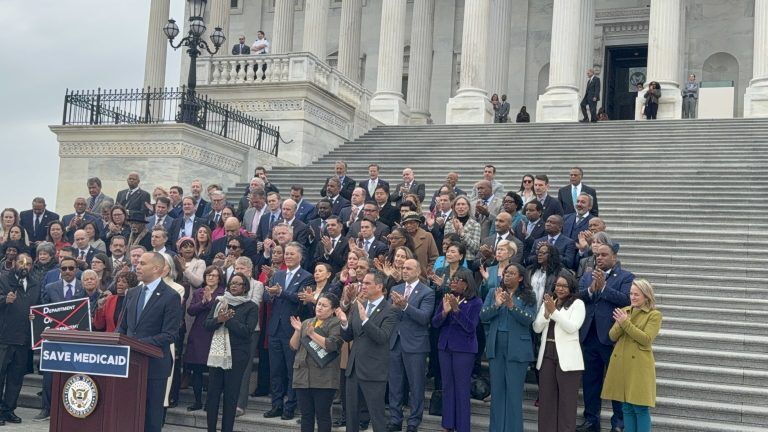
“It is about tax cuts so that we can give tax cuts to the wealthy and were taking away much-needed services like Medicaid and Head Start and SNAP benefits, and these are services that folks back home depend upon,” Sewell told Alabama Daily News.
More than half of Alabama’s children are covered by Medicaid, including half of Alabama’s births. More than 20 percent of Alabama’s population was insured through Medicaid in 2023, according to the Kaiser Family Foundation.






Figures said Medicaid and SNAP are critical for his district’s residents. He said the budget resolution would make it harder for working families.
“We know that we have high rates of poverty, high rates of rural poverty, and we cannot afford to be in a position where we’re pushing a budget that gives more and more to the wealthiest of Americans while taking away from the people of my district,” Figures told ADN.
The House version also calls for a $100 billion increase for the House Armed Services Committee to spend on defense. Chairman Mike Rogers, R-Saks, spoke in support of the resolution on the House floor Tuesday. He said the spending increase will help fund the Department of Defense’s mission at the border, expand U.S. shipbuilding capacity, and enhance missile defense.
“The $100 billion in defense spending this resolution unlocks will enable us to begin restoring American deterrence, prioritizing lethality, and ensuring peace through strength,” Rogers said.
Rep. Barry Moore, R-Enterprise, said he hasn’t seen any proposed cuts, as the budget resolution doesn’t explicitly call for Medicaid or SNAP cuts. It will be up to the committees to decide how they will cut billions in federal spending. Moore said he supports adding work requirements for social programs, like Medicaid, for people who don’t have dependents at home and who can work.
“No reason everybody working should be securing those folks,” Moore told ADN.
Rep. Robert Aderholt, R-Haleyville, said a majority of his district voted for Trump and said Tuesday’s budget vote will help the president’s agenda get enacted.
“They voted for secure borders, energy independence, economic prosperity, and a strong national defense,” Aderholt said in a statement. “Today’s vote was the first procedural step toward delivering on those priorities.”
The House and Senate will now have to agree on the same budget resolution before unlocking the reconciliation process, which allows the Senate to pass the legislation with a simple majority. Committees can then start devising their own spending plans under the guidance of the resolution.

(0) comments
Welcome to the discussion.
Log In
Keep it Clean. Please avoid obscene, vulgar, lewd, racist or sexually-oriented language.
PLEASE TURN OFF YOUR CAPS LOCK.
Don't Threaten. Threats of harming another person will not be tolerated.
Be Truthful. Don't knowingly lie about anyone or anything.
Be Nice. No racism, sexism or any sort of -ism that is degrading to another person.
Be Proactive. Use the 'Report' link on each comment to let us know of abusive posts.
Share with Us. We'd love to hear eyewitness accounts, the history behind an article.