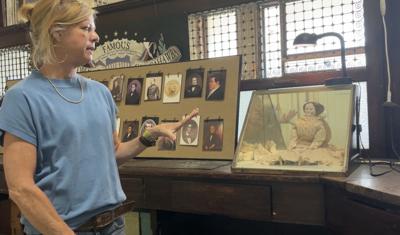

History curator Beth Spivey has spent the past decade turning the Old Depot Museum into one of Selma’s most distinctive historical spaces, and she has done it with a mix of determination, humor and an unwavering belief that preserving the past is a community duty.
In this part of the Black Belt News Network's Voices & Visionaries series, Spivey tells her story, and the story of the museum she cares for, which is as layered as the history housed inside the former train depot.
Spivey grew up in Lowndes County and still lives in her family’s 1856 home, a place she describes as a living archive of her ancestors.
“I feel like it’s my duty to preserve my family’s name by taking care of this house,” she said.
That same sense of responsibility guides her work at the museum.
She arrived at the Old Depot Museum after 16 years working the swing shift at International Paper. When the museum’s longtime curator, Gene Martin, suffered a stroke, Spivey was asked to fill in. Martin passed away shortly afterward, and Spivey stepped into the role full time.
What she found was a building that had been heavily altered in the 1970s, when the depot was converted into the State Forensic Lab. The original high ceilings had been covered with drop tiles, and the walls were paneled. On her first day, the heat was out. She pulled down a ceiling tile, saw the original brick and molding, and decided she was going to restore the building herself. “I’ve always heard it’s easier to ask for forgiveness than permission,” she said.
She tore out ceilings and paneling without telling the board. When they walked in for a meeting and saw the exposed structure, they told her to keep going. Volunteers eventually joined her, including a group of Mormon missionaries who helped remove every ceiling tile and track in a single day.
Spivey has since rebuilt the museum’s displays, focusing on clarity, organization and storytelling. She writes out explanations for visitors who may not understand her Southern accent, keeps reading glasses on hand for those who forget theirs, and has learned to read her audience quickly. Some visitors want a guided tour. Others want silence. “I don’t ever want them to come away with a bad experience,” she said.






Her research is constant. She fields questions about everything from slave trading to cockfighting to the history of Craig Air Force Base. She often quotes historical markers or documents to settle disputes, though she has learned not to argue. “I’ve learned to let people win every argument they want to have with me,” she said.
The museum itself holds some of Selma’s most significant artifacts, including what Spivey says is the oldest known Native American pottery in Alabama and the original land grant for Selma. She reminds visitors that the depot sits on the site of the Confederate Naval Arsenal, which made Selma the second-largest producer of munitions after Richmond, Virginia. When Richmond fell, Union troops came straight to Selma and captured the city in 15 minutes. She notes that exactly 100 years later, the events of 1965 on the Edmund Pettus Bridge again changed the world from this same small town.
Spivey works closely with other museums when possible and often sends visitors to Old Cahawba, especially those who arrive wearing walking shoes. She said tourists come from across the country and around the world, and many locals don’t realize how important Selma is historically or how strong the museum’s collection has become.
The building itself is still a work in progress. Spivey has secured multiple grants from the Alabama Historical Commission to repaint the exterior in stages. A hurricane allowed the city, which owns the building, to replace the roof through insurance. She is now preparing for more exterior work because fading paint has left the upper front wall a different shade than the lower section. Out back, the small firefighters museum needs ceiling repairs.
She hopes to expand the museum’s reach by starting a TikTok account to show younger audiences that Selma’s history is far broader than a single chapter. “Other than Bloody Sunday, Selma has so much more history,” she said.
The museum is open Monday through Friday from 10 a.m. to 4 p.m. Visitors do not need tickets, and they can pay as they come in.
The museum is a nonprofit with a board of directors, and contributions help maintain the aging buildings and preserve the collection. Spivey said along with admissions, the museum will accept donations of any type. “I’ll take your firstborn if you give it to me.”
Spivey said the best thing she hears from visitors is how kind the people of Selma are. She believes the museum is part of that welcome. “They need to come to Selma,” she said. “They need to come see.”
(0) comments
Welcome to the discussion.
Log In
Keep it Clean. Please avoid obscene, vulgar, lewd, racist or sexually-oriented language.
PLEASE TURN OFF YOUR CAPS LOCK.
Don't Threaten. Threats of harming another person will not be tolerated.
Be Truthful. Don't knowingly lie about anyone or anything.
Be Nice. No racism, sexism or any sort of -ism that is degrading to another person.
Be Proactive. Use the 'Report' link on each comment to let us know of abusive posts.
Share with Us. We'd love to hear eyewitness accounts, the history behind an article.