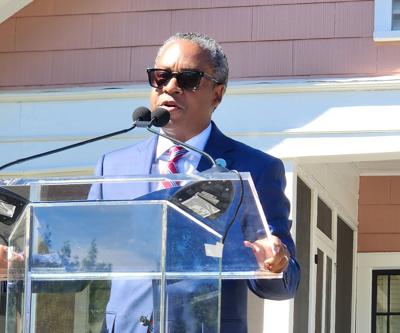
Recently, I had the honor of joining leaders, historians, preservationists, and members of the Jackson family in Dearborn, Michigan, for the dedication of the Jackson House at The Henry Ford’s Greenfield Village.
As I stood before this beautifully restored home, I was reminded that while buildings are made of wood and brick, their true value comes from the stories they hold.
The Jackson House is one of those special places.
For generations, the home of Dr. Sullivan Jackson and his family stood in Selma as a symbol of faith, service, hospitality, and leadership. During the Civil Rights Movement, the house welcomed visitors, activists, and leaders who came to Selma seeking justice and equality. It was a place where conversations were held, plans were discussed, and hope was sustained.
Today, that same house stands in one of America’s most respected historical institutions, where hundreds of thousands of visitors from across the nation and around the world will learn about Selma and its role in shaping American history.
Some may ask whether it is difficult to see a historic Selma landmark relocated hundreds of miles away.
My answer is simple: the spirit of the Jackson House never left Selma.
Its foundation remains here, in the people, churches, streets, and stories that continue to define our city. What has changed is that the reach of that story has grown.
Every visitor who walks through the doors of the Jackson House in Dearborn will encounter a piece of Selma. They will learn about a community that stood at the center of the struggle for voting rights and human dignity. They will discover the courage of ordinary citizens who accomplished extraordinary things. They will come to understand why Selma remains one of the most important places in American history.
That is something we should celebrate.
The Henry Ford and its remarkable team have not simply preserved a house. They have elevated a story. Through their dedication to preserving history and educating others, they have ensured
that future generations will continue to learn from the legacy of the Jackson family and the larger story of Selma.
For that, we are deeply grateful.
The dedication of the Jackson House should also remind us of an important truth: Selma’s greatest asset is its story.
People travel from around the world to experience places that changed history. Few communities can claim the significance that Selma holds in the American story. Our challenge and opportunity are to preserve our historic sites, share our stories, and invest in the future of this beloved city.
As Mayor, I believe Selma’s history is not merely something to remember, it is something to build upon.
The same courage that carried previous generations through moments of great challenge can inspire us as we work to create a stronger, safer, and more prosperous Selma. The same spirit that brought people together during theCivil Rights Movement can help unite us around a shared vision for our future.
The Jackson House now stands in Dearborn, Michigan. But every beam, every room, and every story within it points back to Selma, Alabama.
And every person who visits that house will leave knowing that some of America’s most important history began right here.
That is a legacy worth preserving, a story worth telling, and a future worth building. A piece of Selma now inspires the world.
Johnny Moss III is the mayor of Selma.
(0) comments
Welcome to the discussion.
Log In
Keep it Clean. Please avoid obscene, vulgar, lewd, racist or sexually-oriented language.
PLEASE TURN OFF YOUR CAPS LOCK.
Don't Threaten. Threats of harming another person will not be tolerated.
Be Truthful. Don't knowingly lie about anyone or anything.
Be Nice. No racism, sexism or any sort of -ism that is degrading to another person.
Be Proactive. Use the 'Report' link on each comment to let us know of abusive posts.
Share with Us. We'd love to hear eyewitness accounts, the history behind an article.