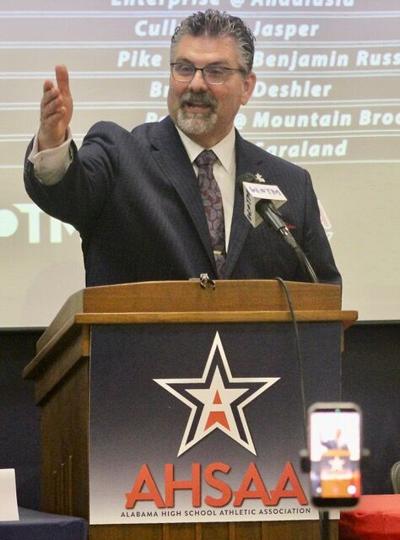
As a teacher, coach, administrator, and now as executive director of the AHSAA, I have come to believe that every high school contest asks the adults in attendance a simple question: Are we helping young people learn the right lessons, or are we allowing the pressure to win to teach the wrong ones?
I have stood on sidelines, sat in administrators’ offices, watched communities rally around their schools, and seen firsthand how powerful education-based athletics can be when they are kept in the proper perspective.
High school sports were never meant to be a smaller version of college or professional athletics. They exist as an extension of the classroom. They are supposed to build discipline, accountability, resilience, humility, teamwork, respect, and integrity. When sportsmanship breaks down, the educational purpose of athletics breaks down with it.
That is why sportsmanship cannot be reduced to a pregame announcement, a poster on the wall, or a reminder after something has already gone wrong. Sportsmanship is not a slogan. It is the standard that protects what makes high school athletics worth fighting for.
Sportsmanship must be taught, modeled, expected, and reinforced by administrators, coaches, officials, student-athletes, parents, spectators, contest workers, cheerleaders, bands, and public address announcers. In other words, everyone who enters the athletic environment becomes part of the lesson.
I say this from experience: adults set the tone. Students notice when a coach loses control. They notice when a parent berates an official. They notice when a student section crosses the line from enthusiastic support into personal disrespect. They notice when opponents are treated as enemies instead of guests. What adults excuse, students often repeat.
Passion belongs in high school sports. Packed stadiums, loud gyms, school bands, cheerleaders, pep rallies, and community pride are part of what makes Alabama high school athletics special. But passion is not permission. It is not permission to taunt. It is not permission to use profanity. It is not permission to blame officials, intimidate opponents, or turn a student-centered event into adult-centered entertainment.
Some of the best moments I have witnessed in high school athletics have had nothing to do with the scoreboard: an athlete helping an opponent up, a coach calming a tense moment, a crowd applauding an injured player from either team, or an official being thanked after a difficult contest. Those moments may not always make headlines, but they reveal what our games are supposed to teach.
Sportsmanship also requires more than good intentions. It requires planning. Schools need written expectations, crowd control procedures, trained contest workers, visible supervision, public address scripts, emergency plans, and consistent follow-up when behavior crosses the line. A respectful athletic culture does not happen by accident. It is built before the game begins and protected throughout the season.
As a former coach and principal, I also know parents have a powerful role to play. A child does not need a post-game interrogation five minutes after leaving the field or court. They do not need adults shouting instructions from the stands while coaches are trying to teach. They need support, perspective, encouragement, and an example of how to handle both success and disappointment with balance.
Officials deserve the same standard of respect. Without officials, games are not played. Without respect for officials, fewer men and women will be willing to serve. Disagreement with a call is part of competition; public abuse is not. If we want students to keep competing, communities must help protect the people who make competition possible.
As executive director, I want our member schools to know that the AHSAA will continue to promote sportsmanship, fair play, and rules compliance because those values are not secondary to our mission. They are central to it. Championships matter. Rivalries matter. Traditions matter. But none of them matter more than the young people these programs are designed to serve.
My challenge to all of us is simple. Let us cheer loudly without humiliating others. Let us compete fiercely without losing perspective. Let us hold students accountable while holding adults to the same standard. Let us remember that every contest is a classroom, and every adult in that classroom is teaching something.
I still believe high school athletics are one of the greatest classrooms we have. But that classroom only works if we protect the values that make it meaningful. If we defend sportsmanship, we defend the purpose of high school athletics. If we fail to defend it, we risk losing the very thing that makes education-based athletics different, meaningful, and worth preserving.
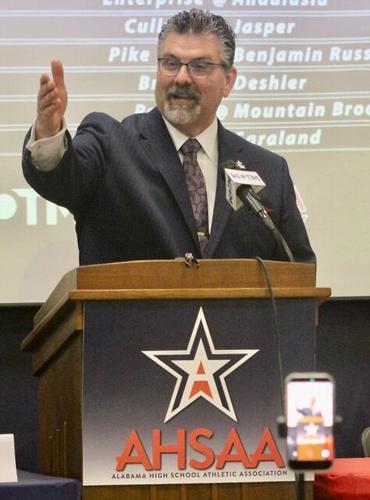
Heath Harmon began his tenure in July 2024 as executive director of the Alabama High School Athletic Association (AHSAA), the organization responsible for administering education-based athletics for its member schools across Alabama. Harmon became the sixth full-time executive director in AHSAA history after serving as principal of Oxford High School. A lifelong Alabama resident and graduate of Munford High School, he has served in education as an English and history teacher, coach, athletic director, assistant principal, and principal. Harmon also served as head football coach at Cordova, Munford, Andalusia, and White Plains high schools before moving into educational administration. He earned a bachelor’s degree in secondary education from Jacksonville State University, along with a master’s degree in secondary education and educational leadership and an educational specialist degree from the University of Alabama. He is also a graduate of the 2023 Alabama Superintendents Leadership Academy.
###
About the Alabama High School Athletic Association
The Alabama High School Athletic Association (AHSAA), founded in 1921, serves its member schools by governing and directing education-based interscholastic athletics that foster integrity, sportsmanship, safety, fair play, and lifelong values. Organized by its member schools, the AHSAA regulates, coordinates, and promotes interscholastic athletic programs among public, private, and parochial member schools. The Association serves 425 senior high members and 335 junior high and middle school members, with more than 150,000 students participating in AHSAA programs. Through strategic leadership, legislative processes, championship programs, officials training, and commitment to the educational mission, the AHSAA supports member schools in advancing educational excellence through athletics. For more information, visit www.AHSAA.com.
(0) comments
Welcome to the discussion.
Log In
Keep it Clean. Please avoid obscene, vulgar, lewd, racist or sexually-oriented language.
PLEASE TURN OFF YOUR CAPS LOCK.
Don't Threaten. Threats of harming another person will not be tolerated.
Be Truthful. Don't knowingly lie about anyone or anything.
Be Nice. No racism, sexism or any sort of -ism that is degrading to another person.
Be Proactive. Use the 'Report' link on each comment to let us know of abusive posts.
Share with Us. We'd love to hear eyewitness accounts, the history behind an article.