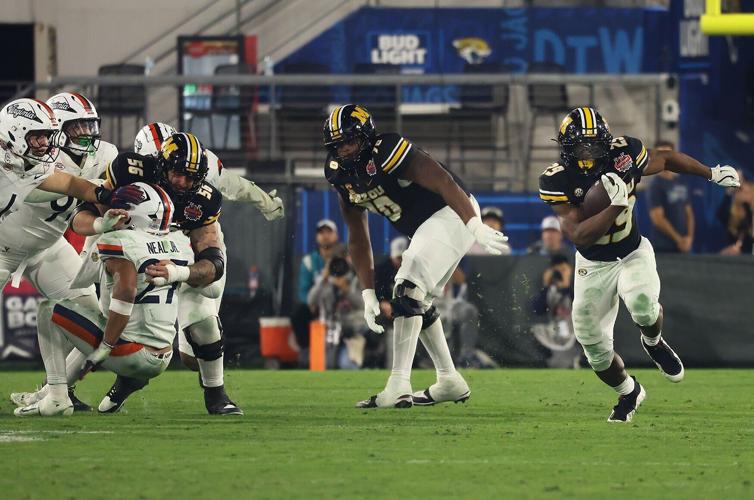
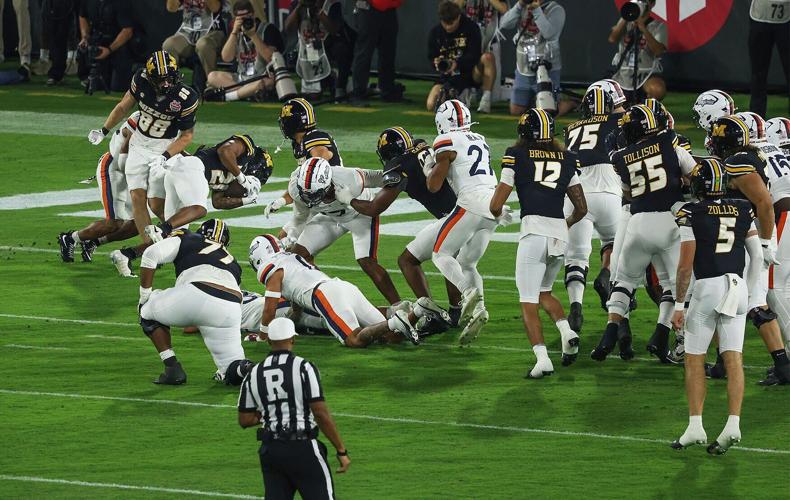



Mizzou running back Ahmad Hardy (29) runs the ball Saturday at EverBank Stadium in Jacksonville, Fla. Despite long stretches when he didn’t touch the ball, Hardy set the new single-season rushing record for Mizzou.
Missouri’s offense didn’t stall in the Gator Bowl because it suddenly lost its identity.
It stalled because its identity had narrowed.
When Missouri sprinted 74 yards on seven plays to open Saturday’s game, the Tigers looked like themselves: downhill runs, a quarterback kept honest by quick throws, and Ahmad Hardy ripping off a chunk play that reminded everyone why he broke the program’s single-season rushing record.
Then the answers ran out.

Mizzou running back Jamal Roberts (20) scores a touchdown during the first half of the Gator Bowl on Saturday at EverBank Stadium in Jacksonville, Fla.
Missouri scored on its opening drive and didn’t score again, falling 13-7 to Virginia at EverBank Stadium in Jacksonville, Florida on Saturday. But the more revealing part of the night wasn’t the final score.
It was the shape of the struggle and how familiar it looked to the Tigers’ late-season offensive issues: a rushing attack defenses were ready to load up against, a passing game that rarely punished it, and a young quarterback often asked to win from uncomfortable situations.

Mizzou quarterback Matt Zollers (5) reacts to getting tackled after running the ball during the second half of the Gator Bowl on Saturday at EverBank Stadium in Jacksonville, Fla. Zollers was 2 yards short of a first down.
That’s why Missouri’s offseason offensive reset matters. Chip Lindsey, Michigan’s offensive coordinator and quarterbacks coach, was hired to take over play-calling in 2026, and his biggest task is straightforward: Give Missouri a passing identity.
Because, by the end of 2025, the Tigers were too one-dimensional to survive against the teams that could force them off script.
Missouri finished the season with 2,445 passing yards on 240 attempts and 2,968 rushing yards on 558 rush attempts. Hardy carried the load all year, finishing with 256 carries for 1,649 yards, the most rushing yards in a season in program history. Jamal Roberts added 124 carries for 753 yards.
When those runs were flowing, Missouri could win.

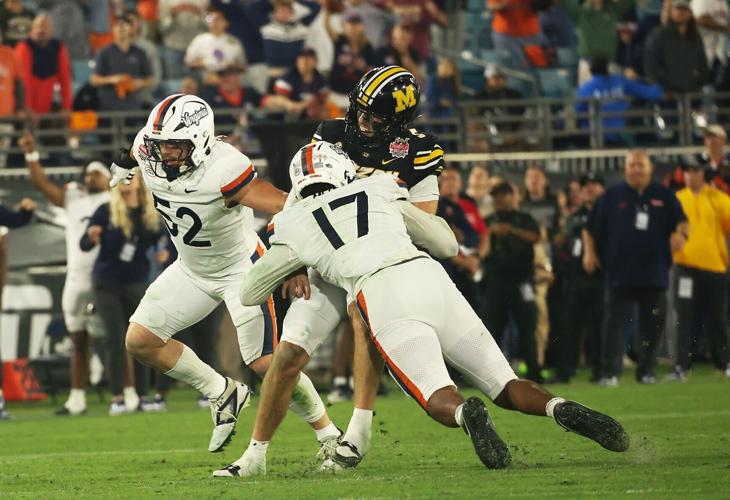
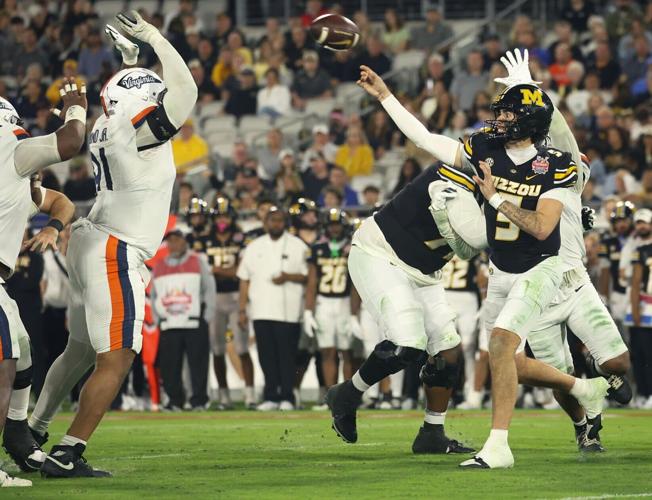
Mizzou quarterback Matt Zollers (5) is hit after throwing the ball Saturday at EverBank Stadium in Jacksonville, Fla. Zollers and the MU offense were held under wraps most of the night in a 13-7 loss to Virginia in the Gator Bowl, leaving a new offensive coordinator the task of finding a decent passing game.
When opponents built their game plan around making Hardy fight through a crowded box and daring Missouri to throw its way out, the Tigers didn’t consistently counter. That’s what showed up down the stretch, and it’s what showed up again Saturday when Missouri’s offense couldn’t find rhythm after its first two drives.
Drinkwitz, calling plays for the first time since before Kirby Moore’s arrival, didn’t duck responsibility afterward.
“It’s on me,” Drinkwitz said. “I didn’t do a good enough job calling plays tonight or getting us into a rhythm.”
Missouri’s opening series was balanced and explosive: five runs, two passes, and Hardy’s 43-yard burst that set up the Tigers’ first and only touchdown. Missouri’s second drive moved 40 yards, but ended without points. After that, possessions became short, disjointed and often predictable, with the Tigers struggling to stay on schedule.
Hardy, Missouri’s best player and its most consistent offensive answer all season, barely touched the ball for long stretches. He did not carry the ball in the third quarter, and he didn’t get a touch in the second half until under five minutes remained in the fourth. By then, Missouri was chasing the game and searching for anything that could jump-start an offense that had spent most of the night stuck in neutral.
Hardy understood what Virginia was doing.
“They’re stacking the box,” Hardy said. “Probably throw the ball out some more, something like that.”
That’s the point Missouri has to solve for 2026.
The solution isn’t that Missouri must hand Hardy the ball 35 times every week. The solution is that, when defenses sell out to take him away, Missouri has a consistent set of answers that creates easy yards and keeps the offense from drifting into long-yardage downs that telegraph a pass.

Mizzou quarterback Matt Zollers (5) throws a pass on Saturday at EverBank Stadium in Jacksonville, Fla. Zollers had plenty of misfires, but showed plenty of arm strength and made some excellent throws in the final drive.


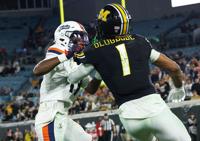

True freshman quarterback Matt Zollers started three games, against Texas A&M, Mississippi State and Virginia, and played the second half at Vanderbilt after Beau Pribula was injured. Across those four appearances, Zollers finished 47-for-88 (53.4%) for 503 yards with four touchdowns and two interceptions. The talent is obvious, but the growing pains are, too.
He looked young at times Saturday. He was late on throws. He missed opportunities. He took hits. And too often, it felt like the offense didn’t consistently put him in positions that made the job easier.
Drinkwitz saw both sides.
“I thought he did some really good things,” Drinkwitz said. “A lot to build on. … That’s his third start, right? I thought he gave us an opportunity.”
Hardy echoed that.
“I think he did great as a true freshman,” Hardy said. “He comes back, he’ll be better next year.”

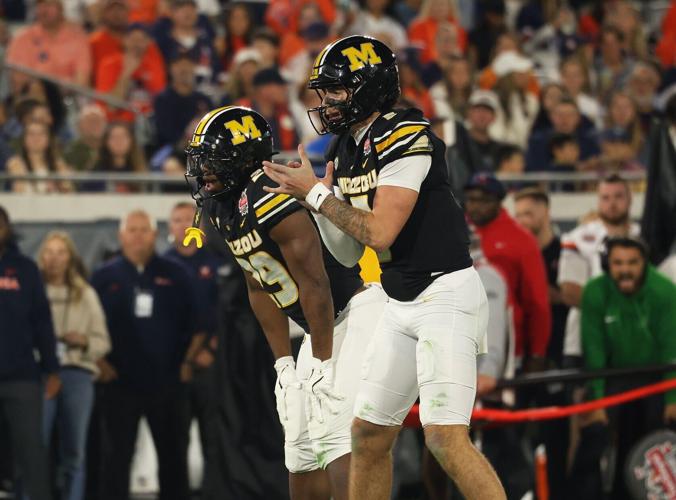
Mizzou quarterback Matt Zollers (5) claps while awaiting a snap during the first half of the Gator Bowl on Saturday at EverBank Stadium in Jacksonville, Fla.
That improvement doesn’t happen just because a quarterback matures. It happens because the system around him gives him clearer answers, simpler reads and more ways to find rhythm. It happens when an offense can create completions that feel like extensions of the run game and punish teams for loading the box.
That’s where Lindsey’s hire can change the entire equation.
Lindsey arrives with a reputation for quarterback development and for building offenses around a team’s best players, blending a spread passing game with a commitment to running the football. At Michigan, he worked with an offense that wanted to be physical but needed explosive plays through the air. Missouri is staring at the same challenge, except the Tigers already have a consensus All-American running back returning.
The job now is to make Hardy harder to defend, not by simply feeding him carries, but by forcing defenses to pay for overcommitting to him.
That’s what Missouri didn’t consistently do in 2025, especially against ranked opponents. Missouri finished 0-5 in those matchups, and those games often followed a similar script: Hardy grinding through tight spaces, the passing game struggling to tilt coverages, and the offense shrinking as the down-and-distance got worse.
The Gator Bowl was a snapshot of that script.
Virginia crowded the box. Missouri struggled to sustain drives. And when the Tigers finally had a chance to steal the game late, the moment felt like a microcosm of the bigger issue. Missouri faced a fourth-and-2 down six points with just over two minutes left, and the offense called for Zollers to keep it, taking the ball out of Hardy’s hands in the game’s biggest snap.
Missouri came up short.
Afterward, Hardy said he was surprised when he came out on that fourth down. On the telecast, color analyst Louis Reddick was saying how the situation cried out for Hardy to get the ball while the camera showed him jogging off the field. Hardy didn’t complain publicly afterward, but he didn’t hide some disappointment, either.
The frustration Missouri felt Saturday is the same frustration it must address this offseason. Not by rewriting everything, but by expanding what the offense can be when the run game isn’t enough.
That’s what Lindsey is being hired to do. Make Missouri more balanced. Make the passing game functional and dangerous. Give Zollers a system that helps him grow instead of forcing him to survive. Create answers when Hardy is boxed in. Find tempo when the offense is stuck. Build an identity that doesn’t depend on one gear.
Missouri is bringing back the pieces that matter: Hardy. Zollers. A core that Drinkwitz said will carry the culture into 2026. The next step is building an offense that gives those pieces room to breathe.
Because, if 2025 taught Missouri anything, it’s that being predictable is a losing strategy.

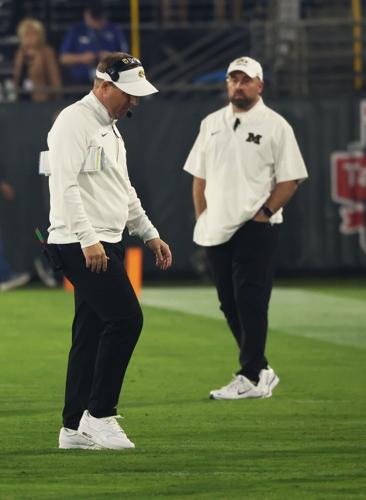
Mizzou head coach Eli Drinkwitz walks away from the huddle Saturday during the Gator Bowl at EverBank Stadium in Jacksonville, Fla.
And if 2026 is going to look different, the change has to start with the one thing Missouri didn’t have enough of this season.
Balance.


(0) comments
Welcome to the discussion.
Log In
Keep it Clean. Please avoid obscene, vulgar, lewd, racist or sexually-oriented language.
PLEASE TURN OFF YOUR CAPS LOCK.
Don't Threaten. Threats of harming another person will not be tolerated.
Be Truthful. Don't knowingly lie about anyone or anything.
Be Nice. No racism, sexism or any sort of -ism that is degrading to another person.
Be Proactive. Use the 'Report' link on each comment to let us know of abusive posts.
Share with Us. We'd love to hear eyewitness accounts, the history behind an article.