Editor’s note: This is the second of three stories that look back on the protests at the University of Missouri from 2015 and the Mizzou football team’s involvement.
The 2015 Mizzou football team is most remembered for what happened off the field.

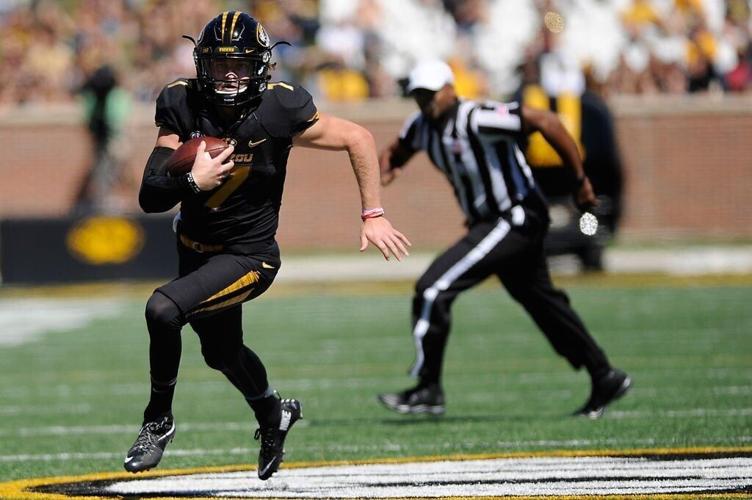
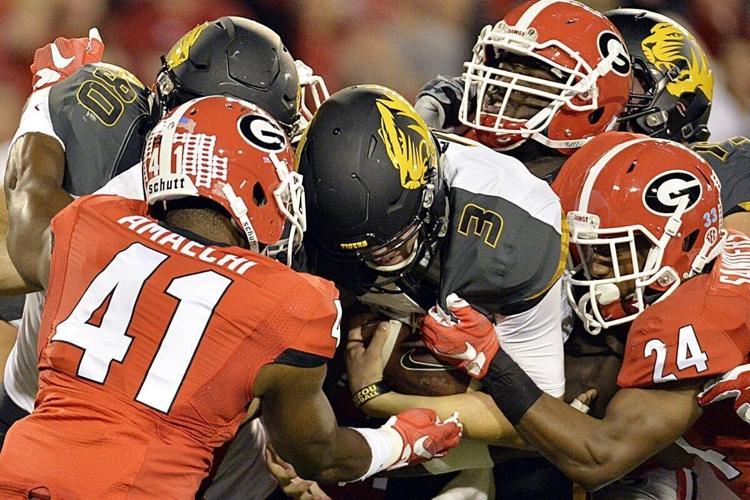
Drew Lock is tackled as he runs the ball during the first quarter against the Georgia Bulldogs on Oct. 17, 2015, at Sanford Stadium in Athens, Ga. The Tigers lost 9-6 against the Bulldogs.
In early November, tensions at MU were sky-high as a result of racist incidents targeting Black students and a lack of action from university leadership over the previous few weeks. Graduate student Jonathan Butler was in the midst of a hunger strike, vowing not to eat until he died or UM System President Tim Wolfe was removed from office.
On Nov. 7, two days after Mizzou fell to Mississippi State at home, a group of Black MU football players announced on Twitter (now X) that it would refuse to participate in football-related activities until Wolfe resigned. The next day, coach Gary Pinkel posted a photo on Twitter featuring many coaches and players who represented different races. The message said: “The Mizzou Family stands as one. We are united. We are behind our players. #ConcernedStudent1950 GP.”
Wolfe announced his resignation the next day.
The players had succeeded in pushing a social movement over the finish line, but the universe tossed another obstacle at them. In the week leading up to the BYU game, which was scheduled for Nov. 14 in Kansas City, Pinkel announced that he would retire at the end of the season because of health issues. He had been diagnosed with lymphoma in May.
Despite the off-field chaos, the Tigers rallied to beat the Cougars 20-16 at Arrowhead Stadium.

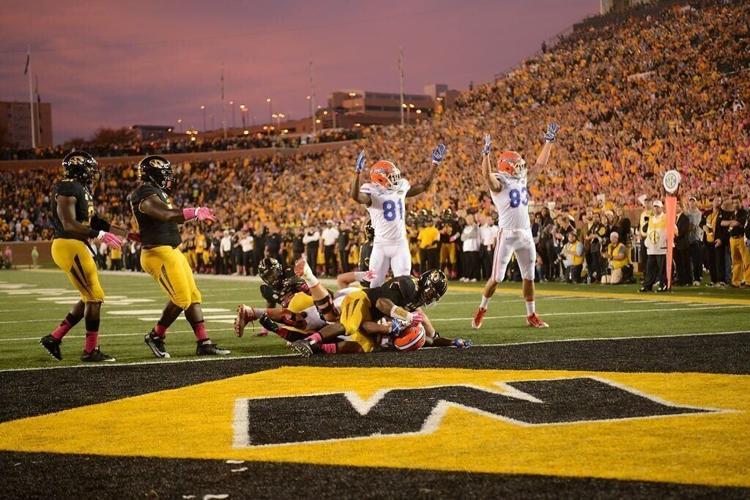
Florida players, from left, Antonio Callaway and Jake McGee celebrate Oct. 10, 2015, after a tackle during the homecoming game.
The win was Mizzou’s first since Oct. 3. It was also its last of the season. The Tigers finished 5-7 overall and 1-7 against SEC opponents. While off-field events understandably took the spotlight, what MU did on the field that season is historically fascinating.
For most of its existence, Mizzou football has cycled between being elite and far from it. In terms of individual seasons, few have exemplified the dichotomy between magnificence and mediocrity quite like 2015.
MU had one of the best defenses in the country that season, allowing just 4.3 yards per play (No. 2 nationally) and 16.2 points per game (No. 5 nationally). Charles Harris, a future first-round NFL Draft pick at edge rusher, tallied a team-high 18½ tackles for loss, while six players had between eight and 12 tackles for loss. Only twice did an opponent score more than three touchdowns against the Tigers.
On the other side was one of the saddest, most disheartening offenses in program history. A true freshman quarterback who wasn’t quite ready, one of the worst run games in the FBS and a leaky offensive line created one of the worst offenses in the sport. Many of the players who lifted Mizzou to consecutive SEC title game appearances in 2013 and 2014 had graduated, and their holes couldn’t be filled even close to adequately.

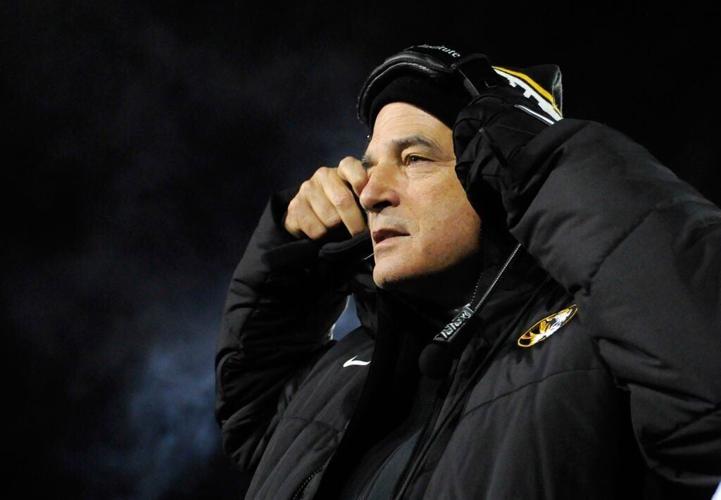
Gary Pinkel puts on his headset before his last home game as coach on Nov. 21, 2015. The Missouri Tigers lost to Tennessee Volunteers 19-8.
The first two games of 2015 didn’t raise major alarm bells, although they weren’t totally silent. The Tigers beat SEMO by 31 points in the season opener, but they needed a last-minute interception to seal a tight win over Arkansas State on the road.
Mizzou’s Week 3 contest against UConn offered bleak foreshadowing. At halftime, the Huskies led 6-2; the combined point total was bested by seven Major League Baseball games that same day.
A long touchdown drive put the Tigers ahead in the third quarter, and just like the week before, the defense saved the day late in regulation. With 39 seconds left, the Huskies lined up for a potential game-tying field goal, only for holder Tim Boyle to pop up from his holding stance and throw a pass. Two Mizzou defenders crashed into each other going for the ball, but safety Anthony Sherrils swooped in for an interception to clinch a 9-6 victory.
Over the following two weeks, Mizzou lost 21-13 to Kentucky then beat South Carolina 24-10.

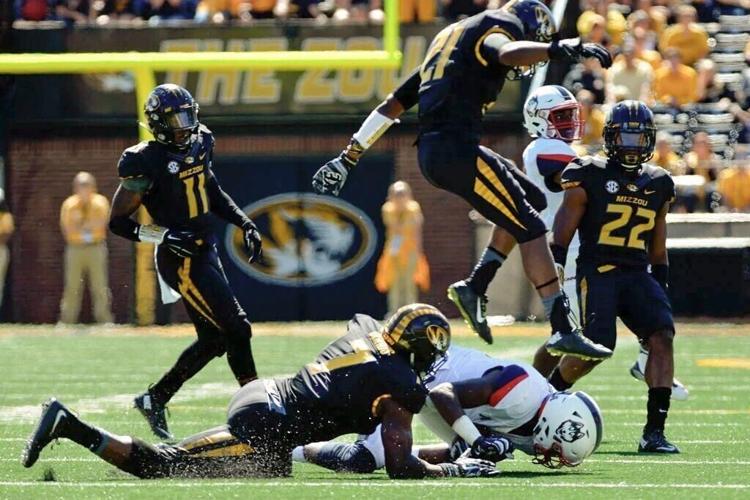
Missouri safety Ian Simon leaps over Missouri defensive back Kenya Dennis and Connecticut wide receiver Thomas Lucas during the fourth quarter of the football game Sept. 19, 2015 on Faurot Field.
The worst was yet to come.
Quarterback Maty Mauk, who impressed in 2014 as the full-time starter, missed the final eight games of the 2015 season while serving consecutive suspensions for “disciplinary” reasons (Mauk would be dismissed from the team the following January for “violating team rules”).
That meant true freshman Drew Lock became QB1. A highly touted recruit from the Kansas City area, Lock arrived at MU as the Class of 2015’s top-ranked high school football player in Missouri. The future was promising, but with Mauk now out of the picture, the future had to become the present.
Lock’s first start, against the Gamecocks, went well, as he completed 21 of 28 passes for 136 yards and two touchdowns in a win. In terms of completed passes, completion percentage and passing touchdowns, that would be his best game of the season. Outside of the upset win over BYU in November, the rest of October and November were all downhill for Lock and MU’s offense.

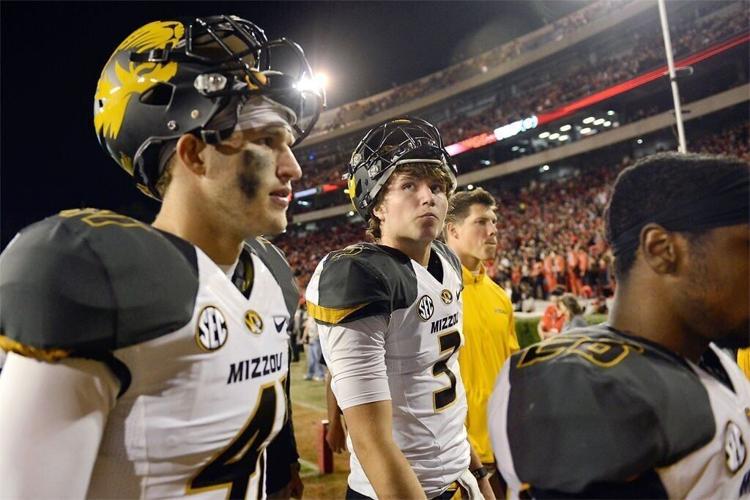
Missouri quarterback Drew Lock (3) walks off the field Oct. 17, 2015, after Mizzou’s 9-6 loss to Georgia in Athens, Ga. Lock completed 11 of 26 passes in the defeat.
The following collection of statistics conveys how awful the Tigers were on offense that season. Read at your own risk.
Over a period that spanned October and November, Mizzou went three straight games without scoring a touchdown. The Tigers had a bye after the third game, which meant that they went over a full calendar month without a TD.
The first of those games was a 21-3 loss to Florida on Homecoming. Since the Nixon presidency, the Tigers had only one other Homecoming game during which they scored just three points (1988 versus Iowa State). Mizzou started this game 0-of-8 on third down, and on the ninth attempt, Lock tried to connect with tight end Jason Reese on an out route, but the pass was intercepted by UF cornerback Teez Tabor and returned for a touchdown.
Late in the fourth quarter, with Florida up big, the ESPN broadcast spotlighted Mizzou chain crew member Rich Montgomery, who’d done the job for half a century before retiring in 2018. What seemed like a sweet gesture was actually salt in the wound: Montgomery was the chain crew member responsible for keeping track of downs in the infamous Fifth Down loss to Colorado in 1990.
Things didn’t get much better the next week against Georgia. The opening moments of the game summed up the difference between the offense and defense: On the first play from scrimmage, Mizzou defensive back Ian Simon intercepted UGA quarterback Greyson Lambert and returned it to the Georgia 1-yard line. One fumble and consecutive run stuffs later, Mizzou settled for a field goal. A Herculean defensive effort had gone to waste.

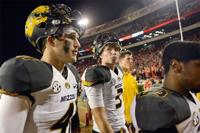
That was one of five offensive drives that traveled 1 yard or less. The Tigers lost 9-6.

Maty Mauk runs the ball during Missouri’s game against UConn on Sept. 19, 2015, at Memorial Stadium. The game was the last Mauk played before his suspension.
Against Vanderbilt on Oct. 24, Mizzou’s first nine drives totaled 39 yards. Vanderbilt would go on to win 10-3, snapping a 10-game losing streak to SEC opponents.
In Mizzou’s final game, against Arkansas on Nov. 27, just over half of its plays went for zero or negative yards. Lock went 9-of-27 for 83 yards with an interception. Mizzou lost 28-3.
The Tigers finished the season losing each of their last six SEC games. They didn’t score 10 points in five of their final seven games, which they’d only done twice before since World War I (1989, 1971).
Since 2016, Mizzou has failed to reach 200 yards of offense in a game just once. In 2015, the Tigers did that three times.
They also averaged just 13.6 points per game. Only Kent State had fewer points per game (13.1) among all 128 FBS teams.

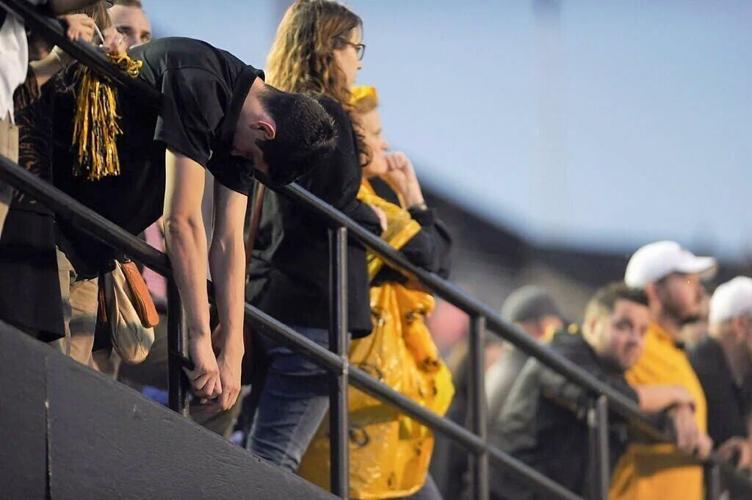
A Missouri fan slumps over the rail after watching kicker Andrew Baggett’s field goal attempt hit the post in the third quarter of the Tigers’ game against Vanderbilt on Oct. 24, 2015, in Nashville, Tenn. MU lost 10-3.
Offensive ineptitude is conducive to a lot of punting. Corey Fatony, then a freshman at MU, punted 81 times in 2015, breaking a program record that’d stood for 20 years and still stands today.
A team punting often meant that it struggled on third down, and “struggled” is a kind term in this context. Over their final six SEC games, the Tigers were 11-of-85 (12.9%) on third down. The worst FBS teams on third downs over a full season usually convert around 24% of the time.
The offense’s lack of success took a massive toll on the defense. Over MU’s final six SEC games, the defense was on the field for almost 83 more minutes than the opposing teams’ defenses. If you broke some speed limits, you could make it from Columbia to Lake of the Ozarks in that amount of time.
But there’s one stat that stands above all.
Over the past 40 years, there have been 480 instances of a team allowing fewer than 17 points per game in a season. Only 10 of those teams — 2.1% — had a losing record. Mizzou’s 2015 team was one of them.

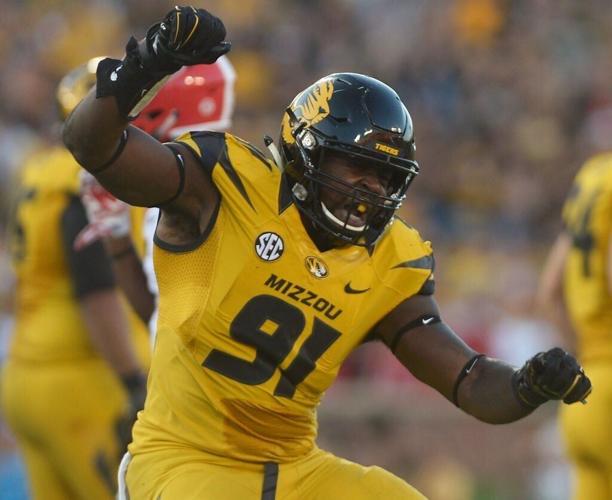
Defensive end Charles Harris celebrates after getting a third down tackle during the first quarter against the Georgia Bulldogs on Sept. 17, 2016, on Faurot Field.
Charles Harris celebrates a tackle (copy)
On that list of 480 are all-time great teams, many of which went on to win the national championship, including Indiana this past season. On average, teams in this group won about 78% of their games.
Mizzou couldn’t even become bowl-eligible.
Exclusive clubs are usually fun to be a part of, but the club Mizzou joined is one you want to leave immediately after walking into it. Boston College only cleared 20 points twice in 2015, and both instances came against FCS teams (Howard and Maine) that combined to go 4-18. In 2004, Penn State lost a game 6-4 and over its first six conference games combined for a whopping 44 points. In 1990, Bowling Green went over a full calendar month without crossing the 14-point mark.
If two individual plays encapsulated the season, they were the last plays of Mizzou’s final two contests of 2015.
On the last play of regulation against Tennessee, the Volunteers led 19-8. Winning was impossible, but the Tigers still ran one last play from their own 41-yard line. Lock stepped up in the pocket, which is normal. He then bumped into offensive lineman Taylor Chappell, who was facing Lock, which is not normal at all. But Lock stayed upright, rolled to his right and fired a rocket about 30 yards down the right sideline.

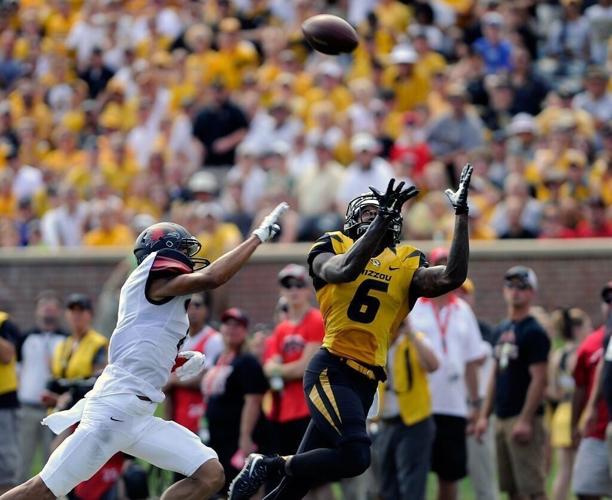
Southeast Missouri cornerback Michael Ford attempts to intercept Missouri wide receiver J'Mon Moore during the first quarter of the football game on Sept. 5, 2015, on Faurot Field.
The only player in the camera view was Tennessee defensive back Malik Foreman, who watched the ball bounce harmlessly out of bounds a few yards in front of him as the clock read zeros.
Facing Arkansas, Mizzou’s last offensive play came with 79 seconds left in regulation. UA led 28-3. Facing a fourth-and-10 from the Arkansas 33-yard line, Lock stood in shotgun formation. He faked an inside handoff, stepped up in the pocket and threw a deep shot to the end zone, where the only player near the ball was Arkansas defensive back Josh Liddell. The interception was more like receiving an arm punt, as Liddell caught it and knelt in the end zone to end the game.
The two plays were also representative of a deep passing game that seldom got off the ground. According to PFF, Lock attempted 57 passes of at least 20 air yards in 2015. Only nine of them were completed, good for a percentage of 15.8.
Since PFF began tracking college data in 2014, there have been 721 instances of an FBS quarterback attempting at least 50 passes of 20-plus air yards in a season.
Lock’s completion percentage ranked No. 720.

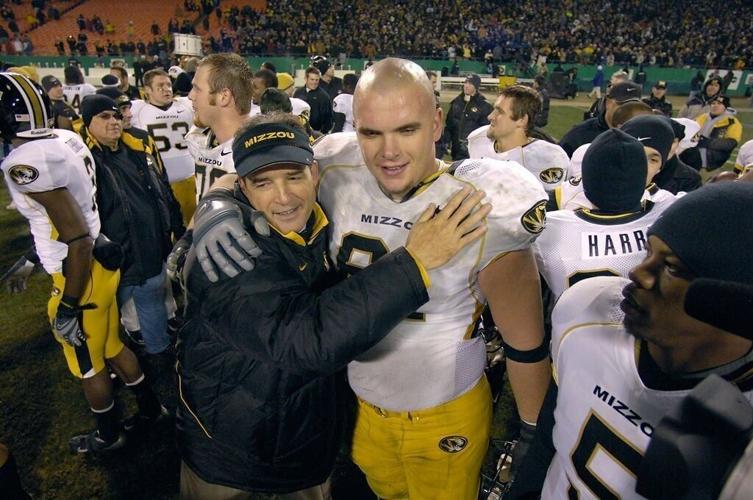
Missouri head coach Gary Pinkel and embraces offensive lineman Colin Brown after Missouri’s victory against Kansas on Nov. 24, 2007 on Faurot Field.
So, what’s the on-field legacy of this team? Was this simply an odd blip in history? When looking at the past and future, the answer is yes. Mizzou had been to the SEC title game in 2013 and ’14 but tied with South Carolina for the worst SEC record in 2015 (1-7). From 2016-19, the Tigers were largely defined by having electric offenses and shoddy defenses under coach Barry Odom. That 2015 season was the complete opposite.
But no matter how confounding the team was on the field, its legacy will always reside off the field. And even amid one of the darkest periods in the university’s history, the football team still carved out a silver lining. Inaction from university leadership may have continued had the team stayed silent.


(0) comments
Welcome to the discussion.
Log In
Keep it Clean. Please avoid obscene, vulgar, lewd, racist or sexually-oriented language.
PLEASE TURN OFF YOUR CAPS LOCK.
Don't Threaten. Threats of harming another person will not be tolerated.
Be Truthful. Don't knowingly lie about anyone or anything.
Be Nice. No racism, sexism or any sort of -ism that is degrading to another person.
Be Proactive. Use the 'Report' link on each comment to let us know of abusive posts.
Share with Us. We'd love to hear eyewitness accounts, the history behind an article.