
When Mark Peterson talks about food insecurity in Alabama’s Black Belt, he frames the issue a little differently than most.
“Hunger isn’t really a food problem,” Peterson said. “It’s a logistics problem.”
The Selma native believes the biggest barrier to healthy food in rural communities isn’t always supply - it’s access. Grocery stores have closed across much of the region, leaving residents to travel miles for basic groceries. Peterson’s startup, Ziscuit, is built around a model he hopes can change that.
Operating from the Selma Mall, Peterson is testing a system that allows residents to order affordable grocery online and pick them up locally at designated sites potentially using refrigerated lockers or existing freezers in buildings that once housed grocery stores.
His goal is to build a network of convenient pickup locations across the Black Belt.
One of his first targets is Orrville, where the closure of the town’s Family Dollar store last year left residents with even fewer food options.
Peterson has been in talks with the building’s owner about using the freezers and shelving still inside the closed store to hold grocery orders for residents.
“Those units are already there - eight to 10 of them - and they’re perfect for storing food until residents come pick it up,” he said.
Under the model, residents would order groceries before a weekly deadline. Ziscuit would deliver the food the same day it arrives, and customers would select a pickup time slot.
Peterson said he also hopes to test the concept in Uniontown and other rural Black Belt towns where grocery stores have disappeared.
“For a lot of seniors, driving to Selma or Thomasville for groceries isn’t an option,” he said. “People are already asking neighbors or family members to pick things up for them. We’re just trying to create a better system.”
A partnership to test the idea
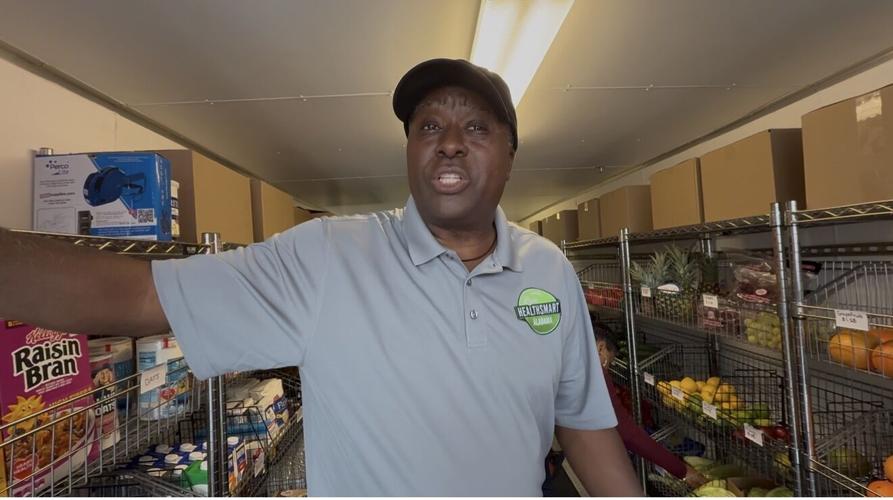
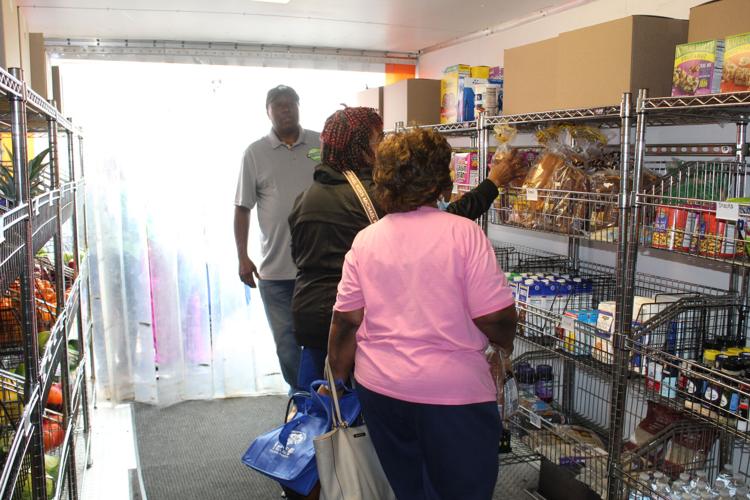
Peterson has already begun experimenting with the concept through a partnership with UAB’s Live HealthSmart Alabama Mobile Market, which brings fresh produce to underserved communities.
Ziscuit sources the produce for the mobile market events in Selma and Demopolis. Peterson said every event so far has sold out.
“My part of the partnership is sourcing food and driving the price down so it becomes compelling for families to invest in healthy food instead of processed food,” he said.
The next step, he said, is allowing residents to preorder groceries through Ziscuit before the mobile markets arrive, helping organizers plan inventory and allowing customers to pick up boxes they already purchased.
Peterson said he is also working to enable EBT payments so the system can serve families who rely on SNAP benefits.
Lessons from a childhood mentor
Peterson traces his interest in food access back to childhood in the Black Belt.
Growing up, he watched Marzel Easley, a Linden pastor who operated a network of small convenience stores in rural communities such as Gallion and Linden.
Peterson describes Easley as a “retail genius” who understood how to serve communities where transportation and income were limited.
“He met people right at their point of pain,” Peterson said. “You could buy one pickle, a cup of flour or even a single egg.”
Easley even created a grocery layaway system that allowed customers to pay for food throughout the month, keeping track of accounts on index cards.
“That kind of innovative thinking stayed with me,” Peterson said.
Early experiments in college
Peterson carried that mindset with him to Dartmouth College in New Hampshire, where he began experimenting with his own small-scale retail ideas.
He ran late-night hot dog carts on campus after dining halls closed and created a small convenience operation that allowed students to charge purchases to their student IDs and have parents pay the bill later.
“It was basically a rolling grocery store,” he said. “And it worked.”
A career in tech — and a return home
After college, Peterson built a career in the technology sector.
He worked with Pridelock, a company that managed outsourced fingerprinting and background-check data for new hires. The system allowed job applicants to book appointments at locations such as UPS stores across the country.
The platform grew to serve major banks and other large clients before eventually being sold to First American.
Peterson said the experience helped shape the infrastructure behind Ziscuit.
“It showed me how to build a network across many locations and manage it through technology,” he said.
Building a new grocery infrastructure
Peterson launched Ziscuit through Birmingham’s Innovation Depot startup incubator and was a participant in the Techstars accelerator program in 2022.
While early pilots began in Birmingham, Peterson said bringing the model to Selma felt natural.
“This is home,” he said. “It’s a place where there’s real need, but also the space to learn and refine the model.”
The system relies on refrigerated lockers and pickup sites located at places people already visit — libraries, hospitals, schools and community centers.
Customers order groceries online and retrieve them later, reducing the need for large, expensive grocery stores.
“If you can build enough pickup points, you can extend people’s food budgets and bring healthy food closer to where they live,” Peterson said.
In some locations, he hopes the system will eventually operate without staff.
Customers would receive a code, unlock a locker, retrieve their order and close the door — similar to an automated package pickup system.
“If we get enough volume, the operating costs go way down,” he said.
A community-driven model
Peterson said he plans to hold a town hall meeting in Orrville with Mayor Louvenia Lumpkin to discuss how the program might work locally.
The goal is to create a system residents feel ownership over and that can sustain itself long-term.
“There has to be a shared vision,” he said. “People have to see the value.”
If the Orrville pilot works, Peterson believes it could become a model for other rural towns facing the same challenges.
“This could be a case study for how to implement something like this in rural America,” he said.
His long-term vision is ambitious: a nationwide network of pickup lockers and distribution points that make healthy groceries — and eventually other essentials like medicine — accessible in places where traditional stores struggle to survive.
“I think about it like building infrastructure,” Peterson said. “The way Tesla built charging stations.”
“If we can connect these communities into one network, we can make healthy food available at prices people can actually afford.”

(0) comments
Welcome to the discussion.
Log In
Keep it Clean. Please avoid obscene, vulgar, lewd, racist or sexually-oriented language.
PLEASE TURN OFF YOUR CAPS LOCK.
Don't Threaten. Threats of harming another person will not be tolerated.
Be Truthful. Don't knowingly lie about anyone or anything.
Be Nice. No racism, sexism or any sort of -ism that is degrading to another person.
Be Proactive. Use the 'Report' link on each comment to let us know of abusive posts.
Share with Us. We'd love to hear eyewitness accounts, the history behind an article.