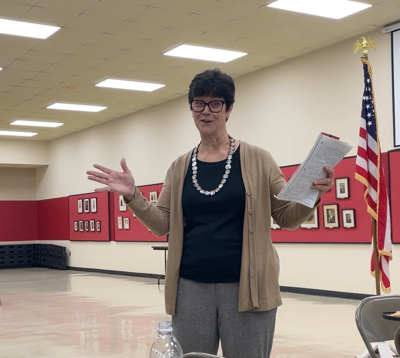

The Selma Redevelopment Authority is still in its early stages of rebuilding, but Executive Director Sarah Aghedo says the past year has laid a foundation for long-term downtown revitalization.
Speaking to the Selma Rotary Club on Monday at Cornerstone Presbyterian, Aghedo walked members through what the authority is, what it has accomplished and what it hopes to tackle next.
More than $6 million in private investment has flowed into the Water Avenue and lower Broad Street area in the past two to three years, she said, and several major projects – including the Harmony Club and the Adler building – are moving forward.
“It’s slow,” she told Rotarians. “But when we see progress, it makes us feel better. One year in and ready for the next.”
Aghedo acknowledged challenges continue, such as vacant buildings, code enforcement gaps and the long-delayed reopening of the Interpretive Center at the foot of the Edmund Pettus Bridge, which she said is not expected to open before 2028. She has asked the National Park Service to consider moving construction fencing to improve pedestrian access and to allow for directional signage.
The closed St. James Hotel, noting that an investor is interested but must work through ownership and operational hurdles. Reviving the Washington Street Market, she said, could help address the downtown food desert and support both residents and visitors once the hotel reopens.
Aghedo said her first year with SRA has centered on three priorities: building relationships, sharing information and offering practical assistance to downtown businesses. She has spent much of her time walking the district, meeting business owners and conducting a business survey that included everyone from Queen City Market and Spiller Furniture to barbershops, salons and small retailers. “We’ve done our best to answer questions and connect people with resources they may not be aware of,” she said.





The authority also hosted several workshops, including a meet-and-greet for developers and contractors, an “Eggs and Issues” breakfast for business owners, and a tax credit luncheon led by Opportunity Alabama to highlight incentives beyond historic tax credits. Aghedo said the authority has also used social media to keep the public informed and to promote downtown dining options through its “lunchtime list.”
Practical assistance has included a unified signage grant that provided storefront decals, sandwich boards and planters to participating businesses. A revised façade grant program now reimburses up to $5,000, half the cost of approved exterior improvements, including roofs. The authority also launched its first “storefront showdown” during the Christmas season, awarding $1,500 in façade funding to Grace Furniture, with Lena’s Floral Shop and Queen City Market taking second and third place.
Aghedo highlighted Selma’s progress as an aspiring Main Street Alabama community, noting that training sessions in cities like Jasper and Anniston show what is possible with sustained effort. “If we follow the road map that Main Street provides, we can potentially also have a very walkable downtown,” she said. Main Street’s focus on economic development through historic preservation, she added, aligns well with Selma’s strengths.
Aghedo reminded the group that the authority is a municipal body created by the Selma City Council in 1994 and reestablished in 2016. She has served as director for the past year, overseeing a seven-member board recently expanded with three new council-approved appointments. The board is chaired by Dr. Rose Wilkins, with Jimmy Coleman as vice chair, Councilman Clay Carmichael as secretary, and Sylvia Smith as treasurer. New members include developer Erica Day, funeral home owner Aubrey Larkin and Selma High School teacher Daryl Walker.
The authority’s mission, she said, is defined by Alabama law: to encourage and promote improvement, revitalization, and long-range planning within a designated downtown district. Selma’s redevelopment footprint stretches from J.L. Chestnut Boulevard to Water Avenue and from Martin Luther King Street to Church Street, with an additional extension near Selma Avenue and Alabama Avenue.
Financial support for the authority’s work has come from the city, county, Ala-Tom RC&D, the Daniel Foundation, the Goodrich Foundation and the Alabama Humanities Alliance, which funded a historic photo banner project now underway.
Looking ahead, Aghedo said the authority plans to deepen its partnerships with city and county officials, continue working with property owners and developers, and pursue full designation as a Main Street community. She also emphasized the need for better communication around major events after downtown businesses missed opportunities during a large bike race last weekend. “There’s our opportunity for next year to make sure everyone is aware of it,” she said.

(0) comments
Welcome to the discussion.
Log In
Keep it Clean. Please avoid obscene, vulgar, lewd, racist or sexually-oriented language.
PLEASE TURN OFF YOUR CAPS LOCK.
Don't Threaten. Threats of harming another person will not be tolerated.
Be Truthful. Don't knowingly lie about anyone or anything.
Be Nice. No racism, sexism or any sort of -ism that is degrading to another person.
Be Proactive. Use the 'Report' link on each comment to let us know of abusive posts.
Share with Us. We'd love to hear eyewitness accounts, the history behind an article.