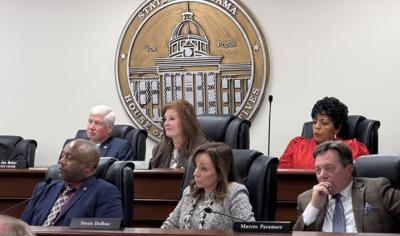
BIRMINGHAM, Ala. – Lawmakers return this week with a slate of education bills poised for committee action, ranging from school prayer and Ten Commandments displays to changes in school grading and career tech workforce programs.
With 13 legislative days remaining, several proposals are set for committee votes this week after drawing debate in earlier hearings.
School prayer and pledge proposal
A proposal to put school prayer and the Pledge of Allegiance into the state constitution is slated for a vote in two separate House committees on Wednesday.
House Bill 43, sponsored by Rep. Reed Ingram, R-Pike Road, would place a constitutional amendment on the November ballot requiring public schools to conduct the Pledge of Allegiance and requiring local boards of education to vote on whether to adopt a policy allowing daily voluntary prayer and Bible reading.
While the pledge is already required under state law, Ingram’s proposal would impose a financial penalty of up to 25% of a district’s state funding for noncompliance.
Student-initiated voluntary prayer is already permitted in Alabama public schools under state law, provided it is not school-sponsored or led by employees.
The bill would also require school boards to vote on the prayer policy within 90 days of the amendment’s ratification or face the same funding loss.
The measure drew criticism from some House Education Policy committee members last week, who questioned both its necessity and the severity of the funding penalty. Committee Chair Terri Collins, R-Decatur, said she did not believe the bill had enough support to advance at the time and asked Ingram to bring it back Wednesday. It is scheduled to be voted on in the committee’s 1:30 p.m. meeting.
Ingram filed an identical bill, House Bill 511, that is scheduled for consideration later Wednesday afternoon in the House State Government Committee where a public hearing has been called.
Ten Commandments display bill
Also on Wednesday’s House Education Policy agenda is House Bill 216, sponsored by Rep. Mark Gidley, R-Hokes Bluff, which would require displays of the Ten Commandments in certain public school classrooms and common areas serving students in grades 5 through 12.
The bill calls for the Commandments to be presented in a historical context and displayed in history classrooms and at least one additional common area serving those grades.
A Senate companion, Senate Bill 99, sponsored by Sen. Keith Kelley, R-Anniston, cleared a Senate committee last week and awaits consideration by the full Senate.
School grading changes proposed
A third bill the House Education Policy committee will consider is House Bill 396, sponsored by Chair Collins, which would revise the formula used to assign annual letter grades to Alabama public schools.
Collins presented a revised version of the bill in committee last week.
The bill would adjust the weight of existing measures and add a new metric focused on academic growth among the lowest-performing 25% of students. It would also allow the state to raise the performance thresholds required to earn each letter grade after three years, based on recommendations from a newly created accountability council.
During a public hearing last week, school superintendents and other education officials warned the changes could significantly affect schools’ annual ratings and argued lawmakers should not alter the grading system after schools have operated under the current framework for years.
Collins said last week she will continue to work with officials to refine the bill before bringing it to the committee for a vote.
Two other bills that would alter report card measures have not yet been considered. House Bill 406, sponsored by Rep. Marcus Paramore, R-Troy, would remove all measures of students who receive a non-standard high school diploma. House Bill 495, sponsored by Rep. Jamie Kiel, R-Russellville, would exclude the academic performance measures of students who transfer from a failing school for the first three years of their enrollment.
Bill package targets career tech teacher shortages
Two bills aimed at expanding Alabama’s career and technical education workforce are up for consideration in the House Ways and Means Education committee Tuesday at noon.
House Bill 517, sponsored by Rep. James Lomax, R-Huntsville, would create the Talent Readiness and Industry Needs, or TRAIN, Act. The proposal would allow employers to temporarily loan qualified industry professionals to teach CTE courses in public high schools and community colleges while offering up to $10 million annually in income tax credits to participating companies.
The bill would also establish a new Workforce Teaching Certificate outlining minimum qualifications, including a background check.
A companion measure, House Bill 520, sponsored by Rep. Marcus Paramore, R-Troy, would create an expedited certification pathway for experienced out-of-state teachers seeking to teach CTE courses in Alabama public high schools.
National Guard scholarship expansion debated
Lawmakers are also considering an expansion of the Alabama National Guard Educational Assistance Program.
House Bill 233, sponsored by Rep. Ed Oliver, R-Dadeville, would broaden the program to cover on-campus housing costs and certain workforce training programs for dependents of Guard members – benefits not currently covered under the program.
The proposal drew criticism last week from Alabama Commission on Higher Education Executive Director Jim Purcell, who told lawmakers the bill contains unresolved administrative and cost concerns.
A Senate companion, Senate Bill 108, sponsored by Sen. Andrew Jones, R-Centre, has cleared a Senate committee and awaits consideration by the full Senate.
The Senate Education Policy and Senate Finance and Taxation Education committee agendas were not available before the article was published.
Still to come
Lawmakers are also expected to take up the nine-bill education budget package soon as they balance competing priorities within the Education Trust Fund.
Gov. Kay Ivey has proposed a $10.5 billion ETF budget – the maximum amount allowed under current law.
Within that framework, lawmakers must decide how to address a projected $380 million shortfall in the Public Education Employee Health Insurance Plan, fund a proposed 2% teacher raise estimated at $100 million, determine how much to allocate to the growing CHOOSE Act school choice program and account for additional spending required under the K-12 RAISE Act, which directs more funding to students with greater needs.

(0) comments
Welcome to the discussion.
Log In
Keep it Clean. Please avoid obscene, vulgar, lewd, racist or sexually-oriented language.
PLEASE TURN OFF YOUR CAPS LOCK.
Don't Threaten. Threats of harming another person will not be tolerated.
Be Truthful. Don't knowingly lie about anyone or anything.
Be Nice. No racism, sexism or any sort of -ism that is degrading to another person.
Be Proactive. Use the 'Report' link on each comment to let us know of abusive posts.
Share with Us. We'd love to hear eyewitness accounts, the history behind an article.