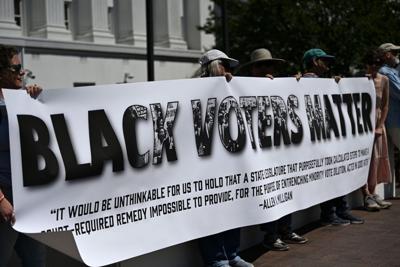
Plaintiffs seeking to maintain Alabama’s current congressional maps on Monday afternoon urged the U.S. Supreme Court to uphold a lower court’s ruling requiring Alabama to use a “race-blind” congressional map for the 2026 elections.
The 54-page brief came after Alabama officials appealed a May 26 ruling by a three-judge panel in the Northern District of Alabama District Court that the Legislature-passed congressional map denied Black Alabamians the chance to elect a candidate of their choice.
The plaintiffs argued Monday that there was no time to reassign voters under a new map; the 2023 map intentionally discriminated against Black Alabamians; and the lower court found the map still violates Section 2 after the Callais decision.
“Nothing has changed in Alabama or the record to warrant a different conclusion today. The Court should deny Alabama’s stay motion on any one or more of these independent grounds,” the brief stated.
The appeal to the U.S. Supreme Court comes almost a month after the high court substantially weakened Section 2 of the Voting Rights Act in a case known as Louisiana v. Callais, and weeks after Gov. Kay Ivey called a special session in which Republican lawmakers set special primaries for August in the expectation that the state would be allowed to use the 2023 map, which would likely cost Democrats a seat in Alabama’s House delegation.
The plaintiffs also argued that the state fails to show that a stay is warranted.
“The state cannot make out a ‘strong showing’ on the likelihood of success on the merits because the district court’s decision was correct on the merits,” the brief states. “And because the Remedial Plan has been the practical status quo in Alabama, and voting is nearly underway under it, all of the equitable stay factors are dispositively in Plaintiffs-Respondents’ favor here.”
The plaintiffs said the state would face no harm under the court-ordered map, which was used in 2024 and in the May 19 primary, whereas voters would be harmed “irreparably” under the 2023 map.
“States have no legitimate interest in furthering racial discrimination, including by using a map that a court has found to be a product of intentional discrimination. That is especially true when dealing with elections,” the brief states. “Alabama does not face irreparable harm, because ‘rather than spawning electoral chaos and serious error potential’ it has long sought to avoid, ‘the special master plan provides for certainty.’”
The three-judge panel last week upheld their previous ruling after being ordered to review the case by the Supreme Court under Callais. The panel said the map was still intentionally racially discriminatory, even though Republican lawmakers and state officials started arguing the map was drawn with partisan intent after the Callais decision.
The judges — U.S. District Judge Anna Manasco, U.S. District Judge Terry Moorer, appointed by President Donald Trump; and U.S. Circuit Judge Stanley Marcus, appointed to the circuit by former President Bill Clinton — wrote in the 79-page opinion that the state’s argument contradicted its arguments made in 2023, and said the purpose of the 2023 map “was to distribute Black voters across districts to dilute their votes, at least in part because they are Black.”
“Counsel argues mightily that the Legislature’s partisan motives drove the creation of the 2023 Plan, but this enormous record contains no evidence of a partisan motive. And the only evidence on the issue cuts against one: Alabama’s legislative leadership testified that overtures from national party leaders did not affect their work,” the judges wrote last week.
The state appealed the order to the Supreme Court the next day. They requested an expedited response, but Supreme Court Justice Clarence Thomas gave the plaintiffs six hours past the state’s requested decision time to respond. As of early Monday evening, the court had not responded to the appeal.
The Alabama Attorney General’s Office argued that the 2023 map was drawn with partisan gain in mind, and only disobeyed the court’s order to draw a remedial map to avoid racial gerrymandering.
“It cannot be that the only constitutional map for the State to have drawn this redistricting cycle was one where white voters are drawn into white districts and given white representatives and Black voters ‘drawn into ‘Black districts’ and given ‘Black representatives,’’ a scheme ‘repugnant’ to the Constitution itself,” the appeal application stated.
Ivey called a special primary election in the 1st, 2nd, 6th and 7th congressional districts for Aug. 11. The statewide voter rolls lock on Tuesday, meaning that election officials would have less than a day to reassign voters in 14 counties whose districts will change, according to testimony from the state’s election director.
Plaintiffs in a related case, Singleton v. Allen, filed a brief in opposition to the application, arguing that there is not enough time to reassign voters. Most state offices are closed on Monday in celebration of Jefferson Davis’ birthday, the president of the Confederacy, leaving election officials “a few hours on an Alabama holiday” to reassign voters.
“Alabama’s quixotic attempt to condense a months-long process into a few hours is not harmless,” the brief states. “If county registrars complete only part of their work on June 1 or June 2, the voter registration database will lock in a plan that is not the 2023 Plan and not the Special Master’s remedial plan, but some hybrid of the two that no statute or court authorizes Alabama to use, and one that could violate the ‘one person, one vote’ principle required by Reynolds v. Sims.”
The Supreme Court did not repeal Section 2 of the Voting Rights Act in the Callais decision, which prohibits race-based discrimination in voting practices, but it required proof of intentional racial discrimination, a significantly higher standard than the previous one
In the Callais decision, the Supreme Court ruled that racial discrimination with intent does violate Section 2 of the Voting Rights Act, but redistricting in the name of party does not. Texas, California, South Carolina, Tennessee, Florida and Virginia have either redistricted to give either party more guaranteed congressional seats in the 2026 midterm elections, or are in the process of doing so.
Despite the wave of mid-decade redistricting for partisan gain, Marshall said on Capitol Journal Friday that if there was more time, the Legislature could have drawn a congressional map with seven Republican districts.
“I think that’s very conceivable, but they defaulted to the [2023] map and we believe that map itself is lawful,” he said.
State officials doubled down on their application Monday evening, arguing that the timing argument only strengthens the state’s eligibility to use the 2023 map.
“Plaintiffs insist (without evidence) that only the court’s map ‘aligns with [public] expectations,’ but after the state held a special session of the Legislature to enact a new election schedule, called off the May 19 primary for affected districts, and then scheduled a new primary for August using the 2023 Plan, that plan was the legal and practical status quo,” the seven-page brief states. “It will then be for Alabama’s elected officials to determine the best path forward for the upcoming elections in light of the time crunch at hand.”
Amici briefs
John Sauer, the Solicitor General of the United States, filed a brief in support of Alabama officials Wednesday afternoon, urging Thomas to grant the stay. Sauer supported Marshall’s claims that the redistricting efforts were for partisan gains, not racial discrimination.
The National Republican Congressional Committee (NRCC) joined the Department of Justice, supporting the state’s appeal early Monday afternoon. It argued that the Supreme Court has said federal courts should not keep state legislatures from creating their own legislative districts and preventing the use of the 2023 map would go against that precedent.
“A federal court’s displacement of a state’s enacted congressional map creates uncertainty for candidates and political parties nationwide, particularly during an ongoing election cycle. It also undermines the Constitution’s allocation of primary responsibility for districting to political actors,” the brief stated.
The NRCC also argues that, under the Purcell principle — a 2006 precedent that elections should not be changed close to election day — the federal court was “forbidden” from changing the congressional map in the middle of the election.
“Nevertheless, on May 26 — the same day those certifications were due — the district court displaced the 2023 Plan and ordered that all remaining election events proceed under a court-ordered plan. That displacement cannot be squared with Purcell,” the brief stated, in reference to the special primary.
A group of election officials and scholars represented by the Democracy Defenders Fund — a nonpartisan group “dedicated to stopping the assault on democracy and restoring American democracy” — filed a brief in support of the plaintiffs. They urged the Supreme Court to uphold the lower court’s ruling because of the “unprecedented and extraordinary challenges” Alabama election officials will face with a different election map.
“Those challenges will almost certainly lead to widespread confusion, substantial mistakes in voter reassignments, and votes of eligible voters not being counted,” the brief stated.
Currently, voters are assigned to congressional districts in the court-ordered map, which was used in the 2024 election and in the May 19 primary. Alabama Director of Elections Jeff Elrod testified that it usually takes “several months” to reassign voters and an expedited schedule could lead to voters being assigned to incorrect districts and being given incorrect ballots.
Alabama Reflector is a nonprofit newsroom in Montgomery. It is part of the States Newsroom agency.

(0) comments
Welcome to the discussion.
Log In
Keep it Clean. Please avoid obscene, vulgar, lewd, racist or sexually-oriented language.
PLEASE TURN OFF YOUR CAPS LOCK.
Don't Threaten. Threats of harming another person will not be tolerated.
Be Truthful. Don't knowingly lie about anyone or anything.
Be Nice. No racism, sexism or any sort of -ism that is degrading to another person.
Be Proactive. Use the 'Report' link on each comment to let us know of abusive posts.
Share with Us. We'd love to hear eyewitness accounts, the history behind an article.