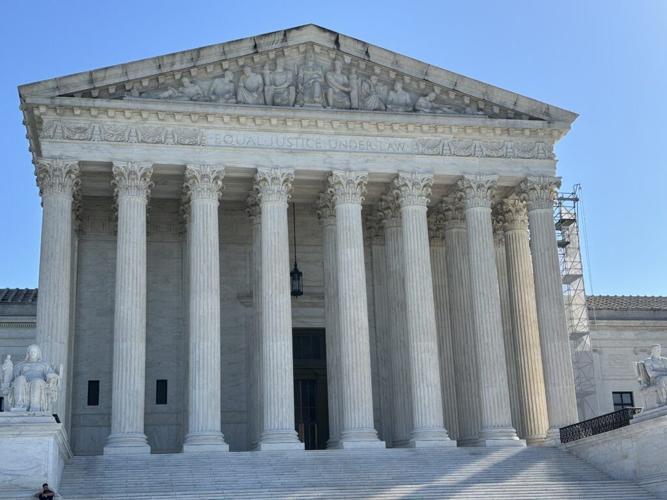
The U.S. Supreme Court Monday overturned a 2023 ruling blocking use of a congressional map the courts ruled as racially discriminatory, which could open the way for Alabama to use new district lines this year.
The order from the nation’s highest court in the case, known collectively as Allen v. Milligan, came about a week before the state’s May 19 primaries and about a week and a half after the court significantly weakened Section 2 of the Voting Rights Act, which prevents racial discrimination in voting laws, in a case known as Louisiana v. Callais.
The ruling said plaintiffs challenging maps under Section 2 must show intentional discrimination to prevail.
As is common practice, the majority did not provide an opinion with Monday’s order.
Supreme Court Justice Sonia Sotomayor dissented in the order, joined by justices Elena Kagan and Ketanji Brown Jackson, saying there is no reason to reconsider Alabama’s case.
“In addition to holding that Alabama’s 2023 Redistricting Plan violates [Section] 2, the district court held, in one of the three cases before this Court, that Alabama violated the Fourteenth Amendment by intentionally diluting the votes of Black voters in Alabama,” Sotomayor wrote. “That constitutional finding of intentional discrimination is independent of, and unaffected by, any of the legal issues discussed in Callais.”
The state currently uses a congressional map drawn by a special master appointed by a federal court in 2023, after the courts ruled a congressional map approved by the Alabama Legislature in 2021 discriminated against Black voters in the state by not giving them a full chance to select their preferred leaders. The U.S. Supreme Court upheld the ruling in 2023, after delaying its implementation for over a year, past the 2022 midterms.
A new map drawn by the Legislature in 2023 was also ruled a violation of Section 2 of the Voting Rights Act. Under the current map, the 2nd Congressional District, currently represented by U.S. Rep. Shomari Figures, D-Mobile, has a Black Voting Age Population (BVAP) of about 49%, while the 7th Congressional District, represented by U.S. Rep. Terri Sewell, D-Birmingham, has a BVAP of about 52%.
Section 2 was considerably weakened by the U.S. Supreme Court in April in Louisiana v. Callais, which said plaintiffs challenging congressional maps had to prove intentional discrimination, a far higher bar than the previous standard of showing discriminatory effects.
“The Court’s decision interferes with the ongoing election and puts the validity of the votes of thousands of early voters into doubt,” said Deuel Ross, director of litigation at the Legal Defense Fund (LDF), which represented the plaintiffs in the Milligan case. “We will consider all of our options for protecting the rights of voters and reinstating the court ordered map.
A message seeking comment from Gov. Kay Ivey was left Monday evening. Marshall said federal courts had “punished” the state for drawing its own maps, but the Supreme Court “vindicated the state’s long held position.”
“For too long, unelected federal judges had more say over Alabama’s elections than Alabama’s voters. That ended today,” Marshall said in a video posted to social media. “My job in this office was to put the Legislature in the best possible legal position to draw a congressional map that favors Republicans 7-0.”
Alabama Secretary of State Wes Allen said in a statement Monday that the ruling was a “historic win” for Alabama.
“The May 19 primary election will proceed as scheduled,” the statement said. “My office will remain in close contact with the Governor’s Office and the Attorney General’s Office as this situation continues developing.”
Senate President Pro Tem Garlan Gudger, R-Cullman, said in a statement Monday that the court ruling “has cleared the path for Alabama to hold free, open, and fair elections using the constitutional maps drawn by the Legislature rather than the unconstitutional maps forced upon the state by activist federal judges.”
“The Supreme Court’s action removes the thumb from the scale in legislative and congressional elections and allows Republicans to once again have a fair chance to compete,” the statement said.
Republicans control all statewide elected offices; both of the state’s U.S. Senate seats; five of its seven U.S. House seats; 76 of its 105 state House seats and 27 of its 35 Senate seats.
Kim Bailey, president of the League of Women Voters of Alabama, said Monday that the decision was “deeply disappointing and creates uncertainty and confusion for voters about the 2026 elections.”
“We encourage voters not to become disillusioned or discouraged,” the statement said. “Your vote matters. Your voice matters. And voter turnout will remain one of the most powerful tools we have to shape our future and defend representative democracy.”
‘An inextricable, permanent feature of this case’
“The Supreme Court has upended our election jurisprudence and done so in a way that severely, and systematically, disadvantages Black voters,” said Dev Wakeley, worker policy advocate with Alabama Arise. “The idea that this is a more level playing field, or that the safeguards against discrimination that we previously had until Callais were ready to be lifted, is absurd.”
The court Tuesday sent the case back to the three-judge panel with instructions to reconsider its ruling in light of the Callais ruling. Using the 2023 map would reduce the BVAP in the 7th Congressional District, represented by Sewell, to 50.6% and reduce the BVAP in the 2nd Congressional District, represented by Figures, to under 40%. That would likely throw the re-election of Figures into doubt.
Figures in a statement Monday called the court’s action “an incredibly unfortunate decision” and said the conservative justices “just literally substituted themselves in to be the defense lawyers for the state of Alabama.”
“I ran for this seat to be a voice for all of Alabama, and I’m not backing down from that mission now,” the statement said. “The fight must and will go on. Beyond the courts, we know what has to be done. We will organize, we will register, and we will turnout people in record numbers at the polls.”
Sewell in a statement Monday called the ruling “a stunning reversal” but said the decision would not be the final word.
“Black Alabamians have fought too hard and sacrificed too much to be dragged backwards by extremist politicians and an activist court,” the statement said. “Black voters make up nearly one-third of Alabama’s electorate and we deserve no less than two seats where we can select the candidate of our choice.”
Sotomayor noted that the court in Callais said its ruling in Allen v. Milligan — upholding a finding of racial discrimination in congressional maps — remained “good law.”
“This Court’s finding of racially discriminatory vote dilution is an inextricable, permanent feature of this case, and Alabama’s willful decision to respond by entrenching rather than remedying that dilution is, as the District Court correctly recognized, evidence of discriminatory intent,” Sotomayor wrote.
After the session
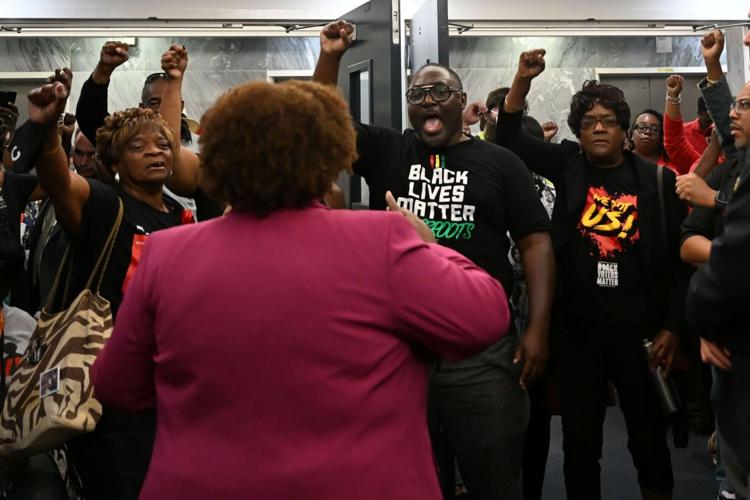
The Alabama Legislature last week approved two bills allowing new primaries to be held in districts that would be affected by the court overturning its prior orders. Lawmakers carried through with the process despite protests throughout the week that culminated with one person getting removed from the statehouse on the final day of the special session.
Plaintiffs in the Milligan case filed briefs on Monday said the injunction should stand because the remedial map currently in does not consider race.
“The district court never held that Section 2 required Alabama to adopt a majority-Black district or otherwise draw districts on the basis of voters’ race,” the plaintiffs said in their response. “The district court’s remedial plan is proof positive: it does not contain a second majority-Black district, and it was ‘prepared race-blind.’”
Opponents have said the primary laws passed by the Legislature last week could be unconstitutional under a 2022 amendment that requires election law changes to be made no later than six months before an election. The date this year was May 3; the special session began on May 4. Republicans said last week the amendment applies to general elections and not primaries.
Alabama Reflector is a nonprofit newsroom and part of the States Newsroom organization.

(0) comments
Welcome to the discussion.
Log In
Keep it Clean. Please avoid obscene, vulgar, lewd, racist or sexually-oriented language.
PLEASE TURN OFF YOUR CAPS LOCK.
Don't Threaten. Threats of harming another person will not be tolerated.
Be Truthful. Don't knowingly lie about anyone or anything.
Be Nice. No racism, sexism or any sort of -ism that is degrading to another person.
Be Proactive. Use the 'Report' link on each comment to let us know of abusive posts.
Share with Us. We'd love to hear eyewitness accounts, the history behind an article.