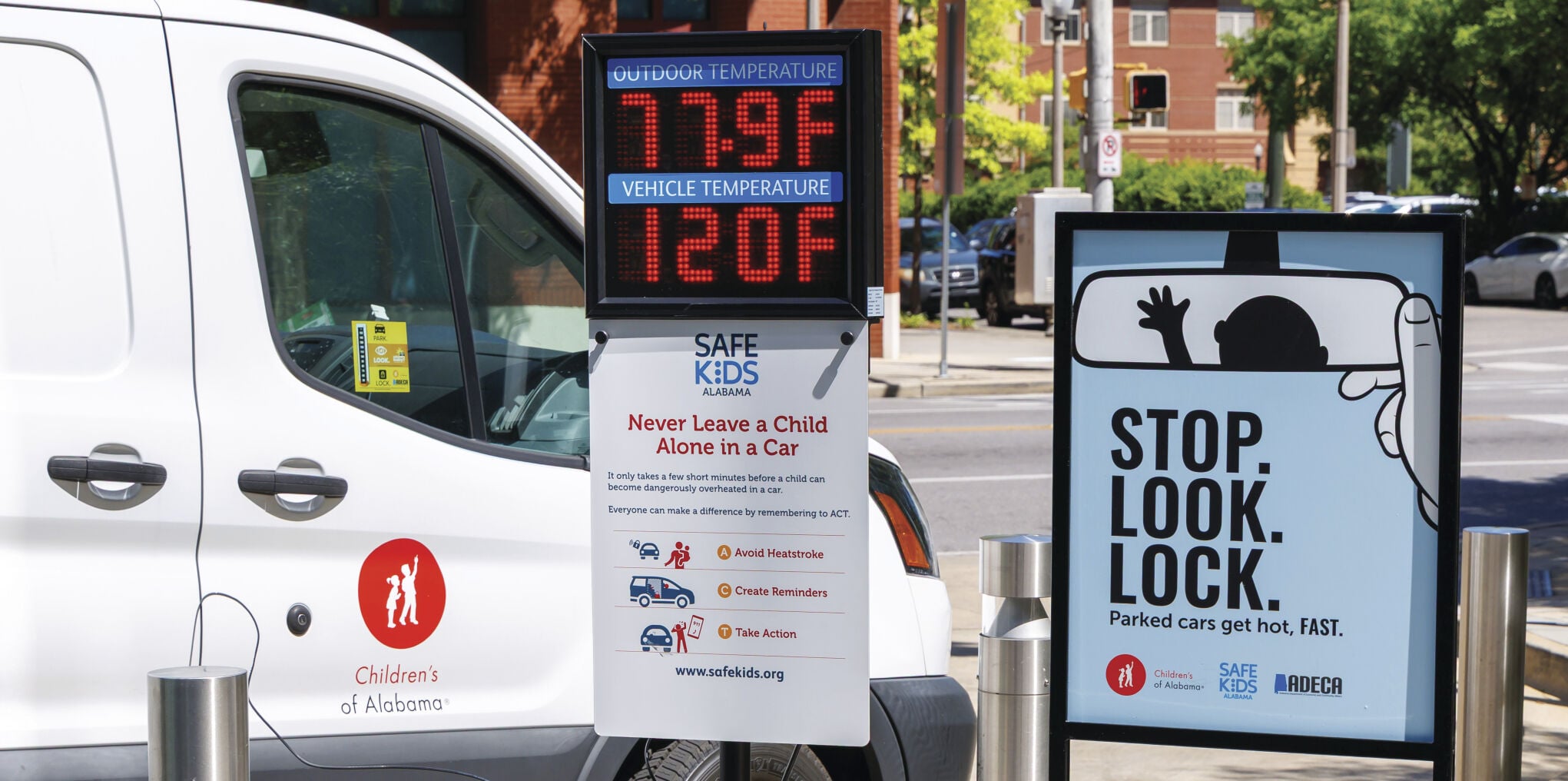

We all know that a moving vehicle can harm a child, but Children’s of Alabama is reminding parents that a parked car can be deadly as well.
Children’s of Alabama has kicked off a statewide campaign to prevent injuries and deaths that occur when adults leave a child in a car or when a child accidentally traps themself in a parked car.
The National Highway Traffic Safety Administration reports that death related to being left or trapped in a closed vehicle is the primary cause of non-crash vehicle-related deaths among children. So far this year, 25 children have died of heatstroke in vehicles. Two of those deaths occurred in Alabama.
Hot car deaths are preventable, according to Ashley Bridgmon, manager of health education and safety center at Children’s of Alabama.
“We want to inform parents that they should ‘Stop, Look and Lock’ to make sure that they haven’t left a child in the car or left the vehicle unlocked so a child can be trapped inside,” Bridgmon said.
“We recommend that parents create reminders,” Bridgmon said. “Put your personal items in the back seat so you have to check the back seat every time you get out. And put the child’s diaper bag or stuffed animal up front with you as a visual reminder.”
Parents should also lock the car and keep car keys out of reach of children. Almost one in four hot car deaths occur when the child becomes trapped in a car when they went into the vehicle to play or to retrieve an item, according to Bridgmon.
Bridgmon said a car can heat up quickly. The inside temperature of a closed car can increase by 20 degrees in 10 minutes, with most of the heat rise occurring in the first 30 minutes. A parked vehicle can become dangerously hot even on a temperate day, she said.
The crisis is compounded because a child’s body temperature rises three to five times faster than an adult’s. That means when a child is left in a vehicle, that child’s temperature can rise quickly, and the situation can quickly become dangerous, according to Dr. Alexis Kinzer, a pediatric emergency medicine fellow at Children’s of Alabama and UAB.
Kinzer said the signs of pediatric vehicular heatstroke include flush skin, extreme fatigue and unconsciousness. A child should be removed from the hot vehicle right away, and treatment includes cooling, ice packs, IVs and in some cases special medicine to prevent seizures, Kinzer said.
The statewide Stop, Look & Lock campaign is funded by a grant from the Alabama Department of Economic and Community Affairs.
(0) comments
Welcome to the discussion.
Log In
Keep it Clean. Please avoid obscene, vulgar, lewd, racist or sexually-oriented language.
PLEASE TURN OFF YOUR CAPS LOCK.
Don't Threaten. Threats of harming another person will not be tolerated.
Be Truthful. Don't knowingly lie about anyone or anything.
Be Nice. No racism, sexism or any sort of -ism that is degrading to another person.
Be Proactive. Use the 'Report' link on each comment to let us know of abusive posts.
Share with Us. We'd love to hear eyewitness accounts, the history behind an article.