
(SWNS)
By Stephen Beech
Cancer patients' chances of survival can be accurately assessed just from a photo of their face — thanks to AI.
Researchers in the United States trained a new artificial intelligence (AI) foundation model using more than 40 million facial images.
They used it to develop AI tools to estimate biological age and directly predict survival risk in patients with cancer.
The research team from Mass General Brigham not-for-profit academic health care system says the tools help doctors assess age and survival risk to guide personalized treatments.
The team built Foundation Artificial Intelligence for Health Recognition, or FAHR-Face, to develop two complementary tools.
FAHR-FaceAge estimates a patient's biological age with greater accuracy compared to prior age estimation algorithms, while FAHR-FaceSurvival directly predicts survival chances in patients with cancer from a face photograph.
The model development and validation study, published in The Lancet Digital Health, showed that the deviation between a patient's FAHR-FaceAge and their chronological age was independently linked to survival.
It also showed the accuracy of the tools across common photo variations.

National Cancer Institute
Study corresponding author Dr. Raymond Mak, a radiation oncologist at Mass General Brigham Cancer Institute in Boston, said: "As the population ages, physicians need better ways to estimate physical reserve and frailty before recommending intensive treatments such as radiation, surgery or systemic therapy.
"Our goal is to make face photograph-based health assessment more quantitative, consistent and scalable so it can support personalized treatment decisions rather than replace physician judgment."
Co-senior author Hugo Aerts said: "The key technical advance is that FAHR-Face learns a general representation of the face from more than 40 million images, which can then be adapted to distinct health outcomes such as biological age and survival.
"This foundation-model approach gives us a scalable way to develop multiple facial health biomarkers rather than training each model from scratch."






Although FAHR-FaceAge and FAHR-FaceSurvival were derived from the same foundation model, the researchers say they captured different and complementary information about a patient's health.
Their predictions were only weakly correlated, and both remained independently associated with survival when analyzed together.
Combining the two measures further improved survival assessments of cancer patients.
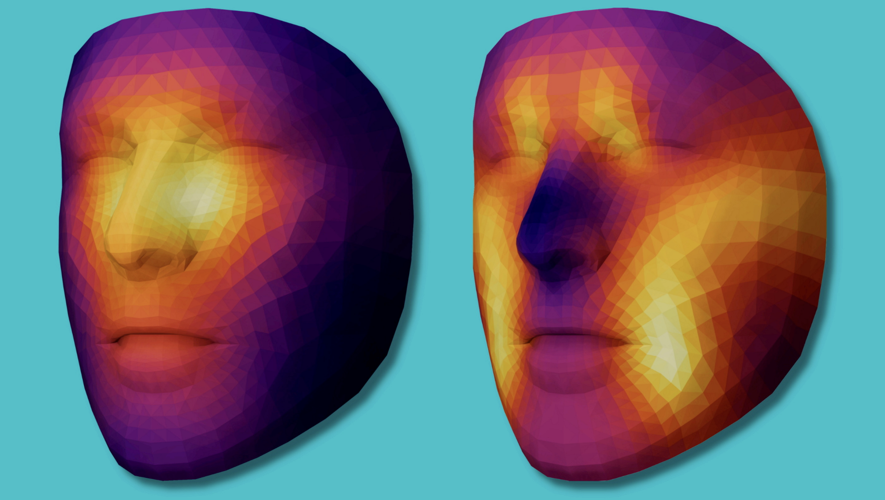
The researchers explained that each algorithm also relied on distinct parts of the face to make the respective predictions of age and mortality risk.

National Cancer Institute
FAHR-FaceAge focuses on the nasolabial folds, the forehead area just above the orbits and the temples, while FAHR-FaceSurvival evaluates the region below the eyes and around the nasal bridge.
Aerts said: "FAHR-FaceSurvival advances the field of facial health recognition AI a step further by learning survival risk directly from facial photographs of patients with cancer.
"To our knowledge, this is the first demonstration that an AI model can directly predict cancer survival from a simple photograph."
The research team also found that lifestyle factors influence facial aging.
For example, heavy drinking, drug use and smoking were associated with looking biologically older.
Smoking showed the strongest pattern, with current smokers looking older than former smokers and former smokers looking older than people who had never smoked.
Dr. Mak said: "Another surprising finding was how consistent FAHR-FaceAge was across common real-world photo variations, including pose, lighting, facial expression and makeup."
He added: "It was also stable across most tested plastic surgery procedures, with only a small shift observed after rhinoplasty."
The team is expanding the research through the FaceAge Research Study, an online, institutional review board-approved study open to the public.
Participants can upload a facial photograph and receive their own FaceAge research readout, while also contributing data that will help the researchers improve and validate AI-based measures of facial aging and health.
(0) comments
Welcome to the discussion.
Log In
Keep it Clean. Please avoid obscene, vulgar, lewd, racist or sexually-oriented language.
PLEASE TURN OFF YOUR CAPS LOCK.
Don't Threaten. Threats of harming another person will not be tolerated.
Be Truthful. Don't knowingly lie about anyone or anything.
Be Nice. No racism, sexism or any sort of -ism that is degrading to another person.
Be Proactive. Use the 'Report' link on each comment to let us know of abusive posts.
Share with Us. We'd love to hear eyewitness accounts, the history behind an article.