





Gustavo Fring
The average American has felt mentally “half present” 67 days over the past year, according to new research.
The survey of 2,000 U.S. adults revealed that people experience this at least once per week, or an average of 5.6 days per month.
Defined as “thinking about tasks other than what’s at hand, feeling too exhausted to be fully invested in what’s happening or not giving full attention to tasks, people, etc.,” Gen Z feels “half present” for nearly twice as many days as baby boomers this year (84 days vs. 46).
But across generations, the same thing was found to be causing this.
Lack of sleep was the No. 1 thing that prevented Americans, of all ages, from being fully present (39%).

(Talker Research)
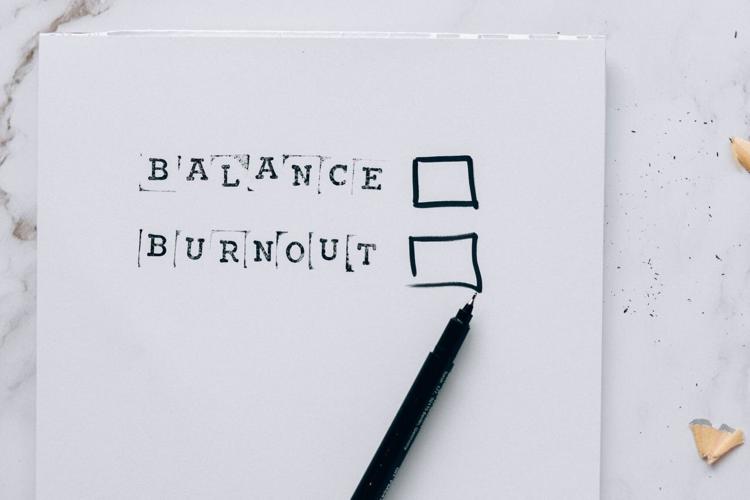
From there, it varied based on generation: Gen Z felt plagued by phone notifications (26%) and even relationship concerns (20%). Millennials battled issues like burnout (28%) and headaches (26%), while the older generations grappled with financial concerns (32% of Gen X and 40% of baby boomers).
While lack of sleep was identified as the most common cause of feeling “half present,” the survey also found that its effects are immediate, often impacting respondents the very next day.
After a poor night’s sleep, those polled are noticeably less focused (33%), less patient (27%) and less present (24%). They’re also not as mentally sharp (28%) and not able to perform at their highest caliber at work (22%).
Respondents shared personal horror stories stemming from simply being too tired: dozing off at work, missing deadlines and appointments, forgetting to pick their child up from school and even getting into the wrong car in a parking lot.
Commissioned by Mucinex Recharge, a nighttime cold and flu medicine, and conducted by Talker Research, the survey explored not only the role sleep plays in Americans’ everyday lives, but also the large impact it has on feeling recharged and ready to take on the next day when they’re battling cold and flu symptoms.

(Photo by Nataliya Vaitkevich via Pexels)





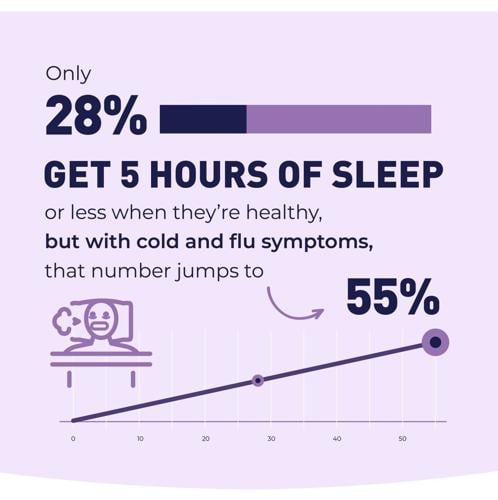
Only 28% of respondents get five hours of sleep or less when they’re feeling healthy, but when cold and flu symptoms strike, that number nearly doubles to 55%.
And it’s not just quantity they’re sacrificing; it’s also quality. When sick, 83% experience poor sleep at least some nights, with 26% admitting it’s every night.
“According to the results, resting (44%) and a good night’s sleep (37%), along with taking over-the-counter medications (38%), are a few of the top ways respondents alleviate cold and flu symptoms at night,” said Henry Turgoose, VP of Upper Respiratory at Reckitt. “Getting plenty of sleep while sick is imperative alongside taking the proper medications that will aid in symptom relief for a restful night’s sleep.”
Though most respondents (61%) agree that it’s no longer taboo to take off work when you don’t feel well, the likelihood of actually doing so decreases with age.
Two in five Gen Z (41%) are “very likely” to take time off from life’s responsibilities when they start to feel cold and flu symptoms, along with 34% of millennials, 25% of Gen X and just 18% of baby boomers.

Kelly Sikkema
And it’s not just life admin tasks that take a hit when sickness strikes. Many respondents have had to cancel plans they’d really been looking forward to (32%).
Gen Z and millennial respondents were the most likely to have had an unnecessary argument with someone (29% and 21% respectively), missed a loved one’s important event (26% and 20%) or even lost a large sum of money (27% and 20%) due to being sick.
This may be why 61% of all respondents feel like they always get sick at the worst possible time.
“Getting sick is rarely convenient and there’s never a ‘right’ time to deal with cold and flu symptoms,” said Turgoose. “That’s why it’s so important to ensure you’re setting yourself up with the right tools to ensure you’re putting your symptoms at bay and getting a quality night’s sleep to recharge at night so that you can conquer tomorrow.”
Research methodology:
Talker Research surveyed 2,000 U.S. adults who have access to the internet; the survey was commissioned by Mucinex and administered and conducted online by Talker Research between Sept. 18 and Sept. 25, 2026. A link to the questionnaire can be found here.
To view the complete methodology as part of AAPOR’s Transparency Initiative, please visit the Talker Research Process and Methodology page.
(0) comments
Welcome to the discussion.
Log In
Keep it Clean. Please avoid obscene, vulgar, lewd, racist or sexually-oriented language.
PLEASE TURN OFF YOUR CAPS LOCK.
Don't Threaten. Threats of harming another person will not be tolerated.
Be Truthful. Don't knowingly lie about anyone or anything.
Be Nice. No racism, sexism or any sort of -ism that is degrading to another person.
Be Proactive. Use the 'Report' link on each comment to let us know of abusive posts.
Share with Us. We'd love to hear eyewitness accounts, the history behind an article.