

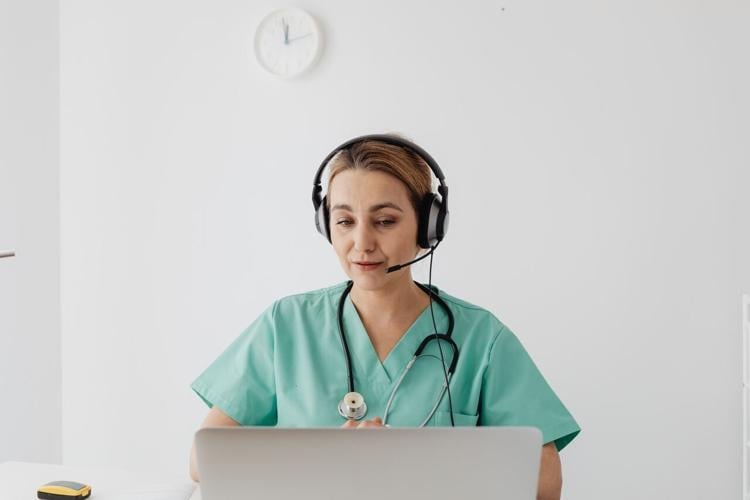








(Photo by Ivan S via Pexels)
By Stephen Beech
Patients' messages to their doctor may determine how quickly they get seen, suggests a new study.
Researchers found that how people write notes to the surgery may affect whether their doctor responds.
Analysis of millions of patient portal messages suggests that patients' writing style may influence how their care teams respond — and may help explain disparities.
Portal messages have become a routine way for patients to communicate with their GP surgery, particularly since the COVID-19 pandemic.
But the new study suggests that how patients write those messages can play a key role in whether — and from whom — they receive a response.

(Photo by kaboompics via Pexels)
Researchers in the United States analyzed more than 3.6 million patient portal message threads.
They found that patients from historically marginalized groups were generally less likely to receive responses from their care teams, and, in particular, were less likely to receive responses from the messages' originally intended recipient — most often their doctor.
While the content of a message was an important predictor of care team response, it explained little of the differences by race, ethnicity, education or insurance.
Writing style — including factors such as length, formality, sentiment and how a message opened — accounted for nearly half of those differences, according to the findings published in the journal JAMA Network Open.
Study co-author Mitchell Tang said: "Patient portal messages are an increasingly central channel for patient-clinician communication, but there are inequities in how responsive care teams are to messages sent by patients from historically marginalized groups.

(Photo by RDNE Stock project via Pexels)
"Our findings suggest that message writing style may be a potential source of bias in message triage and point to possible ways to reduce these disparities."
Portal messaging volumes surged during the COVID-19 pandemic and remain elevated.





Tang said: "Unbeknownst to many patients, these messages do not usually go directly to their doctor's inbox."
He explained that, in many health systems, messages go through a "triage" process in which nurses, medical assistants or other care team members review them first, determine their urgency and complexity, and decide whether to respond themselves or escalate them to the patient's doctor.
Tang, of Columbia Mailman School of Public Health, New York, said: "In many message triage systems, nurses and medical assistants must quickly assess messages and make judgments about their urgency, complexity and need for escalation.
"Given those constraints, writing style may understandably influence how messages are perceived and prioritized."

(Photo by Tima Miroshnichenko via Pexels)
In the study involving 511,020 adult patients, the researchers analyzed 3,619,390 patient medical advice request messages between 2021 and 2023.
Overall, patients from historically marginalized groups — including non-white patients, patients who preferred a language other than English, patients with lower educational attainment, and Medicaid or Medicare-Medicaid dual-eligible patients — were less likely to receive a response from their care team and the message's originally intended clinician.
Compared with white patients, Black patients had a 3.7% lower response rate from the intended clinician.
Using natural language processing, the research team analyzed the content and writing characteristics of the messages and used statistical analysis to determine how much those factors contributed to differences in response among patient groups.
Writing style features accounted for 48% of the difference in intended clinician response for Black patients relative to white patients, 35% for Hispanic patients, 60.5% for patients with only a high school education compared with those with a college degree, and 43% for Medicaid patients compared with commercially insured patients.

(Photo by Tima Miroshnichenko via Pexels)
Tang said: "One of the most important writing-style features was the message's salutation.
"Simply beginning a message with 'Dear Dr. Tang' seemed to make it much more likely that Dr. Tang would end up responding."
The findings build on Tang's previous research in a 2024 study showing racial and ethnic disparities in the triaging of patient portal messages and 2025 research examining differences associated with insurance type and preferred language in addition to race and ethnicity.
He added: "The results could help health systems identify potential sources of bias in portal-message triage and develop more equitable approaches to digital communication.
"But they are also a reminder to think about how communication style can influence the way we perceive and respond to people — not only in health care, but in our everyday lives."

(0) comments
Welcome to the discussion.
Log In
Keep it Clean. Please avoid obscene, vulgar, lewd, racist or sexually-oriented language.
PLEASE TURN OFF YOUR CAPS LOCK.
Don't Threaten. Threats of harming another person will not be tolerated.
Be Truthful. Don't knowingly lie about anyone or anything.
Be Nice. No racism, sexism or any sort of -ism that is degrading to another person.
Be Proactive. Use the 'Report' link on each comment to let us know of abusive posts.
Share with Us. We'd love to hear eyewitness accounts, the history behind an article.