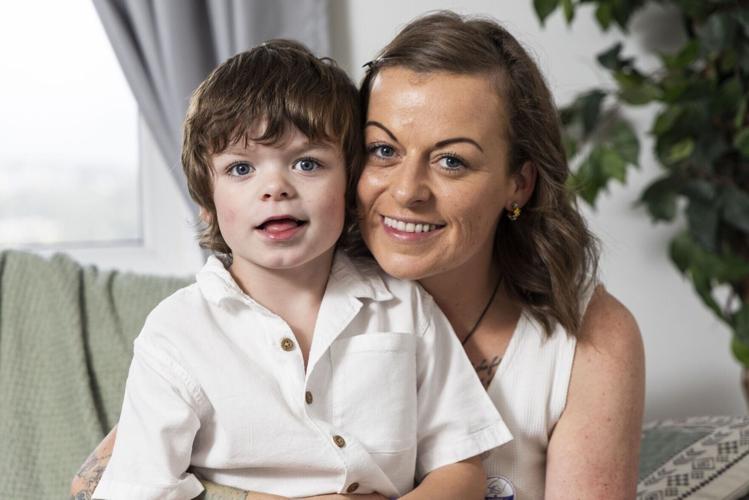
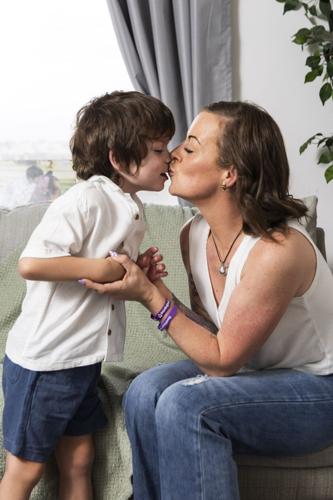
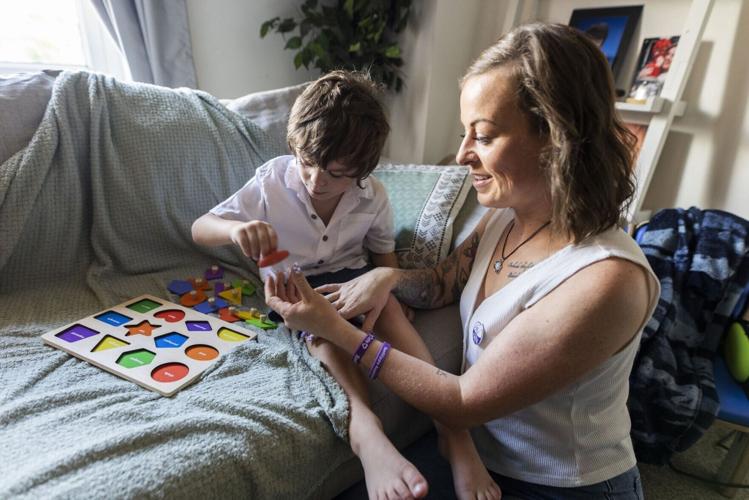

A mom thought her son was "too good to be true" when he rarely cried as a baby - and it turned out to be subtle sign of childhood dementia. (Tom Wren via SWNS)
By Filipa Gaspar
A mom is in a race against time to raise £3 million ($4 million) to save her son from a rare form of childhood dementia.
Tammy McDaid, 34, took little Tate Flaherty to the doctors when he was two years old, thinking he had autism because he rarely cried, but never thought it was anything more sinister.
Doctors noticed a bump on his head, and an MRI flagged the possibility of Sanfilippo syndrome.
The disorder is a rare neurodegenerative metabolic disorder known as childhood Alzheimer’s, as it causes children to lose all the skills they have gained and has no cure.
Just over a year later, doctors told the family that Tate Flaherty, now five, didn’t have the condition, but McDaid had seen other kids who looked like her son on TikTok.
McDaid pushed for further investigations and, after what she describes as a misdiagnosis, Tate was diagnosed in September 2025 with Sanfilippo syndrome Type A, a rare genetic and terminal condition often called childhood dementia.
Tate is currently showing early signs of cognitive decline, he is also autistic and has always been nonverbal.
But a life-changing gene therapy to stop Tate’s terminal condition progression has just been approved in the U.S., but his mom still faces the challenge of raising millions to access the treatment.
The mom initially set a fundraising target of £1.5 million ($2 million) based on estimates provided by Sanfilippo charities.

(Tom Wren via SWNS)
However, the mom recently learned the treatment has been priced at approximately £2.95 million ($3.95 million) per patient in the U.S.
Reacting to the approval of the treatment, McDaid, from Swansea, Wales, said: “I had a happy panic attack, if that makes sense.
“It got denied last August, and Tate officially got diagnosed in September, but dementia had been on our table for a couple of years already.
“I’ve been living on hope all year and fundraising and doing what I can. Last week was anxiety-riddled because we were just waiting for the decision.”
Children with Sanfilippo syndrome typically have full lips, a button nose and coarse heavy eyebrows.






McDaid said the decision had given her hope that her son could finally have a future beyond the devastating prognosis associated with Sanfilippo syndrome.
She said: “For the first time in three years, which is like half Tate’s life, I’ve been able to actually picture him as a happy teenager.
“A lot of the children pass away before their 10th birthday, so I never thought of Tate as being a teenager because it would hurt me too much knowing that the chance of it was never going to happen.
“Whereas once the treatment was approved, the thought that Tate can actually celebrate his 18th birthday is like a dream.”

(Tom Wren via SWNS)
McDaid is urgently trying to raise £1.5 million to get her son to America for breakthrough gene therapy, called UX111, which would stop his condition from progressing.
She explained she received news that a pharmaceutical company is set to charge £2.95 million per child in the U.S. through insurance, but hopes that their case may be different as they are self-funding, and is currently in discussions for further clarity.
They have also found out that they need a blood test done in the U.S. to progress with the treatment.
She said: “I’m really praying for some miracles that they do drop the price for self-funded treatment because we don’t have insurance companies to cover it for us the way that Americans do.”
Supporters have raised nearly £170,000 ($225,000), and fundraisers are coming in the next months.
She believes receiving the treatment as soon as possible will give Tate the best chance of avoiding the cognitive decline associated with the condition.
While the treatment does not reverse the symptoms, it should stop any further brain damage from occurring.
She said: “Right now, Tate is very, very active. If he doesn’t present as a child with dementia at all, he presents as a non-verbal autistic child at the moment.
“A very happy one, because he’s just so blasé with life. He doesn’t get overstimulated, really. He’s just happy in his own little world.
“He’s just a ball of joy, really. So ultimately, that’s what I’m fighting for, because the sooner they get the treatment, the more effective the treatment is.”
The fundraiser can be accessed here, raising funds under the charity Just4Children.
(0) comments
Welcome to the discussion.
Log In
Keep it Clean. Please avoid obscene, vulgar, lewd, racist or sexually-oriented language.
PLEASE TURN OFF YOUR CAPS LOCK.
Don't Threaten. Threats of harming another person will not be tolerated.
Be Truthful. Don't knowingly lie about anyone or anything.
Be Nice. No racism, sexism or any sort of -ism that is degrading to another person.
Be Proactive. Use the 'Report' link on each comment to let us know of abusive posts.
Share with Us. We'd love to hear eyewitness accounts, the history behind an article.