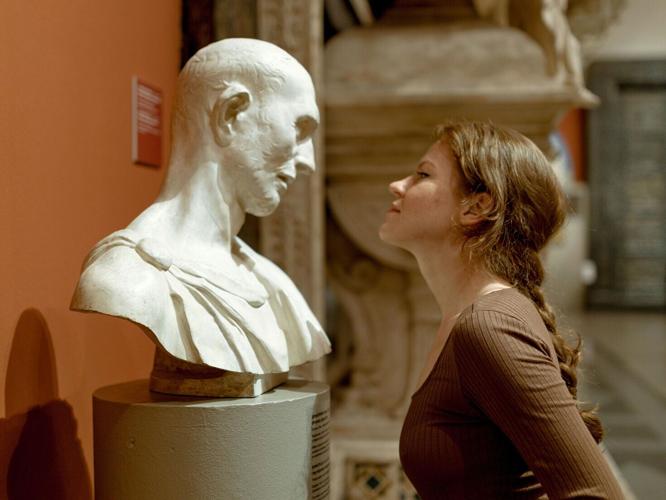













(Photo by Patricia Bozan via Pexels)
By Stephen Beech
Arty types age better, suggests a new study.
Culture vultures who regularly take part in arts and culture activities — such as reading, listening to music or visiting a museum or gallery — may slow the pace of their biological aging, according to the findings.
Researchers from University College London (UCL) looked at survey responses and blood test data from 3,556 adults in the UK.
The team compared participants' arts and cultural engagement with chemical changes to DNA that influence biological aging without altering the genetic code.
The findings, published in the journal Innovation in Aging, showed that those who engaged in arts and cultural activities more frequently, and who engaged in a wider diversity of such events, appeared to have a slower pace of aging and a younger biological age, as suggested by changes to DNA.
The apparent effects were comparable to those seen for exercise, according to the UCL team.

(Photo by Sofya Borboris via Pexels)
For example, people who did an arts activity at least once a week seemed to age 4% more slowly than those who rarely engaged with arts.
That was the same as those who exercised at least once a week compared to those who did no exercise.
The links were stronger for middle-aged and older adults aged 40 or above and remained after accounting for factors that might skew the results such as body mass index (BMI), smoking, education level and income.
Study lead author Daisy Fancourt said: "These results demonstrate the health impact of the arts at a biological level.
"They provide evidence for arts and cultural engagement to be recognized as a health-promoting behavior in a similar way to exercise.

(Photo by Ene Marius via Pexels)
"Our study also suggests that engaging in a variety of arts activities may be helpful.
"This may be because each activity has different 'ingredients' that help health, such as physical, cognitive, emotional or social stimulation."






Senior author Feifei Bu said: "Our study provides the first evidence that arts and cultural engagement is linked to a slower pace of biological aging.
"This builds on a growing body of evidence about the health impact of the arts, with arts activities being shown to reduce stress, lower inflammation and improve cardiovascular disease risk, just as exercise is known to do."
The research team used data from the UK Household Longitudinal Study, a nationally representative sample whose participants' blood samples were analyzed to estimate biological age and pace of aging.
That was done using seven epigenetic clocks — tests that look at age-related DNA changes.

(Photo by Miguel González via Pexels)
Each of the seven clocks measured methylation at different sites on the genome.
The two newest clocks, DunedinPoAm and DunedinPACE, estimate the pace of aging, with a faster aging score associated with a higher risk of age-related diseases.
Both frequency and diversity of arts engagement and physical activity were found to be linked to slower aging.
For the DunedinPACE clock, doing an arts activity at least three times a year was linked to aging 2% more slowly, monthly engagement was linked to 3% slower aging, and weekly activity to a 4% slower aging rate, compared to those who engaged with arts less than three times a year.
Fancourt said: "This difference in pace of aging is comparable to that found in previous studies between current smokers and ex-smokers."

(Photo by Kampus Production via Pexels)
In another test, PhenoAge, which estimates biological age, people who engaged in arts and cultural activities at least weekly were a year younger on average compared to those who rarely engaged.
People who did exercise at least weekly were just over half a year younger on average.
The other, older epigenetic clocks analyzed in the study did not show any benefit for either arts and cultural engagement or physical activity.
The team noted that was in line with previous studies finding no link between epigenetic age, as measured by the clocks, and physical performance such as walking speed.
The researchers said that may be because the clocks were less sensitive to predicting age-related decline.

(0) comments
Welcome to the discussion.
Log In
Keep it Clean. Please avoid obscene, vulgar, lewd, racist or sexually-oriented language.
PLEASE TURN OFF YOUR CAPS LOCK.
Don't Threaten. Threats of harming another person will not be tolerated.
Be Truthful. Don't knowingly lie about anyone or anything.
Be Nice. No racism, sexism or any sort of -ism that is degrading to another person.
Be Proactive. Use the 'Report' link on each comment to let us know of abusive posts.
Share with Us. We'd love to hear eyewitness accounts, the history behind an article.