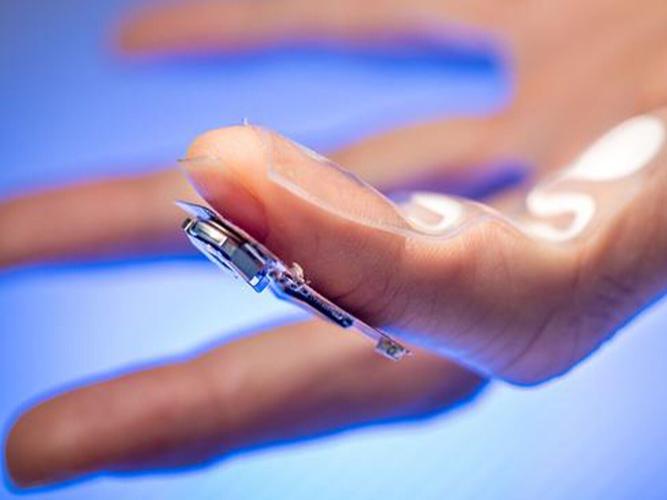




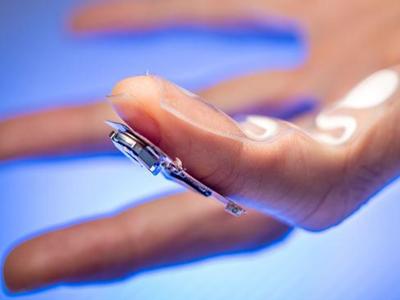
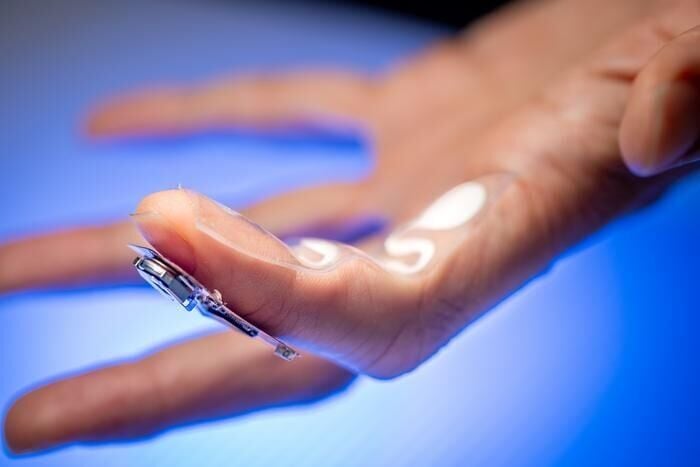
This wearable device monitors levodopa, the gold standard drug for Parkinson's disease, in a patient's fingertip sweat. That same sweat also helps power the device. (David Baillot / UC San Diego Jacobs School of Engineering)
By Stephen Beech
A new sweat-powered fingertip patch accurately monitors medication levels in Parkinson's disease patients as accurately as a blood test, according to new research.
The soft, wearable device continuously tracks drug levels in people with the debilitating condition through their perspiration.
American engineers who devised the patch explained that it operates using chemicals in the patient's sweat — with no batteries required.
Its measurements were comparable to those obtained by standard laboratory blood tests, according to a study published in the journal Proceedings of the National Academy of Sciences (PNAS).
The team behind the device says it could enable doctors to precisely customize daily medication schedules for patients at home.
Study co-first author Tamoghna Saha, of the University of California San Diego, said: "The patch monitors levodopa, the gold-standard drug for managing the loss of motor control caused by Parkinson's disease.

(Photo by Pixabay via Pexels)
"Prescribing the right dose is challenging: reducing levodopa leaves patients unable to move, while too much triggers severe, uncontrollable jerking movements.
"Initially, the drug's effects can last several hours.
"But as the disease progresses, the therapeutic window narrows down to two hours.
"Currently, clinicians must rely on subjective patient diaries to adjust treatment.






"Unfortunately, these methods fail to catch dangerous dosing gaps.
"The new wearable device offers a way to continuously track real-time concentrations of levodopa in the body."
Saha says the patch is worn on the fingertip, which is packed with a high density of sweat glands.
The patch is equipped with a specially engineered absorbent gel that acts like a sweat sponge.
Saha said: "The gel contains a highly concentrated mixture of salts and benign solvents — and that draws sweat out of the pores, since water naturally flows toward areas with higher salt concentrations.

(Photo by Paul Groom Photography Bristol via Pexels)
"When levodopa in the patient's sweat comes into contact with enzymes embedded in the patch, it triggers a chemical reaction, which in turn generates a small, measurable voltage.
"This chemical reaction is what powers the patch.
"The amount of voltage generated also serves as an indicator of the patient's levodopa level: lower voltage signals low levels, while higher voltage signals high levels."
In clinical tests involving both healthy volunteers and Parkinson's patients, the patch tracked levodopa levels as accurately as standard lab blood tests, which take days to return results.
The data revealed that patients with Parkinson's clear levodopa from their systems significantly faster than healthy individuals.
Saha said: "This result explains why a patient's Parkinson's symptoms can deteriorate so suddenly."
He added: "This technology lays the groundwork for a closed-loop system, where a levodopa monitoring patch could communicate with a pump to automatically deliver the precise doses of the drug right when the body needs it."

(0) comments
Welcome to the discussion.
Log In
Keep it Clean. Please avoid obscene, vulgar, lewd, racist or sexually-oriented language.
PLEASE TURN OFF YOUR CAPS LOCK.
Don't Threaten. Threats of harming another person will not be tolerated.
Be Truthful. Don't knowingly lie about anyone or anything.
Be Nice. No racism, sexism or any sort of -ism that is degrading to another person.
Be Proactive. Use the 'Report' link on each comment to let us know of abusive posts.
Share with Us. We'd love to hear eyewitness accounts, the history behind an article.