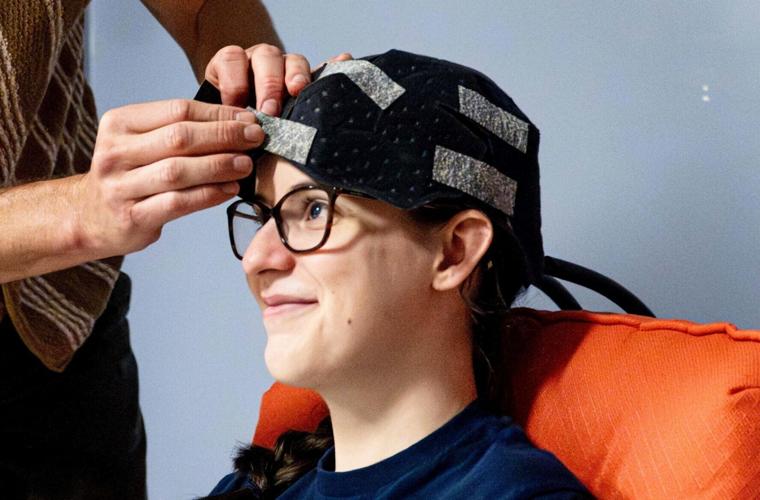


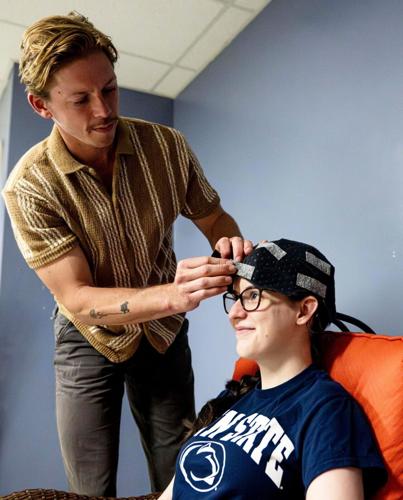

Co-authors Owen Griffith, standing, and Maddie McLaughlin demonstrate the head cooling cap used in the study. (Jaydyn Isiminger / Penn State via SWNS)
By Stephen Beech
Wearing a special "cooling cap" for half an hour can reduce symptoms of depression, according to new research.
The "relaxing and enjoyable" treatment is low risk and may improve mental well-being by changing brain activity, say American scientists.
A pilot study found that young adults who wore the cooling cap for 30 minutes experienced "multiple changes" that could improve their mental health.
The research team say their findings, published in the journal Acta Psychologica, suggest that cooling the brain by donning the cap may improve a person's sense of well-being.
The study showed that it may reduce depressive symptoms and alter the types of brain waves people produce.
While no medical recommendations can be derived from the small-scale exploratory study, the team say the results indicate head cooling may provide mental health benefits for the general population.
The work was inspired by senior author Pennsylvania State University Semyon Slobounov's previous research, which found that athletes with concussions heal faster and experience fewer symptoms when their head is regularly cooled.
Study co-author Owen Griffith, assistant teaching professor of kinesiology at Penn State, said: "A person's mood is tied to their cognition and general brain function.
"In this study, results suggested that people enjoy the sensation of head cooling.

(Photo by Andrew Patrick Photo via Pexels)
"This, in turn, improved their mood, which altered their brain activity."
The research team recruited 24 college students between the ages of 18 and 26.
At the beginning of the study, all the participants completed questionnaires that measured their mental health and cognitive abilities and underwent an electroencephalogram (EEG) to measure brain activity.
Following the EEG, participants spent 30 minutes sitting in a dimly lit room listening to ocean sounds.
Half of them wore a fitted cooling cap, which uses liquid circulating close to the head to maintain a temperature of 33 degrees Fahrenheit (0.55 Celsius).
The other participants wore nothing on their heads.
Immediately after the cooling or sitting session, participants repeated the questionnaires and EEG.
Participants repeated the same sitting or cooling session without testing every day for a week.
The day after the last session, participants repeated the questionnaires and EEG again.






The study design allowed the researchers to observe both the short- and longer-term effects of head cooling.
Co-author Laura Cooney said: "The brain produces different types of waves that are associated with different levels of excitement or brain activation.
"Alpha waves are associated with calmness.
"More specifically, they are indicative of less brain activity overall, so this finding suggests that there was an immediate calming effect of head cooling."
People in the head cooling group displayed an increase in alpha brain waves during the EEG immediately following the first cooling session.
They experienced a 4% increase in alpha waves while participants whose heads were not cooled displayed a 0.5% decrease in alpha waves.
But the research team found there was no significant difference in the alpha wave levels of the sitting and cooling groups when measured on the day after the final cooling session, suggesting cooling does not have a longer-term impact on brain wave activity.

Co-authors Owen Griffith, standing, and Maddie McLaughlin demonstrate the head cooling cap used in the study. (Jaydyn Isiminger / Penn State via SWNS)
Over the course of the week, both groups of participants reported a decrease in depression symptoms, but those in the head cooling group reported a larger decrease than those in the sitting group.
Griffith said: "The reduction of depression symptoms among healthy people suggests that this might be a promising treatment."
The researchers had hypothesized head cooling affected people through changes in neural electrical activity, but the EEGs did not show evidence of that.
Now, the team suspect the effects are psychosomatic, meaning that mental and emotional factors — rather than physiological changes — are causing people's reduced depression symptoms and increased alpha brain wave activity.
Griffith said: "Anecdotally, most people who come into the lab agree that head cooling is relaxing and enjoyable.
"This may not be surprising.
"A cold compress or a bag of ice have been home treatments for migraines for many years."
The study suggests overall that widespread head cooling could be useful, according to the researchers.
Cooney, who graduated from Penn State in 2025 and based her undergraduate thesis on the research, said: "Head cooling shows some potential as an acute calming therapy.
"Not as a replacement for any current therapy, but as another tool in the toolbox."
Slobounov added: "Our previous research demonstrated that head cooling is useful for athletes recovering from concussions.
"This research suggests it may be more useful to a wide group of people.
"It is low risk, does not involve any drugs or chemicals, and people enjoy it."

(0) comments
Welcome to the discussion.
Log In
Keep it Clean. Please avoid obscene, vulgar, lewd, racist or sexually-oriented language.
PLEASE TURN OFF YOUR CAPS LOCK.
Don't Threaten. Threats of harming another person will not be tolerated.
Be Truthful. Don't knowingly lie about anyone or anything.
Be Nice. No racism, sexism or any sort of -ism that is degrading to another person.
Be Proactive. Use the 'Report' link on each comment to let us know of abusive posts.
Share with Us. We'd love to hear eyewitness accounts, the history behind an article.