


What every man needs to know about testosterone and heart health
Most doctors regularly see a version of the same patient — a man in his early 50s who had the kind of cardiac workup his primary care doctor called reassuring: cholesterol and blood pressure within the traditionally acceptable ranges, no family history of heart disease. What isn’t done as often is a more comprehensive panel, including a marker most physicians don’t associate with heart health: testosterone.
Low testosterone is both a warning sign of poor heart health and a potential contributor to it. Men with the lowest testosterone levels have a roughly 40% to 50% higher risk of heart failure than those with healthier levels. But even milder, age-related declines in testosterone levels can increase heart disease risk.
Below, Hone Health outlines how low testosterone is linked to heart disease and what it can mean for men who want to better understand their cardiovascular risk.
Why Testosterone Matters for Heart Health
Testosterone helps regulate the systems that keep your heart healthy:
- How your body handles blood sugar
- How your arteries function
- How much fat accumulates around your organs
When testosterone levels drop, those systems drift in the wrong direction at the same time, compounding risk. The damage can begin long before symptoms show up or standard cholesterol tests indicate a problem.
Major organizations define a normal testosterone range, which represents the middle 95% of healthy individuals, to be 450–600 ng/dL (nanograms per deciliter). Optimal testosterone ranges, which emphasize levels associated with peak functioning and reduced disease risk, may be 700–1200 ng/dL. At healthy levels, testosterone may be protective:
- Keeps blood vessels flexible and open for blood flow
- Maintains muscle mass and regulates blood sugar
- Keeps cholesterol in a healthy range
- Tamps down inflammation
But 1 in 3 men between the ages of 40 and 80 have low testosterone. At levels below 300 ng/dL, those protections erode and are linked to a range of heart problems that can cascade into general health dysfunction. Men with chronic heart failure and low testosterone have measurably higher rates of death from any cause in observational studies.
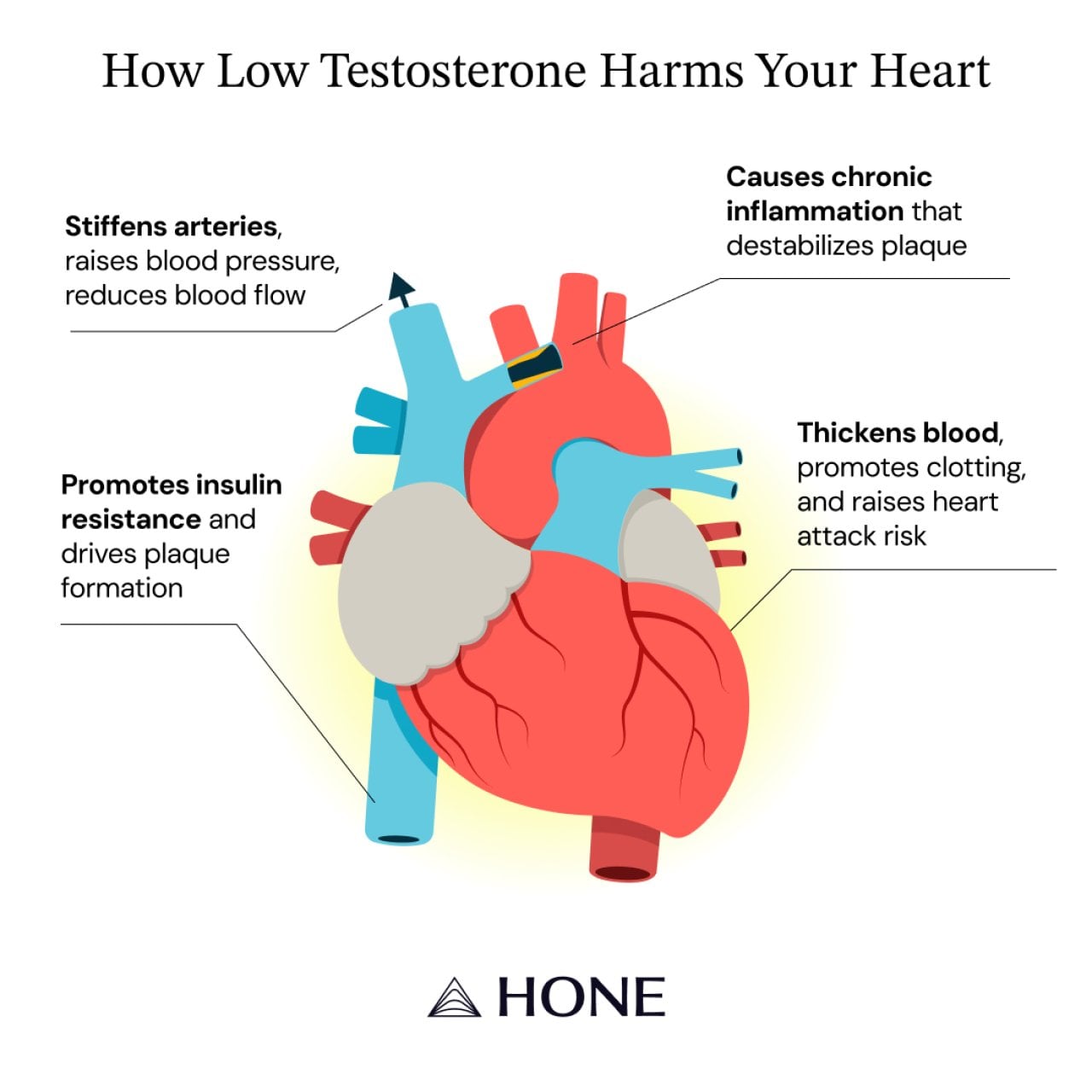





Testosterone helps protect blood vessel function. Testosterone plays a role in producing nitric oxide, a compound that keeps blood vessels flexible and able to expand when the heart needs more blood — during exercise, for example, or under stress. When nitric oxide production declines, arteries stiffen, blood pressure rises, and the heart has to work harder. Over time, reduced blood flow can starve the heart of oxygen and raise the risk of clot formation in narrowed arteries.
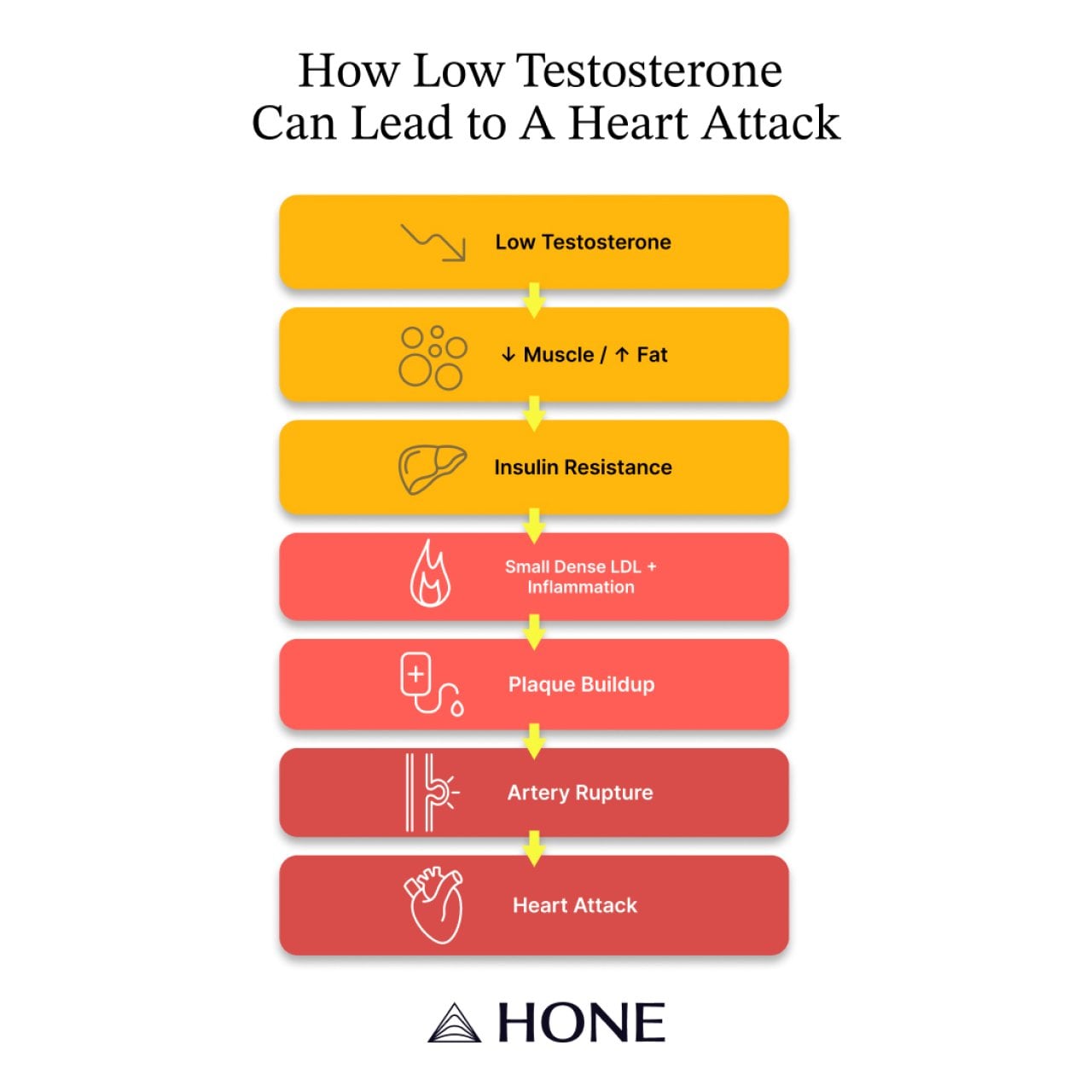
Low testosterone fuels chronic inflammation. Low testosterone promotes visceral fat — the deep abdominal fat that drives chronic inflammation, and inflammation is what turns cholesterol from a bystander into a threat. It activates cholesterol particles, drives them into artery walls, and triggers the plaque buildup that can eventually rupture and cut off blood flow to the heart. Men with low testosterone show measurably higher levels of C-reactive protein (CRP), a key inflammation marker and strong predictor of heart attack and stroke. Another way we know low testosterone can drive inflammation is by the fact that adding it back in — through testosterone replacement therapy (TRT) — has been shown to reduce inflammation measurably.
Testosterone improves insulin sensitivity. Testosterone helps regulate blood sugar by maintaining lean muscle, the body's primary system for absorbing excess glucose from the bloodstream. When testosterone drops, muscles become less effective at that job — blood sugar runs higher, insulin output increases, and the cycle can progress to insulin resistance. Insulin resistance, in turn, promotes the production of small, dense LDL particles that are far more likely to penetrate artery walls and drive plaque buildup than standard LDL particles, which are larger and fluffier and bounce through arteries without causing damage.
Testosterone affects blood flow and clotting. Beyond stiffening arteries and accelerating plaque buildup, low testosterone raises hematocrit and fibrinogen, both of which promote clot formation — while reducing the body's ability to dissolve clots that do form. And because testosterone signals bone marrow to produce red blood cells, low testosterone levels lead to fewer oxygen-carrying red blood cells reaching the heart. Together, these effects create conditions where a clot in a narrowed artery is both more likely to form and harder to clear.
Heart-Safe Testosterone
The myth that TRT is bad for your heart traces back to bodybuilders and athletes taking five to 10 times a normal dose, unsupervised.
Restoring low testosterone to a healthy range under medical supervision is safe and effective. The TRAVERSE study—a large randomized trial of more than 5,000 men—found that testosterone therapy did not increase rates of major cardiovascular events such as heart attack or stroke compared to placebo, even in men with existing heart risk.
Optimizing testosterone for heart health
Staying in the optimal testosterone range with TRT requires regular tracking of both total testosterone and free testosterone, the portion that's available for your body to use.
It also requires monitoring levels of hematocrit, cholesterol and lipid ratios, blood sugar and insulin markers, as well as inflammatory markers, to make sure all stay in a healthy range.
Healthy lifestyle habits, including diet, exercise, and stress management, support healthy testosterone production and influence how well the body responds to treatment.
This story was produced by Hone Health and reviewed and distributed by Stacker.

(0) comments
Welcome to the discussion.
Log In
Keep it Clean. Please avoid obscene, vulgar, lewd, racist or sexually-oriented language.
PLEASE TURN OFF YOUR CAPS LOCK.
Don't Threaten. Threats of harming another person will not be tolerated.
Be Truthful. Don't knowingly lie about anyone or anything.
Be Nice. No racism, sexism or any sort of -ism that is degrading to another person.
Be Proactive. Use the 'Report' link on each comment to let us know of abusive posts.
Share with Us. We'd love to hear eyewitness accounts, the history behind an article.